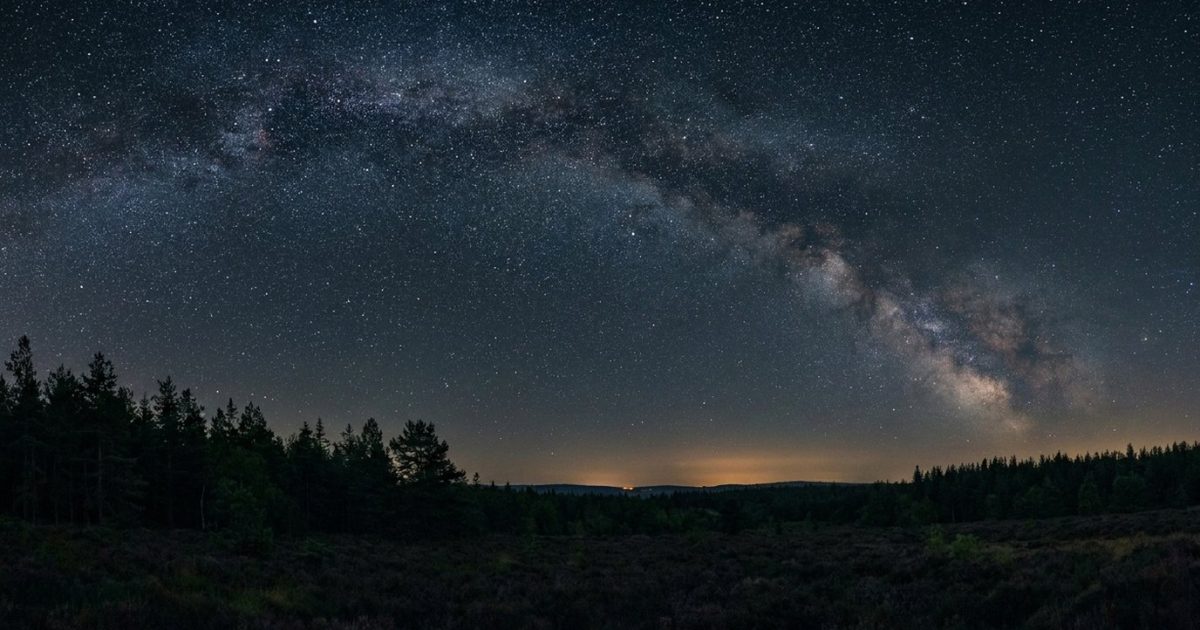
Europe has more than 30 IDA-certified Dark Sky Parks and 15 Reserves — the densest network of protected night skies on Earth. Yet 60% of Europeans can no longer see the Milky Way from where they live, a loss that researchers Venkatesan and Barentine described in a 2023 Science e-Letter as noctalgia: grief for a sky that was once shared and is no longer. This guide covers the science behind dark sky designation, a complete EU site map with verified SQM values, and the research — from LoNNe refugia to Sami astronomical heritage — that explains why these places matter beyond tourism. For the foundational context on light pollution measurement, see our overview at light pollution: science, ecology, and solutions.
What Are Dark Sky Places?
Dark Sky Places are formally designated areas where artificial light is controlled to protect night-sky visibility and nocturnal ecosystems — they are not scenic amenities but functioning scientific infrastructure.
The label sounds like marketing. It is not. The International Dark-Sky Association (IDA), founded in Tucson, Arizona in 1988, developed the designation system to create enforceable standards for outdoor lighting management in specific geographies. A Dark Sky Place is not merely a rural area with low population density. It is a site that has undergone SQM measurement, produced a lighting management plan, committed to ongoing monitoring, and passed IDA review — a process that takes three to six months and requires documented evidence rather than asserted darkness.
The global network now encompasses more than 250 certified places protecting over 196,000 km² of land across more than 20 countries. Europe contains the densest regional concentration — a fact that reflects both the continent’s scientific investment in ALAN research and the political will of national park authorities in the UK, Ireland, Germany, and Hungary to make formal commitments on lighting management.
Why does the label matter? Because it generates accountability. Once a site is designated, sky quality measurements at standard reference points become part of the public record. Recertification every five years means lighting management plans cannot be quietly abandoned. The IDA designation is not a tourism trophy — it is the mechanism by which a place enters the long-term monitoring record for sky brightness change. The 23.6 mag/arcsec² peak reading at Galloway Forest Park, the 21.6–22.0 range at Westhavelland — these are not anecdotes. They are data points in a scientific baseline.
Into this picture, Venkatesan and Barentine introduced the word noctalgia in their 2023 correspondence to Science — submitted fifty years after light pollution first appeared in that journal’s pages. The term names what happens when 60% of Europeans lack access to the Milky Way and 83% of the global population lives under measurably polluted skies (Falchi et al. 2016, Science Advances). Dark Sky Places are one response. They are the last places where the atmosphere is still calibrated to serve biology rather than infrastructure. That is not progress, elsewhere, being reversed. That is a subtraction.
For a deeper examination of the noctalgia concept and its cultural dimensions, see our article on noctalgia: the language of losing the night sky. For the Bortle scale and SQM measurement methods that underpin dark sky certification, see measuring light pollution: methods, data, and research tools.
The Five Types of IDA Certification
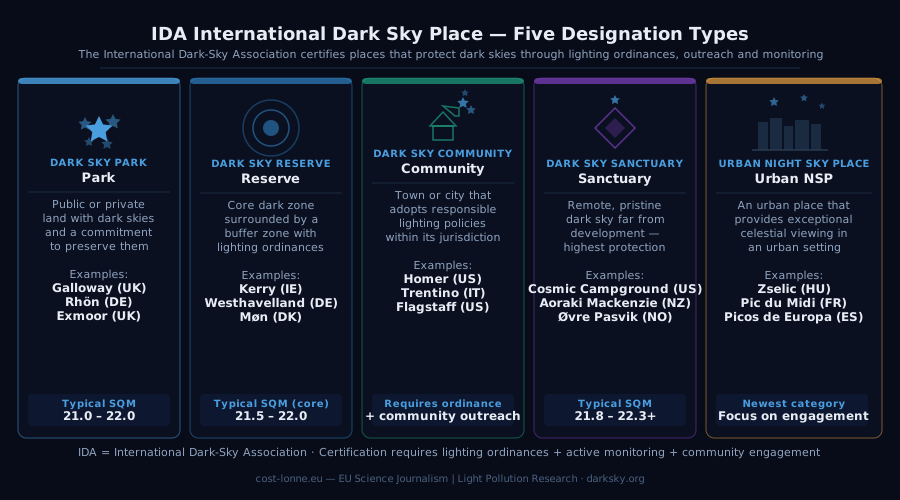
IDA certifies five distinct place types — each with different protection levels, land ownership models, and community obligations.
The taxonomy is precise. Misapplying the categories produces bad policy comparisons. A Dark Sky Park and a Dark Sky Reserve operate under different frameworks. The distinction matters when assessing what a designation commits a place to.
Dark Sky Park. A publicly or privately owned area where land management authority and IDA lighting management obligations overlap. The park authority controls both habitat and outdoor lighting within the designated boundary. Galloway Forest Park — Europe’s first, designated November 2009 and the fourth Dark Sky Park in the world — is the exemplar. Lighting within the park’s managed estate is governed by the management plan. The core zone achieves SQM readings above 21.7 mag/arcsec², the threshold for Bortle Class 1 conditions.
Dark Sky Reserve. A two-zone system: a dark core where lighting management is strict, and a surrounding buffer zone where community and municipal commitment is required. Reserves are more complex than parks because they require multi-stakeholder governance — the buffer zone typically includes towns, roads, and private landowners who must each commit to lighting changes. Kerry International Dark Sky Reserve in Ireland holds the highest tier within this category (see H2 4 below). Reserve designation is demanding and produces more durable protection than park designation because it involves the surrounding community, not just a park authority.
Dark Sky Sanctuary. Reserved for exceptionally remote and undisturbed sites where permanent human presence is minimal. Sanctuaries are the rarest designation — approximately 20 worldwide. None of them are in Europe. By definition they are places where the threat from urbanisation is manageable primarily because access is restricted.
Dark Sky Community. A municipality or small settlement that adopts lighting ordinances and demonstrates commitment across a whole civic area. Sark, in the Channel Islands, was the first Dark Sky Island in the world and the first Dark Sky Community in Europe, designated 31 January 2011. Its advantage is structural: a historic ban on private cars, no public street lighting infrastructure, and a community of roughly 500 residents who collectively agreed to re-site lights that caused light trespass toward the sky. Moffat in Scotland and Jelsa on the Croatian island of Hvar are subsequent European examples. For the SQM and Bortle context underlying these designations, see SQM buyer’s guide: L vs. LU vs. LU-DL.
Urban Night Sky Place. The newest category, introduced in 2016, for urban parks, natural areas, or heritage sites within or adjacent to cities that achieve locally meaningful sky quality despite surrounding urban light pollution. No minimum SQM is required — the standard is relative improvement within an urban context. This category is underused in Europe, which has significant potential in urban green infrastructure near major capitals.
Gold, Silver, and Bronze tiers operate within the Reserve category and are addressed in H2 8. The shorthand: Gold requires a core SQM ≥21.8 mag/arcsec² with active buffer zone management. As of 2024, there is one Gold Reserve in the northern hemisphere.
Dark Sky Places in Europe — The Complete Map
No single source combines IDA type, Bortle class, SQM value, and area for all European sites — this table does.
The table below draws on IDA designation records, park authority submissions, and published SQM measurement data. Where a site’s SQM value has not been independently verified in a published document or IDA submission, the field is marked “—” rather than extrapolated. SQM readings vary with season, atmospheric transparency, and moon phase — peak values indicate best-case conditions, not guaranteed readings on any given night. The Milky Way becomes visible to dark-adapted eyes above approximately 21.5 mag/arcsec²; Bortle Class 1 begins at approximately 21.7 mag/arcsec².
| Name | Country | Type | Area (ha) | Bortle | SQM (mag/arcsec²) | Year |
|---|---|---|---|---|---|---|
| Galloway Forest Park | UK (Scotland) | Park | 78,000 | 1–2 | 21.0–23.6 | 2009 |
| Zselic Starry Sky Park | Hungary | Park | 9,300 | 2 | ~21.4 | 2009 |
| Hortobágy National Park | Hungary | Park | 82,000 | 2 | ~21.5 | 2011 |
| Exmoor National Park | UK (England) | Reserve | 69,300 | 2–3 | ~21.5 | 2011 |
| Sark | Channel Islands | Community | 540 | 2 | ~21.9 | 2011 |
| Brecon Beacons (Bannau Brycheiniog) | UK (Wales) | Reserve | 133,000 | 2–3 | ~21.4 | 2012 |
| East Carpathian Dark-Sky Tripark | PL / SK / UA | Reserve (tri-state) | ~213,000 | 2 | ~21.6 | 2013 |
| Kerry International Dark Sky Reserve | Ireland | Reserve (Gold) | 70,000 | 2 | ~21.8 | 2014 |
| Westhavelland | Germany | Reserve | 75,000 | 2–3 | 21.6–22.0 | 2014 |
| Rhön Biosphere Reserve | Germany | Reserve | 243,000 | 2–3 | ~21.3 | 2014 |
| Bükk National Park | Hungary | Park | 43,000 | 2–3 | — | 2014 |
| Snowdonia (Eryri) | UK (Wales) | Reserve | 213,000 | 2–3 | ~21.5 | 2015 |
| Northumberland | UK (England) | Park | 405,000 | 2 | ~21.8 | 2013 |
| Jelsa (Hvar) | Croatia | Community | — | 3 | ~21.0 | 2011 |
| Øvre Pasvik National Park | Norway | Park | 11,900 | 1–2 | — | 2024 |
Reading the table: The Bortle scale runs from 1 (perfection — zodiacal band and gegenschein visible) to 9 (inner city). A Class 1 site reads approximately 21.7 mag/arcsec² or above on an SQM. A Class 9 city measures around 17–18 mag/arcsec². Most European cities are Class 7–8. The sites in this table cluster in Class 2 — exceptional conditions achieved through active lighting management, not merely geography. Galloway’s SQM span of 21.0 to 23.6 reflects the difference between its park boundary near roads and its managed dark-core interior at Galloway hill stations. The 23.6 reading is extraordinary — approaching photographic darkroom conditions and matched by very few other European locations. Europe accounts for the largest regional cluster of IDA designations in the world. That density is not accidental; it reflects a decade of co-ordinated effort by national park authorities, dark-sky advocacy communities, and the scientific legacy of COST Action ES1204.
Europe’s Flagship Dark Sky Places
Five sites illustrate what IDA certification achieves in practice — ecologically, economically, and culturally.
Exmoor — Europe’s First Dark Sky Reserve
Exmoor National Park in Somerset and Devon received IDA Dark Sky Reserve status in October 2011. It was the first Dark Sky Reserve anywhere outside North America — a designation achieved before any German, Scandinavian, or Mediterranean site. The core dark zone covers approximately 69,300 ha of moorland and combes in southwest England, with an SQM reading of approximately 21.5 mag/arcsec² on clear moonless nights. The Exmoor designation proved that reserve status was achievable in landscapes with significant human populations in the buffer zone — a demonstration that directly influenced the subsequent Irish and German applications.
Kerry — The Only Inhabited Gold Reserve in the Northern Hemisphere
Kerry International Dark Sky Reserve was designated in January 2014, covering approximately 70,000 ha across nine landscape regions on the Iveragh and Beara Peninsulas. Its Gold Tier status — the highest level in the IDA Reserve category — requires a core zone SQM of at least 21.8 mag/arcsec², active lighting management in the surrounding buffer zone, and demonstrated long-term governance commitment. Kerry was the first permanently inhabited area in the northern hemisphere to hold Gold status (joined by Central Idaho Dark Sky Reserve in 2017).
The archaeology adds a dimension that IDA certification does not formally recognise but cannot be separated from. Bronze Age petroglyphs in the Kenmare River region bear astronomical alignments documented by archaeologist Aoibheann Lambe at University College Cork. Beaghmore in County Tyrone — seven stone circles, approximately 2000 BCE, with solstice and equinox alignments — is within range of Kerry’s dark zone. These are not picturesque coincidences. They are evidence that the landscape was used for systematic celestial observation long before industrialisation introduced the interference that now requires formal legal protection to suppress. A stone circle aligned to the midsummer sunrise makes no sense under sodium streetlights.
Galloway Forest Park — Britain’s First, Europe’s Darkest
Galloway Forest Park in southwest Scotland received IDA designation in November 2009, the first Dark Sky Park in Europe and the fourth in the world. The park covers 78,000 ha of managed forest and moorland. What makes Galloway unusual — beyond its historic precedence — is the documented SQM range. The 23.6 mag/arcsec² peak reading from the park’s dark-core stations has been verified in IDA submission documents. That value is consistent with observing sites in the Atacama or Namib; it is genuinely extraordinary for a location 120 km from Glasgow and 300 km from Edinburgh. The reason: Galloway is shielded on three sides by the Galloway Hills and the Irish Sea, reducing the intrusion of Scottish urban skyglow to levels achievable in few other places within 500 km of a major metropolitan area.
Westhavelland — Germany’s Reserve 70 km from Berlin
Westhavelland Nature Park became Germany’s first International Dark Sky Reserve in February 2014. The designated dark sky area covers approximately 75,000 ha of wetland, fen, and agricultural land in Brandenburg — roughly 70 km west of central Berlin, the most populous city in Germany. A metropolitan fringe reserve at this distance from a capital of 3.7 million people is rare globally. Westhavelland’s SQM range of 21.6 to 22.0 mag/arcsec² confirms that the landscape genuinely achieves Bortle Class 2 conditions despite proximity to Berlin’s light dome, a consequence of the park’s flat wetland topography and the orientation of the capital’s light emission pattern. The reserve also sits within a Natura 2000 area, making it one of the clearest examples of overlapping EU legal protection frameworks. See the cross-silo treatment in H2 5 below, and the dedicated article on Westhavelland — Germany’s dark sky 60 km from Berlin.
Northumberland — £25 Million and 450 Jobs
Northumberland National Park received IDA Dark Sky Park (Gold Tier) status in 2013 and is the largest in the UK at 405,000 ha. It is also the most economically documented dark sky designation in Europe. A 2018 Economic Impact Assessment commissioned by the park’s Dark Sky Steering Group found that astrotourism contributed £25 million per year to the local visitor economy and supported approximately 450 jobs — in hotels, observatories, guided stargazing events, and outdoor equipment suppliers. Kielder Observatory, Battlesteads Observatory, and Stonehaugh Observatory all developed or expanded in direct response to the designation. The £25 million figure is not a marketing projection. It is a conservative estimate from a controlled economic methodology conducted five years after designation, when the tourism infrastructure had had time to develop in response to the park’s changed identity.
For Galloway and Kerry site details, see our dedicated sub-articles: Galloway Forest Park — Europe’s first dark sky park and Kerry dark sky reserve — the northern hemisphere’s first inhabited Gold Tier.
Why Dark Sky Places Matter
Dark Sky Places are not scenic amenities — they are functional refugia for nocturnal biodiversity, measurable economic assets, and the only remaining laboratories where baseline sky darkness can be tracked over decades.
Dark Sky Refugia — What LoNNe Found
COST Action ES1204 — the Loss of the Night Network (LoNNe), active 2013–2017 across more than 27 partner countries and coordinated by the Leibniz Institute of Freshwater Ecology and Inland Fisheries (IGB) in Berlin — was the first structured European research network focused on ALAN’s ecological and human impacts. Its outputs changed how European ecologists think about dark sky protected areas.
The key conceptual shift: LoNNe framed IDA-certified sites not as tourist destinations with low light pollution but as refugia — in the strict ecological sense of the word — for species and communities that can no longer survive in surrounding illuminated landscapes. Bats in the Myotis and Rhinolophus genera, moths, fireflies, migrating birds, and nocturnal pollinators require continuous dark corridors to feed, breed, and move. In a landscape where every road margin, field edge, and water body is illuminated, the certified dark sky reserve becomes the only contiguous dark habitat large enough to sustain viable populations. LoNNe did not just describe the problem — it located the last places where the problem hasn’t won yet.
For the full ecological treatment of refugia dynamics and how ALAN fragments habitat, see our companion article on light pollution and wildlife: how ALAN destroys ecosystems.
Natura 2000 and Dark Sky Overlap
Natura 2000 covers approximately 18.6% of EU land area — nearly 27,000 designated sites protected under the Habitats Directive (92/43/EEC) and the Birds Directive. The network is legally the most powerful biodiversity protection instrument in the EU. What it does not protect is darkness.
Multiple IDA-designated sites sit within or adjacent to Natura 2000 areas. Westhavelland is the most direct example: the reserve and its surrounding nature park overlap with Natura 2000 habitat designations for the same landscape. Hortobágy National Park in Hungary combines IDA dark sky designation with UNESCO World Heritage status, Biosphere Reserve recognition, and Natura 2000 protection — four parallel legal frameworks operating over the same 82,000 ha of puszta grassland, none of which explicitly requires darkness management. EU Habitats Directive Annex IV lists bat species whose roost connectivity and foraging behaviour are demonstrably disrupted by ALAN, yet no Natura 2000 management plan currently in force in any EU member state includes a lighting ordinance. The protection protects the species. It does not protect the darkness the species requires.
Dark Infrastructure — Connecting the Islands
Sordello, Busson, Longcore and colleagues formalised the concept of dark infrastructure in Landscape and Urban Planning (219: 104322, 2022) — a plea for the intentional preservation of dark corridors between protected areas. The argument: a Dark Sky Park that is surrounded by uniformly illuminated agricultural land is an island. Species that require contiguous dark habitat for movement — light-averse bat species, large moths, migrating birds below 200 m altitude — cannot colonise the park from adjacent populations if every route between parks crosses lit territory.
The IGB Berlin team, including Franz Hölker and Sibylle Schroer, was among the contributors to this framing in 2022. The practical implication for Europe’s IDA network: designating individual parks and reserves is necessary but insufficient. The dark corridors between Galloway and Northumberland, between Westhavelland and Rhön, between Kerry and the Irish midlands — these are as ecologically important as the parks themselves. For the full engineering and policy case for dark infrastructure, see dark infrastructure: the Dutch Donkerte-Netwerk and Natura 2000 corridors and the solutions overview at how to reduce light pollution: engineering, policy, and ecological design.
Astrotourism — The Economic Case
The global astrotourism market was estimated at approximately USD 1.45 billion in 2024 and is projected to exceed USD 4 billion by the early 2030s across multiple market analyses. The UK dark sky network — Northumberland, Galloway, Exmoor, Brecon Beacons, Snowdonia — is the largest clustered astrotourism market in Europe, with Northumberland’s £25 million figure as the best-documented single-site economic study. The economic model is structurally different from conventional tourism: low capital cost (dark skies are a public good requiring no construction), high local multiplier (overnight stays, guided events, equipment rental concentrated in local SMEs), and countercyclical to light pollution’s growth trend. Darker parks are more valuable destinations. This creates a genuine financial incentive for local authorities to maintain and extend lighting management — one of the few policy areas where the conservation-economy tension runs in the right direction.
Eastern Europe’s Rising Dark Sky Scene
Eastern Europe has the lowest light pollution density in the EU — and the most underdeveloped dark sky protection infrastructure.
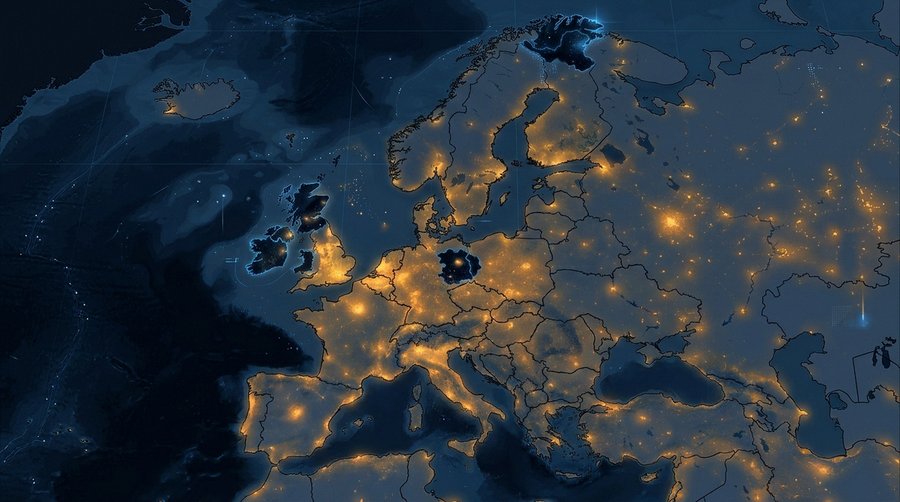
The paradox is visible in any light pollution map. The eastern half of the continent — Poland, Slovakia, the Balkans, the Hungarian plains — is measurably darker than western Europe at equivalent latitudes. Less dense road networks, more extensive forest cover, lower urban concentration. Yet the IDA designation map is heavily weighted toward the UK, Germany, and Ireland. Eastern Europe has fewer designations not because it lacks eligible sites, but because the local SQM monitoring expertise and the organisational infrastructure to complete an IDA application have been slower to develop.
Hungary’s Three IDA Parks
Hungary is the only EU country with three IDA-certified Dark Sky Parks. Zselic Starry Sky Park (9,300 ha, designated 2009) was among the earliest IDA designations outside the UK. Hortobágy National Park (82,000 ha, designated 2011) is simultaneously a UNESCO World Heritage Site, a Biosphere Reserve, and a Ramsar Convention wetland — the most multiply-protected dark sky site in Europe. Bükk National Park (43,000 ha, designated 2014) extends Hungary’s certified zone into forested upland terrain. Hungary’s concentration of designations reflects active engagement by park authorities with IDA, not superior sky quality relative to neighbouring Slovakia or Romania, which have comparable or darker skies but no IDA designations as of 2024.
Croatia’s National Lighting Law
Croatia enacted national legislation on light pollution protection in 2019 — one of the earliest such national laws in Europe. The law restricts outdoor lighting across all of Croatia’s protected areas, which comprise approximately 12% of the country’s total land area. Unlike France’s 2018 Arrêté, which imposes specific CCT ceilings and ULR caps, Croatia’s law operates primarily through protected area designations and a general prohibition on high-intensity skyward lighting in those zones. Jelsa on the island of Hvar was the first IDA Dark Sky Community in Croatia, predating the national law by eight years — a demonstration that community-level designation can precede and arguably catalyse national policy. Croatia’s most recent IDA designation — Petrova Gora-Biljeg Dark Sky Park — has added to the country’s certified network since the national law came into force.
The East Carpathian Dark-Sky Tripark
The East Carpathian Dark-Sky Tripark is the world’s only tri-state dark sky designation. It encompasses three contiguous national parks — Bieszczady (Poland), Poloniny (Slovakia), and Uzhansky/Transcarpathian (Ukraine) — formalised through a joint memorandum in 2017 and aligned with IDA certification principles. Combined area exceeds 200,000 ha. The Tripark demonstrates something specific: dark sky protection does not require a single national authority. Where three states share a continuous dark landscape, a shared commitment document can create de facto designation conditions that serve IDA-equivalent functions. The East Carpathians Biosphere Reserve, which encompasses this territory under UNESCO’s Man and the Biosphere programme, provides the administrative framework. The sky quality is consistent across the border — Bortle Class 2, with SQM readings around 21.6 mag/arcsec² in the most sheltered sections. The light pollution map does not know where Slovakia ends and Ukraine begins. The sky doesn’t either.
Nordic Dark Skies — Aurora, Polar Night and Sami Heritage
Nordic dark sky places operate under conditions no other IDA site experiences: polar night, aurora borealis, and a living astronomical culture whose vocabulary was built for a sky that light pollution is now erasing.
I write from Stockholm, at 59°N. The Nordic relationship with darkness is not metaphorical. In December, this city receives fewer than seven hours of civil daylight. Tromsø at 69°N goes dark completely for roughly two months. The idea that Scandinavians need light pollution explained to them is wrong. What they need is for the science to catch up with the cultural reality — that the night sky in this part of the world is not merely an aesthetic resource but an active component of how northern populations have organised time, navigation, and identity for thousands of years. ALAN threatens that in ways that a visitor to Majorca cannot fully appreciate.
Øvre Pasvik — Europe’s Northernmost IDA Park
Øvre Pasvik National Park, in the far northeast of Norway near the Russian border in Finnmark county, was designated Europe’s first Norwegian International Dark Sky Park in July 2024 — the most northerly IDA designation in Europe, situated at approximately 69°N. The park covers 11,900 ha of boreal taiga forest, bog, and lake in the Pasvik Valley, approximately 100 km south of Kirkenes. Polar night — the period when the sun does not rise above the horizon — runs from late November through January, providing roughly 60–70 consecutive days of genuine night sky access without astronomical twilight interference.
Aurora borealis is visible on 100 to 150 nights per year in Øvre Pasvik’s latitude band, depending on geomagnetic activity (Kp index ≥2). The park’s Bortle Class 1–2 conditions place it among the darkest certified sites in Europe. The practical constraints are real: operating temperatures reach −30°C in mid-winter, battery performance in cameras and electronic equipment degrades rapidly below −10°C, and snow albedo — reflected moonlight and aurora light from snowpack — can raise effective ambient brightness by several magnitudes, complicating precise SQM readings even under otherwise dark skies. Visitors should treat winter SQM values as approximate in snow-cover conditions.
For the full site profile, see Øvre Pasvik — Europe’s northernmost dark sky park (2024). For the health dimension of Nordic chronobiology and how extreme seasonality interacts with ALAN, see Nordic chronobiology: polar night, midnight sun, and the ALAN paradox.
Stargazing Under Polar Night Conditions
The observational conditions at Øvre Pasvik and comparable subarctic sites are genuinely unlike anything in the IDA network south of the Arctic Circle. In mid-winter, darkness is not an interlude between twilights — it is the default state. Astronomical twilight, which extends usable dark time by approximately 30 minutes at each end of the night in mid-latitude sites, is functionally irrelevant: in polar night, there is no twilight at all for weeks at a time. This means the effective dark-sky observing window runs from mid-afternoon to mid-morning — a 14–16-hour continuous window of astronomical darkness when cloud-free conditions permit.
The aurora is not merely an attraction at subarctic sites; it is a light pollution source. A strong aurora event (Kp 5+) can raise effective sky brightness by two to three magnitudes at the zenith, temporarily eliminating faint-object visibility. Serious astrophotographers at Øvre Pasvik monitor space weather forecasts alongside meteorological ones. The balance — dark enough for the Milky Way in the gaps between aurora — is one of the distinctive scientific conditions this latitude provides. No site in the UK, Germany, or France can replicate it.
Sami Astronomical Traditions and the Right to Dark Skies
The Sami people — the indigenous population of Sápmi, the territory spanning northern Norway, Sweden, Finland, and the Kola Peninsula of Russia — number approximately 80,000 and have maintained active astronomical traditions for thousands of years. These are not archaic curiosities. They are functional knowledge systems adapted to life in a landscape where the night sky determines seasonal timing, navigation, and ecological calendars.
In Sami cosmology, the North Star (Boahjenástit) is the Pillar of the World — the fixed point around which all celestial motion rotates and by which long-distance navigation across snowfields and tundra is calibrated. Dávggát — the Big Dipper — functions as a clock: its rotation around the Pole Star has been used for centuries to mark night hours during reindeer migration. The asterism that Western astronomy divides into Cassiopeia, Perseus, and Auriga is conceptualised in Sami tradition as a single enormous Moose, with Cassiopeia forming the antlers. These constellations are not decorative. They are a navigational and phenological database, readable only under dark skies.
When artificial light erases the sky above Sápmi — when coastal towns on the Norwegian and Finnish coasts extend their skyglow into territories still used for traditional reindeer herding — the effect is not merely aesthetic. It is the deletion of an active knowledge system from its operational environment. When we dim Scandinavia’s skies, we are not just reducing photons. We are erasing a library. IDA-certified sites like Øvre Pasvik provide, for the first time, a formal legal mechanism to protect the darkness that the Sami sky knowledge requires. Whether that protection will prove adequate to the scale of the challenge is a different question.
Beyond IDA — Gold Tiers, Starlight Initiative and Archaeoastronomy
Dark sky protection extends beyond IDA certification — through tiered quality systems, UNESCO involvement, and prehistoric sky culture that defines what we lose when artificial light wins.
Gold, Silver, Bronze — What the Tiers Mean in Practice
Within the IDA Dark Sky Reserve category, a three-tier quality system applies. Bronze Tier is the entry level: a reserve with a Bortle Class 3 dark core and a committed community buffer, sufficient to achieve meaningful sky protection but not exceptional sky quality. Silver Tier requires a Bortle Class 2 core with documented active buffer zone management. Gold Tier is the most demanding: a core SQM of at least 21.8 mag/arcsec², active lighting management extending into the buffer community, and demonstrated long-term governance capacity backed by ongoing monitoring. Recertification every five years is mandatory at all tiers — a designation cannot be held indefinitely without demonstrating maintained or improved sky quality.
Kerry holds Gold. It was the first permanently inhabited Gold Reserve in the northern hemisphere when designated in 2014. The significance of that qualifier — inhabited — is deliberate. A wilderness reserve with no resident population is straightforward to manage: you can simply prohibit outdoor lighting. A reserve where thousands of people live, run farms, drive roads, and operate businesses is a different engineering and governance challenge entirely. Kerry’s Gold Tier is proof that the Gold standard is achievable with a living population, not just in uninhabited wilderness.
The Starlight Initiative — UNESCO and IAU’s Alternative
The Starlight Initiative was launched in 2007 at a conference in La Palma, in the Canary Islands — not coincidentally the location of the Roque de los Muchachos Observatory, one of the most important optical astronomy sites in the northern hemisphere. The initiative operates under the joint auspices of UNESCO and the International Astronomical Union (IAU), with a slightly different emphasis than IDA: where IDA focuses on community lighting management and ecological protection, the Starlight framework places greater weight on astronomical heritage, scientific usability, and the cultural right of humanity to access the night sky.
European sites recognised under the Starlight framework include Teide National Park and La Palma in Spain’s Canary Islands, Montsec in Catalonia, and Le Revard in the French Alps. Double certification — holding both IDA and Starlight recognition for the same site — is possible and has been achieved for several European locations. The two frameworks are complementary rather than competing: IDA’s strength is its rigorous lighting management plan and recertification protocol; Starlight’s strength is its UNESCO connection and its framing of dark sky access as a cultural and scientific heritage right rather than primarily an ecological one.
Archaeoastronomy — The Prehistory of Dark Sky Rights
The archaeological case for dark sky protection is underused. Kerry’s landscape contains Bronze Age petroglyphs in the Kenmare River valley with documented astronomical alignments — alignments that require a clear, dark horizon to function as their makers intended. Archaeologist Aoibheann Lambe at University College Cork has documented the astronomical orientation of several rock art sites in the region, adding a heritage dimension to the reserve’s scientific and ecological credentials.
Beaghmore in County Tyrone — seven stone circles, several stone rows, and cairns, dating to approximately 2000 BCE — shows consistent solstice and equinox alignments that archaeoastronomers have documented across multiple survey campaigns. These sites encode astronomical knowledge in physical form. That knowledge was accumulated under skies we have since systematically degraded. IDA certification does not restore the prehistoric observing conditions — but it is the only current mechanism that moves in that direction rather than away from it. A stone circle aligned to the midsummer sunrise makes no sense under sodium streetlights. It was built in darkness and requires darkness to be legible.
How to Visit and Support a Dark Sky Place
Visiting a dark sky place requires timing, minimal equipment, and an understanding of what makes these sites fragile — and why your presence should reinforce rather than undermine them.
Timing Your Visit
New moon ±3 days is the optimal window. At full moon, lunar light raises ambient sky brightness by three to five magnitudes — enough to move a Bortle Class 1 site to Bortle Class 4 or 5 conditions for practical observing purposes. The new moon window of roughly six to seven days per month is when the dark sky reserve delivers its advertised conditions. Best months for mid-latitude European sites (UK, Germany, Ireland): September through February, when nights are longest and atmospheric transparency is generally highest. Nordic sites (Norway, northern Sweden, Finland): October through March, when polar or sub-polar night provides extended astronomical darkness. Summer at Nordic latitudes delivers midnight sun, not stars — Øvre Pasvik is emphatically a winter destination for astronomy.
Apps worth knowing before you go: stellarium-web.org for real-time sky charts; lightpollutionmap.info for SQM-based regional light pollution data; Clear Outside for cloud forecast with astronomical twilight timing. The IDA’s site finder at darksky.org lists all designated places with location coordinates and visiting information.
Etiquette and Dark Adaptation
Dark adaptation — the process by which rod photoreceptors achieve full sensitivity — takes 20 to 30 minutes under genuine darkness. A single white LED torch at two metres can reset the process to zero. Red-light torches are standard equipment at dark sky sites because the human rod system is least sensitive at wavelengths above 620 nm: a red torch at equivalent luminance provides enough light to navigate without bleaching rod photopigment. This is not a custom invented for stargazers. It is a direct application of retinal photophysiology. Every dark sky site etiquette guide recommends red light for the same reason — the photochemistry is identical regardless of whether the rule is followed.
Beyond lighting: no vehicle headlights pointed at observation areas, no screen brightness above minimum, no noise (both a courtesy and a practical point — audio distraction breaks the observation focus that dark adaptation supports). IDA membership and local dark-sky club engagement — check the IDA’s chapter directory for groups near any designated site — converts a visit into ongoing advocacy.
How Communities Get Certified
The IDA certification process runs in six steps: Letter of Intent to IDA; sky quality audit using SQM measurements at standardised reference points; submission of a lighting management plan addressing existing and future lighting; IDA technical review (three to six months); designation announcement; recertification every five years. There are no application fees, but the audit and plan preparation require staff time and, for smaller communities, often the assistance of a lighting consultant. The biggest barrier for communities in eastern Europe is Step 2: without locally available SQM expertise and a network of trained volunteers to conduct the measurement campaign, the baseline data required for an application cannot be assembled. This is why Hungary’s three designations cluster — the Hungarian Astronomical Association developed local SQM capacity early — and why comparable sites in Romania, Bulgaria, and Slovakia remain undesignated. For the citizen science tools that support SQM measurement, see Globe at Night: a citizen science tutorial.
Dark sky places are not theme parks. They are the last places where the atmosphere is still honest — where what you see overhead is what the physics of light and gas and gravity actually produce, without the noise floor of human infrastructure beneath it. Whether we maintain that or not is a planning decision, not a geological inevitability. Most of the designations in this article exist because someone decided to do the paperwork rather than assume the darkness would persist on its own. It does not.
Frequently Asked Questions
What is the darkest place in Europe?
Within IDA-certified sites, Galloway Forest Park in Scotland has documented peak SQM readings of 23.6 mag/arcsec² — among the highest recorded in Europe at a permanently designated and monitored site. Øvre Pasvik in Norway achieves Bortle Class 1–2 at its latitude with minimal competing light sources. Certain remote areas of Scandinavia, Iceland, and the Scottish Highlands achieve equivalent or darker conditions without IDA designation. Galloway’s 23.6 reading is exceptional for a location accessible by road within three hours of Glasgow. Øvre Pasvik is more remote but offers the added phenomenon of polar night and aurora. Neither is definitively the continent’s darkest point — that title belongs to uninhabited Arctic and subarctic areas — but both are the best-documented dark sites within the IDA network.
What is the difference between a Dark Sky Park and a Dark Sky Reserve?
A Dark Sky Park protects sky quality within a single managed area — typically a national forest or nature park where one authority controls outdoor lighting. A Dark Sky Reserve uses a two-zone model: a strictly managed dark core surrounded by a buffer zone where surrounding communities commit to lighting improvements. Reserves are more complex to achieve because they require multi-stakeholder governance beyond the park boundary, but they provide broader protection because they engage the communities that produce light pollution from outside the park. The Gold, Silver, and Bronze tiers apply only within the Reserve category, not to Parks.
Are there Dark Sky Places in Scandinavia?
Yes. Øvre Pasvik National Park in Finnmark, Norway became the first IDA-certified Dark Sky Park in Scandinavia in July 2024, at approximately 69°N — the most northerly IDA designation in Europe. Sweden and Finland have no IDA-designated sites as of 2024, though large areas of northern Lapland in both countries achieve Bortle Class 1–2 sky quality. The absence of IDA designation in Swedish and Finnish Lapland reflects organisational and application capacity rather than sky quality deficit — the skies are there, the paperwork is not.
What does the Gold Tier mean in a Dark Sky Reserve?
Gold Tier is the highest quality level in the IDA Reserve category. It requires a core zone SQM of at least 21.8 mag/arcsec² (Bortle Class 1–2), active lighting management extending into the surrounding buffer community, and demonstrated long-term governance with five-year recertification. Kerry International Dark Sky Reserve in Ireland was the first permanently inhabited Gold Tier reserve in the northern hemisphere (designated 2014; joined by Central Idaho in 2017). The Gold standard was designed to be genuinely demanding — a site designation requiring sustained community effort rather than a one-time threshold achievement.
How does light pollution affect wildlife in protected areas?
ALAN disrupts reproduction through photoperiodism — altering the light-dark signals that trigger breeding cycles in bats, birds, amphibians, and insects. It interferes with navigation in migratory birds and sea turtle hatchlings. It suppresses melatonin in mammals at intensities as low as 0.1 lux. In Annex IV Habitats Directive bat species, it breaks foraging corridor connectivity, reducing energy intake during lactation and lowering pup survival. LoNNe researchers framed certified dark sky parks as refugia in the strict ecological sense — the last contiguous dark habitats large enough to sustain viable nocturnal populations in landscapes where surrounding illumination has eliminated their capacity to persist elsewhere. For the complete ecology, see our article on light pollution and wildlife: how ALAN destroys ecosystems.