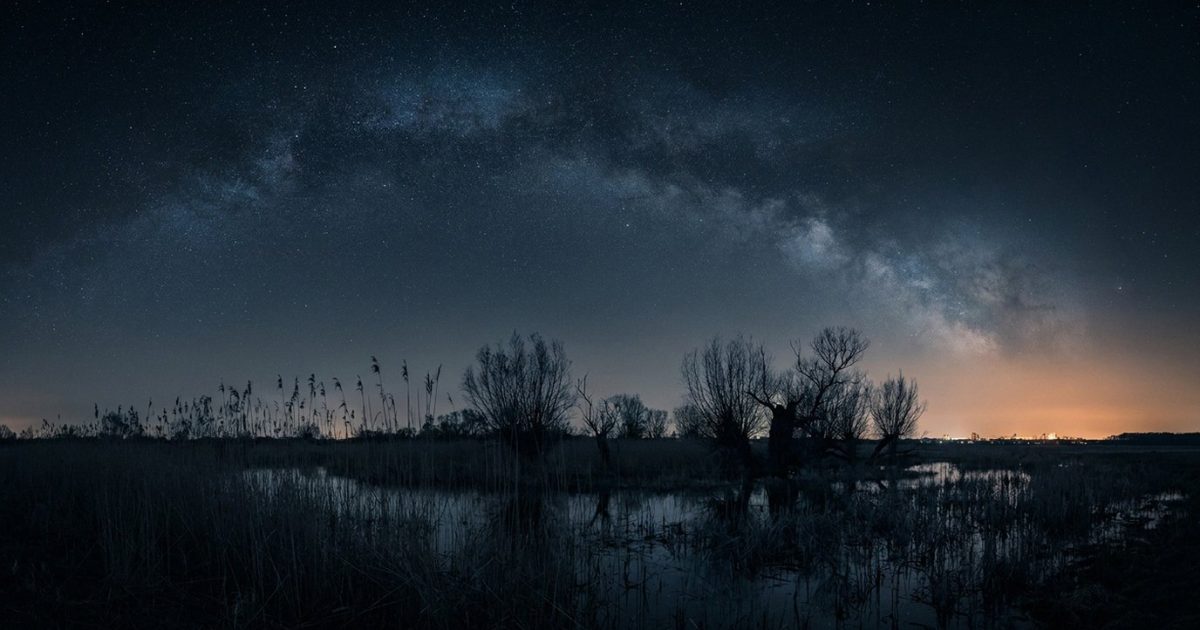
In February 2014, the International Dark-Sky Association designated Sternenpark Westhavelland — approximately 75,000 ha of wetland and fen in Brandenburg — as Germany’s first International Dark Sky Reserve. The site lies roughly 70 km west of central Berlin: a Bortle Class 2 landscape in the commuter shadow of Germany’s most populous city. SQM readings in the core zones reach 21.6–22.0 mag/arcsec². Few certified reserves in Europe sit this close to a metropolis of 3.7 million people, and none of them are inside its regional transport network. For the full context of the European dark sky certification system, see dark sky places in Europe.
Where and What It Is
Westhavelland is a floodplain landscape in the Havelland district of Brandenburg — flat, wet, and almost entirely free of the ground-level obstructions that concentrate light emission in more urbanised terrain.
The IDA-designated dark sky reserve covers approximately 750 km² (75,000 ha), situated within the broader Naturpark Westhavelland — the largest protected area in the German federal state of Brandenburg, spanning roughly 1,315 km². The Naturpark provides the administrative and ecological frame; the dark sky reserve is the formally measured and certified core.
The landscape is shaped by the Havel River and its tributaries. Feuchtwiesen — wet meadows — dominate. Havel floodplains, seasonal ponds, reed beds, and patches of deciduous woodland fill in the rest. Population is low by any European standard: scattered villages, few roads, no industrial infrastructure. The communities within or adjacent to the core zone include Rhinow, Nennhausen, Havelaue, and Gollenberg — small municipalities whose populations number in the hundreds rather than thousands. That sparseness is structural to the sky quality. It pre-existed the application by decades.
The distance from Berlin Mitte to Gollenberg — a focal point for dark sky observation — is approximately 80 km by road, 70 km as the crow flies. That puts Westhavelland inside the radius where Berlin’s regional train network reaches. Not many things that qualify as Bortle Class 2 sit inside a capital city’s regional rail network. Westhavelland does.
The Designation Story
The application for IDA Dark Sky Reserve status began in 2010–2011, driven by a coalition of local astronomy enthusiasts, the Naturpark administration, and regional municipalities — and concluded on 12 February 2014 with Westhavelland becoming Germany’s first certified dark sky site.
The application was developed by Andreas Hänel and Claudia Hesse from the Naturpark, supported by the Förderverein Sternenpark Westhavelland e.V. — the registered support association that had been building momentum for formal recognition since 2009. Community councils voted in 2010 and 2011 to back the application, providing the multi-stakeholder governance commitment the IDA Reserve designation requires. A lighting management plan was completed, voluntarily adopted by participating municipalities, and submitted as part of the IDA dossier.
Westhavelland received Reserve status — not Park — because human settlements are present within the core zone. The Reserve framework anticipates this exactly: a dark core where lighting management is strict, surrounded by a buffer zone where community commitment is required. Local authorities agreed to guidelines covering direction, colour temperature, dimming, and intensity of street lighting. Deutsche Bahn — whose rail lines cross the Naturpark — was engaged directly to reduce light emission from rail infrastructure. The scope extended beyond local government to commercial actors whose footprint cut through the reserve.
Westhavelland was the third IDA Dark Sky Reserve designated in Europe, following Exmoor (2011) and Brecon Beacons (2012), and the first in the German-speaking world. It demonstrated that reserve-level protection was achievable in a flat agricultural landscape without the topographic shielding that coastal sites in the UK and Ireland enjoy naturally. The sky here is dark not because of mountains. It is dark because the communities chose to manage it.
What the Sky Looks Like
Core zone SQM readings of 21.6–22.0 mag/arcsec² — Bortle Class 2 — mean the Milky Way is clearly visible with structure: dust lanes, the Great Rift, the Andromeda Galaxy by naked eye. These are not marginal dark-sky conditions. They are exceptional ones for a site inside a metropolitan commuter zone.
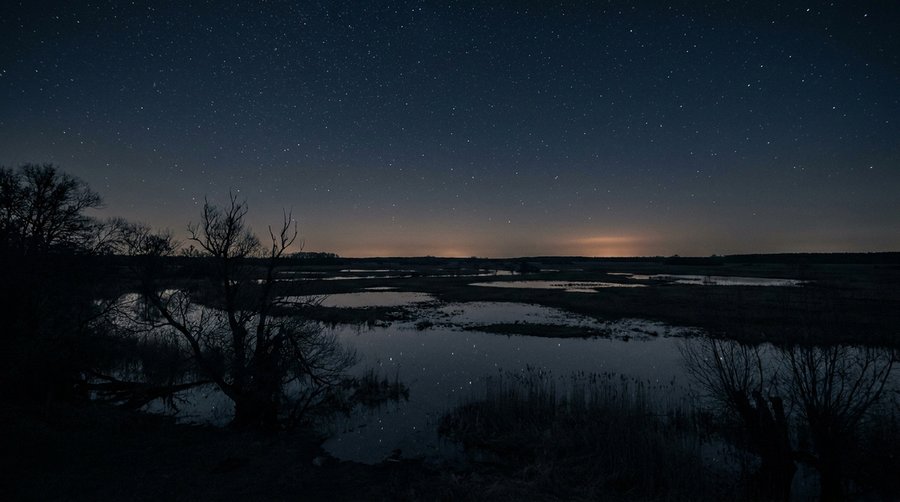
At 21.6 mag/arcsec², M31 — the Andromeda Galaxy — is visible without optical aid; the zodiacal light is detectable in spring and autumn. At 22.0, the Milky Way’s dust structure becomes evident: dark nebulae against the galactic background, M33 (Triangulum Galaxy) detectable by direct vision. These readings come from the best core stations — the Gulper Wiesen and the area near Gollenberg — on clear, moonless, low-humidity nights.
One feature is unambiguous: the Berlin light dome. Looking east, the sky is noticeably brighter than the rest of the horizon. On nights with thin high cloud, the dome spreads and compromises the eastern arc. Observers pointed west and south access the reserve’s best conditions. This is not a disqualifying flaw — every dark sky site near a major city has a dominant light source on one horizon. Kerry has Cork to the northeast. Galloway has Glasgow to the north. The measurement record confirms the Berlin dome does not prevent Bortle Class 2 at the zenith.
Best seasonal windows: late summer (July–August) for Milky Way core; autumn through winter for the longest dark windows and best transparency. The October–November crane migration coincides neatly with the best new-moon observing dates. For the SQM instrument methodology, see SQM buyer’s guide: L vs. LU vs. LU-DL. For how Berlin’s skyglow propagates, see skyglow: causes, reach, and why it stretches 200 km.
Natura 2000 and Wildlife
The Naturpark Westhavelland contains 26 FFH areas under the EU Habitats Directive (92/43/EEC) and four Vogelschutzgebiete (Special Protection Areas) under the Birds Directive — one of the most densely Natura 2000-covered landscapes in Brandenburg, and a rare EU case where darkness is integrated into biodiversity management.
The largest FFH area within the Naturpark is the Niederung der Unteren Havel/Gülper See — approximately 4,450 ha of lowland Havel floodplain. The four Vogelschutzgebiete cover the major wetland systems: the Lower Havel lowland, the Rhinluch, and the Havelland Luch. Management plans for all 26 FFH areas and all four Vogelschutzgebiete were completed by end of 2015.
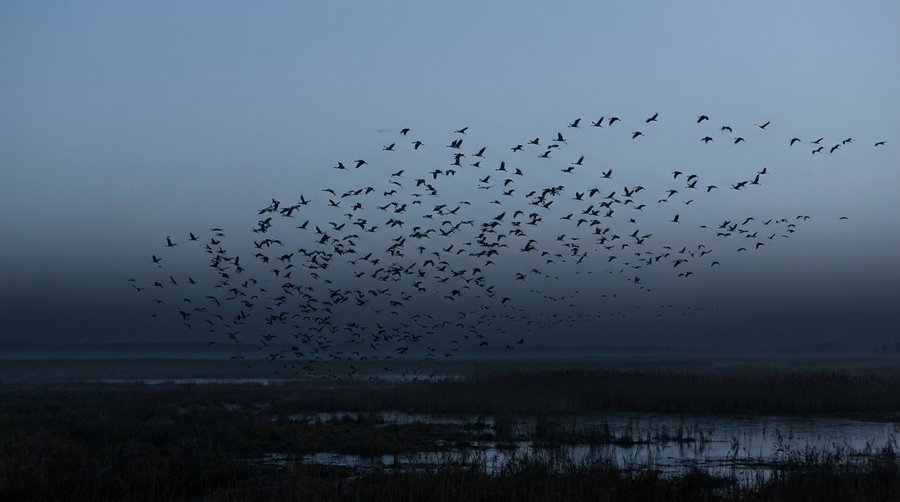
The ecological signature of this landscape is the crane roost. Grus grus — the common crane — uses the Linum ponds within the Naturpark as the largest staging area in the German migration system: up to 100,000 individuals or more have been recorded in a single day during peak October movements, documented by NABU Brandenburg and the Storchenschmiede Linum nature conservation station. Fischadler (osprey) and Seeadler (white-tailed eagle) are present year-round.
The connection between darkness and habitat quality is direct. Nocturnally active species — bats in the Rhinolophus and Myotis genera, moths, migrating birds below 200 m altitude — require intact dark corridors to feed, roost, and navigate. Westhavelland’s lighting management plan is, among other things, a habitat management tool. The EU biodiversity frameworks protect the species. The dark sky designation protects the conditions they require. For the LoNNe refugia framework that formalises this logic, see light pollution and wildlife: how ALAN destroys ecosystems. For the dark infrastructure concept connecting these sites, see dark infrastructure: the Dutch Donkerte-Netwerk and Natura 2000 corridors.
Astrotourism and Visiting
Westhavelland is accessible by regional rail from Berlin, hosts the annual WestHavelländer AstroTreff (WHAT) in September at Gülpe, and accommodates visitors in small Pensionen — deliberately, without large-hotel infrastructure that would introduce new light emission.
The WHAT event is an amateur astronomy Treffen — a field star party — rather than a commercial festival. It reflects the reserve’s origin: driven by enthusiasts, structured around the sky. Accommodation runs to Pensionen in Rhinow, Gollenberg, and surrounding villages. No large hotels exist here; the reserve’s low population density and lighting management posture make that outcome deliberate rather than accidental.
Getting there from Berlin: the RE4 regional express (Deutsche Bahn) runs Berlin Hbf to Rathenow in approximately 50–80 minutes. Rathenow is the eastern gateway to the Naturpark. From Rathenow, the reserve’s core zones are 15–30 km further by bicycle — the area has well-developed cycling infrastructure, with accommodation providers offering bike rental. Total journey time from Berlin Hbf to a dark sky viewpoint: approximately 90–120 minutes.
For the sibling flagship profiles in this series: Galloway Forest Park — Europe’s first dark sky park and Kerry dark sky reserve — the northern hemisphere’s first inhabited Gold Tier. For Europe’s newest designation, see Øvre Pasvik — Europe’s northernmost dark sky park. For the research networks that quantified what these places protect, see LoNNe: Europe’s light pollution field campaigns.
Frequently Asked Questions
How dark is Westhavelland compared to other European Dark Sky Reserves?
Core zone SQM of 21.6–22.0 mag/arcsec² puts Westhavelland in Bortle Class 2 — comparable to Kerry’s ~21.8 Gold Tier reading, above the Bortle Class 1 threshold of ~21.7. A typical European city scores 17–18 mag/arcsec² (Bortle Class 7–8). Galloway’s documented 23.6 peak is higher, but Galloway is 120 km from Glasgow in a shielded hill terrain. Westhavelland sustains Class 2 at 70 km from a capital of 3.7 million across flat wetland. The Berlin dome is visible on the eastern horizon; it does not prevent zenith readings in the 21.6–22.0 range on clear moonless nights.
Can I reach Westhavelland by public transport from Berlin?
Yes. The RE4 regional express runs Berlin Hbf to Rathenow in approximately 50–80 minutes. Rathenow is on the eastern edge of the Naturpark. The dark sky core — Gollenberg, Gülpe — is reachable by bicycle in 30–60 minutes on marked cycling paths. Accommodation providers in Rhinow and Havelaue offer bike rental. Total journey from Berlin city centre to a dark sky viewpoint: approximately 90–120 minutes, making Westhavelland one of the most transit-accessible IDA Dark Sky Reserves in Europe.
When is the best time of year to visit Westhavelland for stargazing?
New moon ±3 days is the non-negotiable variable. Best months: late summer (July–August) for the Milky Way core; October through February for the longest dark windows. October–November doubles as crane season at Linum — up to 100,000 Grus grus at the ponds, visible at dusk before the sky darkens. The annual WestHavelländer AstroTreff is held in September near Gülpe. Summer nights are short but usable from late August onward.