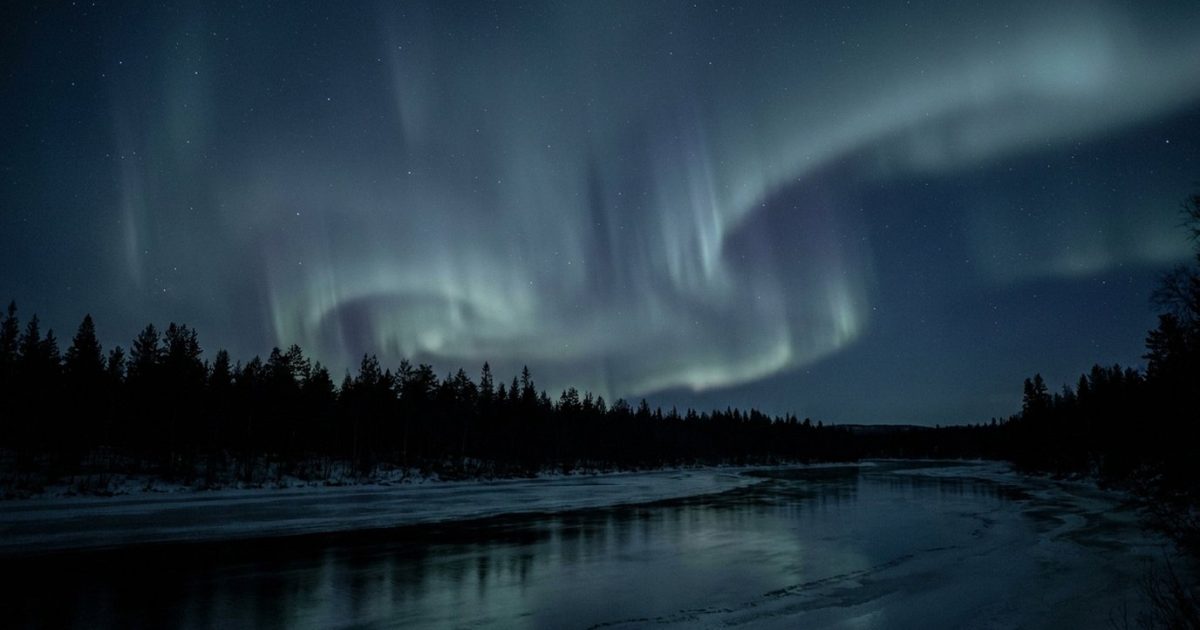
In July 2024, Øvre Pasvik National Park — 11,900 ha of boreal taiga at approximately 69°N in Finnmark, northeastern Norway — became Norway’s first IDA-certified International Dark Sky Park and Europe’s northernmost. Polar night, from late November through mid-January, delivers roughly 60–70 consecutive days without the sun rising above the horizon. Aurora borealis is visible on 100 to 150 nights per year at this latitude. No other certified dark sky site in the IDA network offers both. For the full European dark sky context, see our guide to dark sky places in Europe.
The Geography of Øvre Pasvik
The park sits at the meeting point of three nations — Norway, Russia, and Finland — in a valley so remote that the nearest city of scale is Kirkenes, 100 km north.
Øvre Pasvik occupies the southernmost part of Finnmark county, in the upper Pasvik Valley where the Pasvikelva river runs along the Norwegian-Russian border. Finland meets both at the Treriksrøysa — the Tri-Border Monument, formally Rajakettu in Finnish — a stone pillar marking the exact point where all three state boundaries converge. The park lies within a few kilometres of this marker. It is, geographically, a corner of Europe that few Europeans could locate on a blank map.
The 11,900 ha National Park core is the formally designated dark sky area. Surrounding state-managed forest administered by Statskog — Norway’s state forestry and land management body — provides an effective buffer that extends the dark sky zone considerably beyond the park boundary. Light sources in this region are sparse: Pasvik has no towns, minimal road infrastructure, and a population density that approaches zero across much of the valley. The landscape is boreale Taiga — dense spruce and pine forest interspersed with raised bogs, lakes, and the braided channels of Pasvikelva. It is also one of Norway’s most significant wildlife corridors: brown bear, Eurasian lynx, moose, wolverine, and over 170 bird species documented within the park boundaries. The darkness here is a function of geography, not management. The IDA designation formalises it.
The 2024 Designation
Norway’s first IDA Dark Sky Park designation, granted July 2024, was driven by a Sami upper secondary school and a regional nature and culture association — not a national park authority acting from the top down.
The principal applicants were Samisk Videregående Skole og Reindriftsskole — the Sami Upper Secondary and Reindeer Herding School in Karasjok — and Pasvik Natur- og Kulturpark Naeringsforening, a regional body promoting natural and cultural heritage in the valley. The institutional ownership of the application matters. It signals that the designation was conceived from within the regional community rather than imposed by national conservation bureaucracy.
The Lighting Management Plan, developed in coordination with Miljoedirektoratet (the Norwegian Environment Agency) and Statskog, focuses on three specific areas: limiting infrastructure expansion at the Pasvik hydroelectric installations along the river, managing road-lighting standards on the handful of unpaved access routes into the valley, and adapting lighting at Neiden Skole — the nearest school facility — to 3000K LED. Norwegian national road standards had already moved toward 3000K warm-white LED in rural areas, which reduced the blue-spectrum skyward scatter that higher-CCT installations produce. The Management Plan formalised that approach as a site-specific commitment rather than leaving it contingent on future national policy revision. Recertification under IDA’s standard five-year cycle will require documented sky-quality monitoring against baseline SQM readings established during the application process.
The Sky at 69° North
At 69°N, polar night runs from approximately late November through mid-January — a 50 to 55-day window in which darkness is not an interlude between twilights but the default condition.
I write this from Stockholm, at 59°N, where December delivers six hours and four minutes of daylight on the solstice. Ten degrees further north, that number becomes zero. In the Pasvik Valley in December, the sun does not clear the horizon at all. Midday produces a blue-grey civil twilight lasting an hour or two, a brief marginal brightening that resolves nothing. The astronomical observing window — free of even civil twilight interference — runs from mid-afternoon to mid-morning on the clearest days.
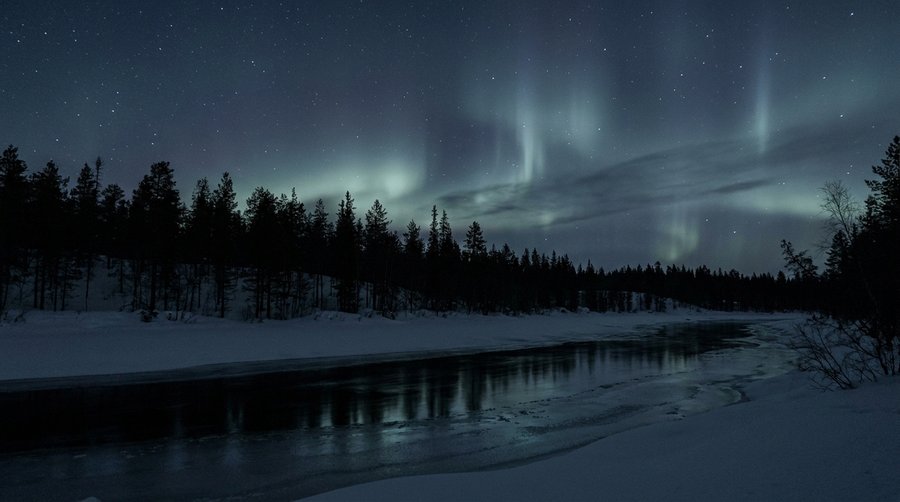
Aurora borealis introduces a complication that no site in Germany, Ireland, or the UK confronts. During active geomagnetic events — Kp index 2 or above, which occurs on roughly 100 to 150 nights per year at this latitude — the aurora emits strongly in the green band (557.7 nm) and, under intense activity, in reds and purples across the full sky. A Kp 5+ event can raise effective sky brightness by two to three magnitudes at the zenith, temporarily eliminating faint-object stellar visibility. IDA’s sky quality assessment for Øvre Pasvik correctly calculates baseline SQM values under aurora-free conditions — Bortle Class 1–2 in the core zone — because the aurora is a natural phenomenon, not artificial light pollution. Visitors monitoring space weather alongside meteorological forecasts will find that the gaps between aurora curtains provide extraordinary Milky Way access under conditions found at no other European designated site. The challenge is timing.
Snow albedo adds a further variable. In Pasvik, winter snowpack reflects aurora and moonlight upward, raising ambient illumination perceptibly. Published winter SQM values are indicative baselines, not guaranteed conditions on any individual night.
Sami Heritage and the Night
The Sami have been present in the Pasvik region for more than a thousand years. Their astronomical traditions are not archival — several are still in active use within reindeer herding siidas.
Sami settlement in Finnmark predates the Norwegian state by centuries. Reindeer herding in the Pasvik-Varanger area is organised through the siida system — a cooperative unit of families sharing grazing territory and managing herd movements in coordination. The Samisk Videregående Skole in Karasjok, which co-led the IDA application, trains herders in both modern wildlife management and traditional ecological knowledge. The IDA application grew from that institutional context — an institution that understands darkness as an operational environment, not a scenic resource.
Sami astronomical knowledge is embedded in language. Boahjenášti — the North Star — translates loosely as the Nail of the Sky, the fixed axis around which all celestial rotation organises itself. Sarva, the Great Reindeer Bull, corresponds to the constellation Western astronomy calls Orion, though the Sami figure extends further — incorporating stars that the Greek tradition divided into separate constellations — because the herder’s sky is not partitioned the same way a Greek sailor’s sky was. Dávggát, the Big Dipper, functions as a clock during the long herding night: its rotation around Boahjenášti marks elapsed time across the dark hours of autumn migration. This is practical knowledge. It was developed for use outdoors in darkness.
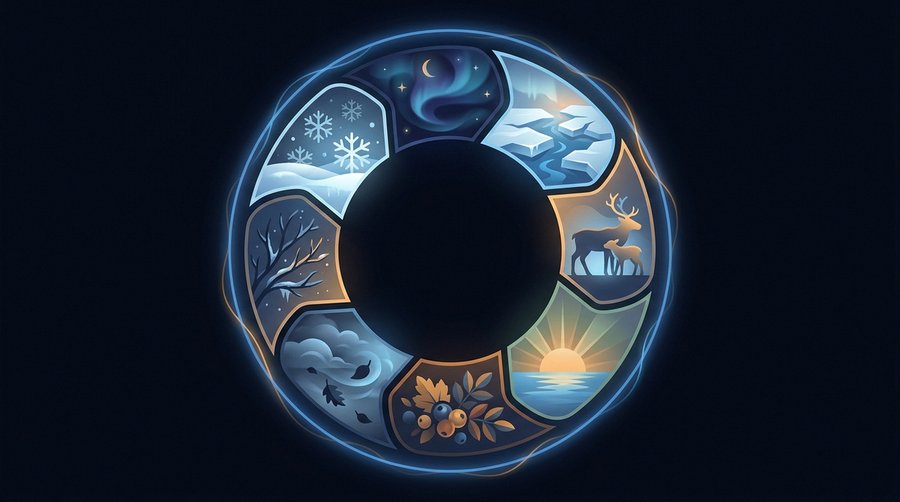
The Sami also recognised eight seasons rather than four — dálvi (winter), giđaveassi (springwinter), giđa (spring), giesaveassi (springsummer), giese (summer), čakčaveassi (autumnsummer), čakča (autumn), čakčadálvi (autumnwinter) — each phase defined by specific environmental conditions including light quality and stellar visibility. As our sibling article on Nordic chronobiology documents in detail, this eight-season structure functions as a chronobiological adaptation to extreme Arctic photoperiod variation, not a decorative cultural classification. Post-WWII Norwegian assimilation policies disrupted Sami language transmission for decades. The Sámi University College in Kautokeino and regional Sami Cultural Councils have led revival efforts since the 1990s. The sky knowledge is part of what requires reviving. IDA designation at Øvre Pasvik provides, for the first time, a formal mechanism to protect the darkness that knowledge requires to function. For how noctalgia — the grief of sky loss — intersects with this cultural dimension, see our article on noctalgia: the language of losing the night sky.
What Visiting Actually Requires
Øvre Pasvik is not Galloway. Getting there from any European capital requires a flight and a long drive, and winter temperatures regularly reach −25°C. Visitors who are unprepared will not see the sky — they will be managing hypothermia.
Access from the south goes via the E6 highway through Finnmark, branching toward Kirkenes and then south into the Pasvik Valley. Kirkenes Airport (KKN) is served by SAS and Wideroe from Oslo; the drive from the airport to the park’s southern boundary runs approximately 80 km on roads that require winter tyres from October through April. The nearest accommodation is Pasvik Hytte — a cluster of self-catering cabins in the valley — and a small number of farm-based guesthouses. There are no large hotels. This is not a developed tourism infrastructure. That is partly the point.
Best months for dark sky observation: November through February. November and December offer the deepest polar night but carry the highest cloud probability — Finnmark winter weather is variable and satellite forecasts matter. January and February are statistically clearer, and January’s polar night still has weeks remaining. April through August is the midnight sun season — no astronomical darkness, no stars. Øvre Pasvik for astronomy is emphatically a winter destination. Gear requirements are genuine Arctic: layered thermal insulation rated to −30°C, chemical hand warmers for handling optics, extra batteries stored warm on your person (lithium cells perform better than alkaline below −10°C), and a red-light torch rated for cold temperatures. Camera and telescope electronics need thermal protection or will fail. The aurora, when active, illuminates the snowpack with a moving greenish light sufficient to walk by.
Frequently Asked Questions
When is the best time to visit Øvre Pasvik for dark skies?
November through February is the window. Polar night — the period when the sun stays below the horizon — runs from approximately late November through mid-January at 69°N, providing 50 to 55 days of genuine round-the-clock astronomical darkness when skies are clear. January and early February tend to have better cloud statistics than December. New moon periods, when lunar light is absent, maximise dark sky conditions on any given night. Summer brings midnight sun — no darkness, no stars — so April through August is the wrong season for astronomy at this latitude.
Can I see the aurora from Øvre Pasvik?
Yes, and at higher frequency than most European aurora destinations. Øvre Pasvik sits at approximately 69°N, within the auroral oval zone where geomagnetic activity produces visible aurora on roughly 100 to 150 nights per year (Kp index 2 or above). Strong events — Kp 5 and above — produce full-sky auroras with visible reds and purples beyond the standard green band. The practical point: during an active aurora event, faint-star visibility is reduced because the aurora itself emits light across the sky. Use space weather apps alongside weather forecasts. Aurora and Milky Way share the same sky, but they compete for the same photon budget.
How do SQM measurements work when aurora is present?
SQM (Sky Quality Meter) instruments measure total sky radiance in mag/arcsec² — they do not distinguish between aurora emission and artificial light at night. A strong aurora event raises the SQM reading in the same way a nearby town would: by adding photons to the measurement. IDA’s certification process for Øvre Pasvik correctly establishes baseline SQM values under aurora-free, clear-sky conditions — that is the measurement of artificial light pollution, which is what the designation protects against. Aurora is geomagnetic noise on top of that baseline. Published Bortle Class 1–2 values for Øvre Pasvik reflect the artificial-light-free baseline, not aurora-active nights. Expect significant variability on aurora-active nights, and plan multi-night stays to ensure at least some aurora-quiet observing windows.