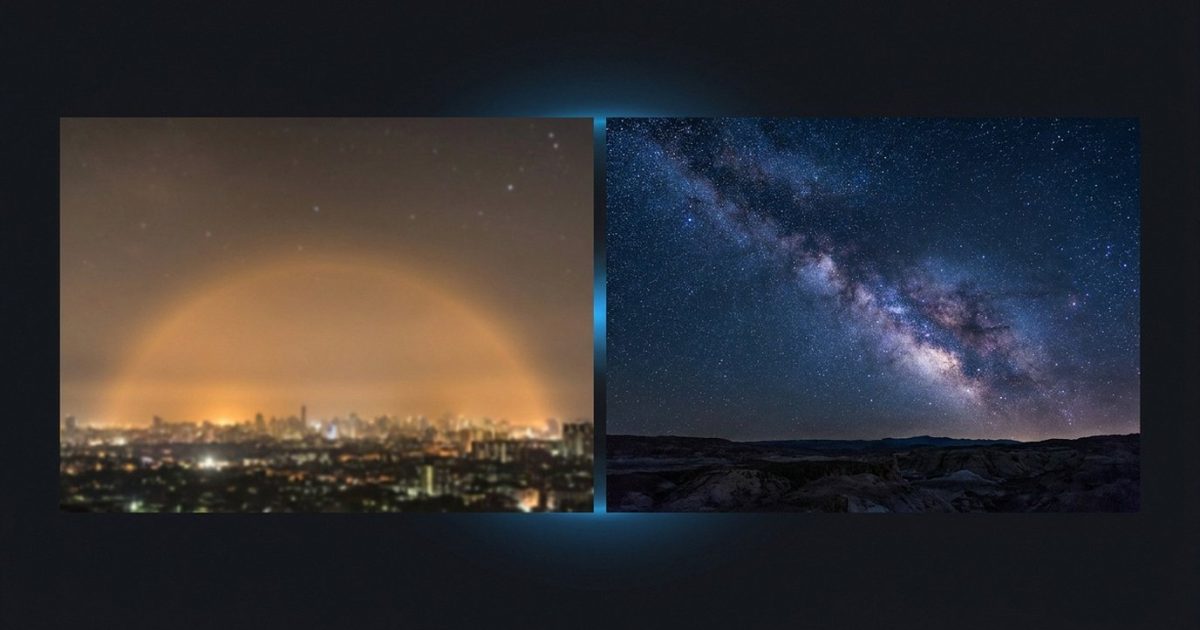
In June 2023, researchers Aparna Venkatesan and John C. Barentine published a two-page e-Letter in Science — a response to Kyba et al.’s finding that stellar visibility across Earth had declined by 9.6% per year between 2011 and 2022. They called the resulting loss noctalgia: sky grief, the accumulated cultural and psychological weight of a night sky that once belonged to everyone and no longer does. Sixty percent of Europeans cannot see the Milky Way from where they live. Eighty-three percent of the global population lives under measurably brightened night skies. What we have lost is not countable in lumens. It is a loss of orientation — to our own history, to the calendar systems that preceded us, to the sky that every human culture before the twentieth century took for granted. For the full account of where dark skies still exist in Europe, see our guide to dark sky places in Europe.
Where the Word Comes From
Etymology matters here. Noctalgia is built from the Latin nox — night — and the Greek algos, meaning pain or longing. The construction deliberately mirrors nostalgia, coined in 1688 by Swiss physician Johannes Hofer to describe the acute homesickness of Swiss mercenary soldiers: a painful yearning for a place left behind. Venkatesan and Barentine’s word applies the same logic to a different kind of departure. You have not left the night sky. The night sky has left you.
The e-Letter was submitted to Science as a correspondence piece responding to Kyba et al. 2023 (Science 379:265–268) — a citizen-science study drawing on Globe at Night observations from more than 51,000 participants worldwide over eleven years. Kyba’s team found that the human eye, looking up at the same patch of sky, sees 9.6% fewer stars per year — a rate that compounds rapidly. A child born in 2000 has already lost half the stellar visibility that existed at their birth by any standard accumulation model. Venkatesan and Barentine’s preprint version is available at arXiv:2308.14685.
One qualification matters and should be stated plainly: the e-Letter is not a peer-reviewed empirical study. It is a scholarly correspondence — a proposed framework, published in one of the world’s leading scientific journals but not through the same review process as a research article. The term noctalgia is a conceptual proposal, not an established clinical or diagnostic category. What gives it traction is not institutional adoption but the precision of what it names. There are people who have driven three hours to stand in a field at midnight and see a sky their grandparents saw from the front step. That is noctalgia. The word was overdue. For the foundational research on how Venkatesan and Barentine’s concept connects to dark sky designation, see our parent pillar on dark sky places in Europe, which discusses this e-Letter in its full IDA context.
The Data Behind the Loss
Fabio Falchi and colleagues’ 2016 World Atlas of Artificial Night Sky Brightness, published in Science Advances, is the study that produced the numbers most often cited when noctalgia is discussed. Using 35,000 calibration data points and satellite observations processed against photometric models, Falchi et al. found that 60% of Europeans and 83% of the global population live under skies too bright to see the Milky Way — that diffuse, granular band that is nothing more than the galaxy’s own disc seen edge-on. The threshold for Milky Way visibility is approximately 21.5 mag/arcsec² on the SQM scale. Most European cities sit between 17 and 19 mag/arcsec². Stockholm, where I write this, is solidly in that range.
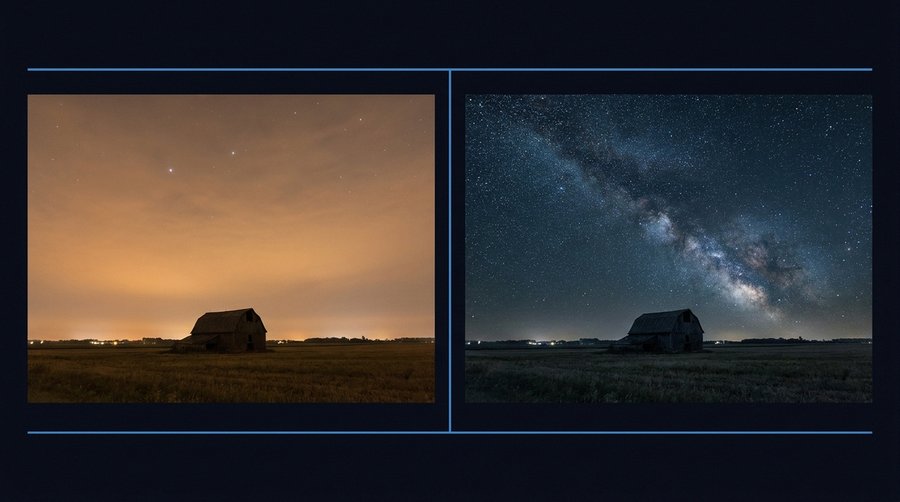
Kyba et al. 2023 added a temporal dimension. Falchi’s atlas documented a moment — a snapshot of 2016 sky brightness. Kyba’s Globe at Night dataset showed the direction of travel: not flat, not stable, but accelerating. Nine-point-six percent per year in stellar visibility loss is not a rounding error. It is a trajectory. Northern Europe and the British Isles — regions that once had genuine rural darkness within hours of major cities — are now among the fastest-brightening zones on the planet, partly because of shifting from orange sodium streetlights to high-efficiency LED systems with broader spectral output in the blue and white bands, which scatter more effectively in the atmosphere and reach further distances from their source.
The refugia that remain are few and formally documented. IDA-certified dark sky reserves — Galloway Forest Park in Scotland, Kerry International Dark Sky Reserve in Ireland, Westhavelland in Germany, Øvre Pasvik in Norway — are among the places where the Milky Way is still accessible to most visitors on a clear moonless night. Their existence as measured, monitored, legally protected darkness is precisely what the data above makes precious. For the skyglow mechanisms that explain this brightening, see our article on skyglow: causes and reach. For the full Falchi and Kyba data context, see Falchi and Kyba: the world atlas of light pollution.
Why It Matters Beyond Astronomy
Astronomers were the first to notice and measure the problem. They are not the only ones with something to lose.
The Sami people of Sápmi — the territory spanning northern Norway, Sweden, Finland, and Russia’s Kola Peninsula — have maintained a calendar of eight seasons for thousands of years, each phase defined by environmental cues including stellar positions, aurora patterns, and the angle of twilight at the horizon. The Big Dipper, Dávggát in Northern Sami, functions as a clock: its rotation around the Pole Star marks night hours during reindeer migration, when precise timing across open tundra has direct consequences for herd safety. Cassiopeia forms the antlers of a celestial moose that spans what Western astronomy divides into three separate constellations. This is not decorative mythology. It is a phenological database, readable only under dark skies. When coastal towns on Norway’s western fjords extend their skyglow inland, they are not merely adding light. They are introducing noise into an active information system. For the full treatment of how Nordic chronobiology and ALAN interact, see our article on Nordic chronobiology: polar night, midnight sun, and the ALAN paradox.
The same logic applies across cultures. Polynesian wayfinding — the system of open-ocean navigation that enabled settlement of the entire Pacific, codified in the Hawaiian star compass used by Hōkūleʻa and revived by the Polynesian Voyaging Society — depends on memorised rising and setting positions of hundreds of stars along the horizon’s 32 houses. It is not metaphor. It was functional navigation. The sky was the chart. Ancient Maya astronomical systems tracked Venus cycles with a precision that required sustained multi-generational observation. The Vedic calendar’s nakshatra system maps the moon’s 27 or 28 stations against a star-field that no longer exists as described from any South Asian city.
A child in Stockholm in 2026 sees fewer stars than any person alive before the 1880s saw from the same location, without exception. That is not a sentimental observation. It is a measurement. What we are losing is not just photons — it is the operational context in which entire knowledge systems were built, tested, and transmitted across generations.
The Refugia and Resistance
Darkness, it turns out, can be protected. The IDA designation system — whatever its limitations as a conservation instrument — demonstrates that a community can choose, formally and legally, to manage its artificial light output in ways that preserve night-sky quality. Galloway Forest Park’s 78,000 ha in southwest Scotland hold some of the darkest certified skies in Europe, with verified SQM peak readings of 23.6 mag/arcsec² — conditions approaching the theoretical maximum for Earth’s atmosphere. Kerry International Dark Sky Reserve, 70,000 ha on Ireland’s Iveragh Peninsula, was the first permanently inhabited Gold Tier reserve in the northern hemisphere when designated in 2014: its core zone sustains SQM readings of approximately 21.8 mag/arcsec², maintained not by emptiness but by community lighting management. Øvre Pasvik in Norway’s Finnmark county, designated in July 2024 at approximately 69°N, became Europe’s northernmost IDA Dark Sky Park — the first Norwegian site in the network.
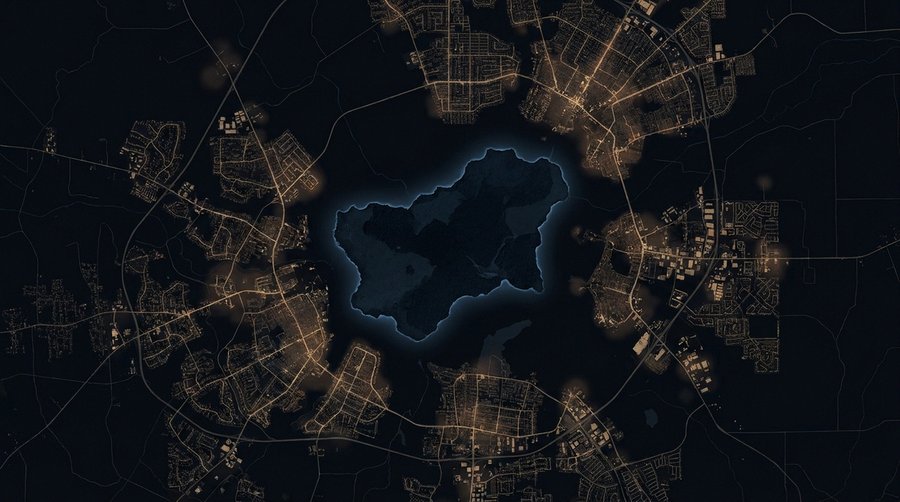
In France, the ANPCEN’s Villes et Villages Étoilées programme recognises municipalities that voluntarily adopt strict outdoor lighting controls. As of 2024, 759 of 1,062 awarded communes have reached higher tiers — a bottom-up cultural movement that began before the 2018 French national lighting decree formalised similar standards at the regulatory level. These are not activists. They are mayors, electricians, and rural councils making procurement decisions. The mechanism is mundane. The effect is measurable darkness, restored incrementally.
Cost-lonne.eu documents this landscape as a journalistic archive — without advocacy, without the assumption that the trend is reversible. For the specific places where darkness still functions: Galloway Forest Park, Kerry dark sky reserve, Westhavelland, and Øvre Pasvik. For the French policy context, see France’s 2018 lighting decree.
What Noctalgia Asks of Us
December mornings in Stockholm begin past eight o’clock. By three in the afternoon the light is gone. I have grown up with this rhythm — the long Nordic dark, which is not romantic and not frightening, just a fact of the latitude. What I have not grown up with is a night sky that performs what it promises. Stockholm’s sky at midnight is the colour of old orange peel. There are no stars worth counting. Occasionally, in February, I drive north for two hours and the sky changes. You can watch it change as the road narrows and the towns become villages.
That change — from polluted orange to something approaching actual darkness — is not nostalgic in the literary sense. It is disorienting. The first reaction is not wonder but wrongness: the feeling that this sky is somehow too much, that you have no category for this quantity of information overhead. Which is precisely the point. We have lost the category. Noctalgia is not grief for a postcard. It is the recognition that a capacity for perceiving the universe has been quietly subtracted from ordinary life — not by accident, not by necessity, but by the accumulation of small lighting decisions made without any awareness of their aggregate effect.
Venkatesan and Barentine’s e-Letter asks for nothing specific. It does not issue recommendations. It names the phenomenon. That is what good vocabulary does — it makes visible something that was happening without a word to hold it. Whether the named thing gets addressed is a separate question. What the word enables is at least the possibility of a conversation that precision requires. “We have lost something” is the beginning of a useful sentence. Noctalgia makes it more specific: we have lost the sky, and we know what that costs, and the loss has a name now. Whether naming it changes anything is a question the data will eventually answer. For the full dark sky places network context, see our guide to dark sky places in Europe.
Frequently Asked Questions
Who coined the term noctalgia?
The term noctalgia was proposed by astrophysicist Aparna Venkatesan (University of San Francisco) and dark sky researcher John C. Barentine (Dark Sky Consulting) in a June 2023 e-Letter published in Science, responding to Kyba et al.’s 2023 study on stellar visibility decline. A preprint is available at arXiv:2308.14685. The term is a scholarly proposal — not an established clinical or diagnostic concept — built from the Latin nox (night) and Greek algos (pain/longing), mirroring the construction of the word nostalgia.
Can I still see the Milky Way in Europe?
Yes, but only in specific locations. Falchi et al. 2016 (Science Advances) found that 60% of Europeans live under skies too bright to see the Milky Way — requiring SQM readings above approximately 21.5 mag/arcsec². IDA-certified dark sky reserves such as Galloway Forest Park (Scotland), Kerry International Dark Sky Reserve (Ireland), and Westhavelland (Germany) achieve those conditions on clear moonless nights. The new moon window — roughly six days per month — is the optimal time. Øvre Pasvik in Norway’s Finnmark county offers Milky Way visibility in winter conditions at 69°N. Outside of designated sites, large areas of rural Scandinavia, northern Scotland, and the Carpathians remain dark enough for Milky Way observation.
Is noctalgia officially recognised as a psychological term?
No. Noctalgia as proposed by Venkatesan and Barentine is a cultural and environmental concept, not a clinical category. The e-Letter was published in Science‘s correspondence section — it was not a peer-reviewed empirical study and the term does not appear in psychiatric diagnostic frameworks such as DSM-5 or ICD-11. Its value is descriptive and cultural: it names a collective loss that previously lacked precise vocabulary. Several science communication outlets have adopted it since 2023, reflecting its usefulness as a term rather than its clinical status.