
France is the only EU member state whose national outdoor lighting law has produced documented, measured reductions in sky brightness. The Arrêté du 27 décembre 2018 relatif à la prévention, à la réduction et à la limitation des nuisances lumineuses requires CCT at or below 3000 K for all newly acquired outdoor luminaires, a nominal upward light ratio below 1%, and enforceable curfews for façade, signage, and interior lighting. The results are twofold and distinct: communes certified under the ANPCEN Villes et Villages Étoilés label programme use approximately 33% less total outdoor lighting than the French national average — a comparison figure, not a national measurement — and at the national scale, the French government’s own statistics document a 19% reduction in exposure to high-level light pollution across mainland France between 2014 and 2023 (SDES, Ministère de la Transition Écologique). No other EU member state has produced an equivalent chain of evidence. For the broader engineering and policy context, see our guide on how to reduce light pollution.
The Long Road from Loi Grenelle to Arrêté 2018
France’s 2018 decree did not emerge from nowhere — it consolidated a decade of incremental regulation that began with a 2010 framework law and tested curfews in 2012 and 2013.

The legal foundation is Law n° 2010-788 of 12 July 2010, the Loi Grenelle II — formally titled the Loi portant engagement national pour l’environnement. The Grenelle process, launched under President Sarkozy in 2007, brought together government, business, environmental associations, and local authorities to negotiate legally binding environmental commitments. Light pollution was one of the named stressors. The law mandated implementing decrees to regulate nuisances lumineuses, establishing the legal authority that made all subsequent arrêtés possible.
The first implementing instrument was Décret n° 2012-118 of 30 January 2012, which addressed illuminated advertising, signage, and enseignes. It required mandatory switch-off of lit advertising panels between 1 a.m. and 6 a.m. — the first national curfew on commercial lighting in France. ANPCEN (Association Nationale pour la Protection du Ciel et de l’Environnement Nocturnes) and France Nature Environnement had lobbied for this provision for years. The second step was the Arrêté du 25 janvier 2013, which extended curfew requirements to exterior and interior lighting of non-residential buildings: all interior lighting had to switch off one hour after the last occupant’s departure; exterior building illumination by 1 a.m.
The 2013 arrêté set times. It did not set spectrum or upward flux limits. That gap mattered enormously. A municipality could comply fully with the 2013 regime while installing 5000 K blue-rich LEDs with ULR values of 15%. The photometric damage continued through the night’s working hours with no constraint at all on what was emitted. The Ministère de la Transition Écologique, working with ANPCEN technical advisors and lighting engineers, spent five years developing the numerical thresholds that became the 2018 decree. The result replaced the 2013 arrêté entirely.
What the Decree Actually Requires
The Arrêté of 27 December 2018 introduces the EU’s only national CCT ceiling and the EU’s only numerical ULR limit for outdoor lighting — alongside curfews that were already being partially enforced since 2013.
The decree covers four source categories: illuminated advertising and signage, façade lighting of non-residential buildings, exterior lighting of non-residential buildings (parking, access roads, outdoor work areas), and interior lighting visible from outdoors. Road and public space lighting is addressed where it falls under municipal procurement.
The spectral requirement: all newly acquired outdoor luminaires must have a correlated colour temperature at or below 3000 K. This is the only national CCT ceiling in EU outdoor lighting law. The scientific rationale is direct — atmospheric Rayleigh scattering disperses shorter wavelengths preferentially, meaning a 4000 K LED contributes more skyglow per lumen than a 2700 K equivalent. Melanopsin in intrinsically photosensitive retinal ganglion cells (ipRGCs) peaks at approximately 480 nm; sources above 3000 K emit disproportionately in that band. For the human health dimension of CCT choices, see our article on the melanopic case for warm-white lighting.
The upward light requirement: the nominal upward light ratio (ULR) must be strictly less than 1% in standard installation conditions. The on-site maintenance ULR must not exceed 4% at any point in the fixture’s operating life. This is the only national numerical ULR limit in EU law. EN 13201 — the continent’s harmonised road-lighting standard — contains no ULR figure whatsoever. A fixture achieving M1-class EN 13201 compliance can simultaneously violate the France decree on spectrum, ULR, and curfew schedule. That gap is not a technicality; it is where the EN 13201 blind spots are most consequential.
The curfew requirements, consolidated from the 2012 and 2013 predecessors: illuminated advertising and commercial signage must switch off between 1 a.m. and 6 a.m. (or one hour after the establishment closes, whichever is earlier). Façade lighting of non-residential buildings must be extinguished by 1 a.m. Interior lighting visible from outdoors must switch off one hour after the last occupant leaves the premises. Annual maintenance and cleaning cycles are required — the decree specifies this explicitly, because lumen depreciation and dirt accumulation cause real-world ULR to drift above the nominal installation value.
What the decree does not prescribe: there is no explicit skyglow-cap measured in mag/arcsec². No bird-safe or bat-safe spectral standard. No mandatory post-installation sky brightness monitoring — the one regulatory gap that a COST Action ES1204 LoNNe approach would add as a matter of course. Enforcement is assigned to communal authorities and préfets. Violations carry fines under Article R. 583-7 of the Code de l’environnement: the penalty is 750 euros per non-compliant installation, not per night of non-compliance.
The 33% — What the Villes et Villages Étoilés Label Actually Measures
The 33% figure comes from ANPCEN’s certification programme — it describes how much less light certified communes use compared to the national average, not a historical reduction from a baseline year.
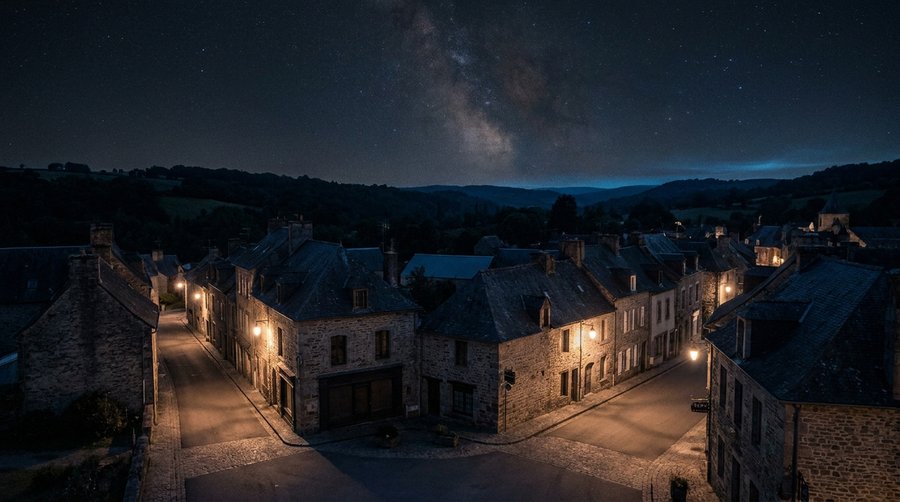
ANPCEN launched the Villes et Villages Étoilés label in 2009 — three years before the first implementing decree under Grenelle II. The programme certifies communes that actively manage their outdoor lighting to reduce light pollution: switching off non-essential lighting at night, retrofitting to full-cutoff warm-spectrum fixtures, dimming street lighting after midnight, and training municipal staff on photometric best practices. Certification involves on-site inspection and SQM sky-brightness measurement at designated monitoring points.
As of the 2024-2025 certification cycle, 759 communes hold the label in the current edition; across all valid label cycles, 1,062 French communes now carry the Villes et Villages Étoilés designation (ANPCEN, 2025). These communes use approximately 33% less total outdoor lighting than the French national average. That comparison — labelled communes versus national average — is the correct interpretation of the 33% figure. It is not a measurement of how much sky brightness has fallen since 2009 in those communes. It is a cross-sectional comparison showing the gap between committed municipalities and the rest of France. The distinction matters because the 33% figure is often cited without that framing and then confused with a measured national reduction — which is the 19% figure from a different source entirely.
ANPCEN also operates a national SQM monitoring network, with instruments deployed in certified communes and reference stations in rural dark-sky areas. The data from this network fed into French government monitoring reports and provided the baseline against which the SDES national analysis was calibrated. For the measurement methodology behind this work — SQM-L field protocols, VIIRS validation, and the intercomparison approaches pioneered by LoNNe — see our article on measuring light pollution and the Globe at Night citizen science tutorial.
The 19% — National-Scale Measurement from SDES
A 19% reduction in high-level light pollution exposure across mainland France between 2014 and 2023 — measured by satellite and confirmed by ground stations — makes France the EU’s only documented national success story.
The Service de la donnée et des études statistiques (SDES), the statistical arm of the Ministère de la Transition Écologique, published its assessment of French light pollution trends in 2023. The methodology combined VIIRS Day/Night Band satellite data — the same sensor family used by Kyba et al. (2017, Science Advances) for global radiance mapping — with ground-based validation from ANPCEN’s SQM network and atmospheric correction models. The headline result: exposure to high-level light pollution in mainland France decreased by 19% between 2014 and 2023. SDES attributed the decline to two compounding factors: the regulatory tightening since 2018, and the energy-saving measures adopted by municipalities, businesses, and citizens following the 2021 energy crisis.
The VIIRS spectral gap — VIIRS DNB is a panchromatic sensor blind to blue wavelengths below approximately 500 nm — means the satellite data underestimates the contribution of white LEDs to total sky brightness. The SDES analysis corrected for this using spectral decomposition from ground stations where fixture spectra were recorded. Even with that correction, the 19% reduction is a conservative estimate; actual sky brightness improvements at spectrally sensitive monitoring sites (including several ANPCEN certified communes) likely exceed that figure. The full methodological detail of satellite versus ground validation is covered in our VIIRS methodology article.
France is the only EU member state where this causal chain is fully documented: national law with specific numerical limits → implementation by municipalities → satellite and ground monitoring → measured reduction. Germany’s LAI 2012 guidelines exist on paper. The Netherlands has dark infrastructure planning. The UK had no equivalent national law before or after Brexit. None of these produced a comparable national measurement. The 19% figure is not marketing — it is the output of a government statistical service using peer-validated satellite methodology.
Implementation Challenges and Enforcement
Compliance is improving but uneven — better at new installations than legacy retrofits, and reliant on ANPCEN’s volunteer monitoring network to fill gaps in municipal enforcement capacity.
Enforcement authority sits with communal governments and préfets. The fine structure — 750 euros per non-compliant installation under Article R. 583-7 of the Code de l’environnement — is modest. Large commercial operators with hundreds of signage installations face meaningful aggregate exposure. Small communes and individual building owners are, in practice, rarely prosecuted. The decree’s most reliable compliance mechanism is not penalty enforcement but procurement: new outdoor lighting installations procured by municipalities are subject to the CCT and ULR requirements at point of purchase, which is a point of maximum leverage. Legacy installations that were legal before 2018 have been subject to phased compliance requirements.
ANPCEN’s monitoring network functions as the de facto enforcement intelligence layer. Volunteer observers with calibrated SQM instruments and systematic reporting protocols flag non-compliant installations that formal authorities then follow up. Without ANPCEN, enforcement would be entirely reactive and complaint-driven. The network also produces the national SQM baseline data that validates the SDES satellite analysis — a feedback structure that no other EU member state has replicated. It is, structurally, the monitoring-evaluate-adapt cycle that the IDA’s Five Principles lack as a mandatory sixth step.
Why Hasn’t the Rest of Europe Followed?
There is no binding EU directive on outdoor light pollution, and the tension between the EU’s energy efficiency push and a light-quality mandate has given member states an easy excuse to do nothing.
France settled a political question that every other EU member state has avoided: is the night sky an environmental resource that requires legally enforceable numerical protection? The answer, in French law since 2018, is yes. Everywhere else in Europe, the answer is still: not quite.
Germany has the LAI 2012 — Hinweise zur Messung, Beurteilung und Minderung von Lichtimmissionen — published by the Länderausschuss für Immissionsschutz under the authority of the Bundes-Immissionsschutzgesetz (BImSchG). It defines Immissionsrichtwerte (advisory thresholds) for luminance and illuminance near ecologically sensitive zones. Advisory. As of 2025, no German Bundesland has transposed these into binding state law. The guidance exists; the enforcement mechanism does not.
Catalonia enacted the EU’s first regional light pollution law in 2001 — Llei 6/2001 de 31 de maig, d’ordenació ambiental de l’enllumenament per a la protecció del medi nocturn — a remarkable early achievement that established lighting zones and spectral restrictions before LED technology even dominated the market. But Catalonia is a region, not a state, and no Spanish national law has followed. The Netherlands developed dark infrastructure planning frameworks after 2010, preserving darkness corridors in nature policy documents. Not a photometric decree. The UK had no equivalent of France’s arrêté before Brexit and developed nothing comparable after it.
The structural obstacle at EU level is the Energy Efficiency Directive (2012/27/EU), which frames LED adoption as an unambiguous environmental good — cheaper lumens, lower carbon emissions, fewer watts per lumen. That framing is correct about energy. It is silent about sky brightness, about CCT, about ULR, and about the Jevons rebound that has seen global sky brightness increase at 9.6% per year (Kyba et al. 2023, Science 379) despite the LED transition. The directive creates political incentives for LED uptake without creating any photometric quality standards. France’s decree adds the missing quality layer. Brussels has not followed. The cost of this absence lands on wildlife corridors, foraging bats, and migrating birds across a continent where the policy template already exists and has been proven to work. For the cultural cost of what is being lost in the meantime, see our piece on noctalgia: the language of losing the night sky.
Frequently Asked Questions
Did France’s 2018 decree really cut light pollution by 33%?
The 33% refers to a specific comparison: ANPCEN-certified Villes et Villages Étoilés communes use approximately 33% less total outdoor lighting than the French national average. It is not a measured national reduction from a baseline year. The national measurement, from SDES (Ministère de la Transition Écologique), documents a 19% reduction in exposure to high-level light pollution across mainland France between 2014 and 2023. Both figures are real; they measure different things.
What does the Arrêté of 27 December 2018 actually require?
Four core requirements: (1) CCT at or below 3000 K for all newly acquired outdoor luminaires — the only national CCT ceiling in EU law; (2) nominal ULR strictly below 1% — the only national numerical ULR limit in EU law; (3) curfews for signage, façade lighting, and interior lighting (switch-off between 1 a.m. and 6 a.m. or one hour after closing/occupancy); (4) annual maintenance cycles to prevent ULR drift above 4% on-site. It applies to advertising, façades, exterior building lighting, and interior lighting visible from outdoors.
How does France enforce the lighting decree?
Communal governments and préfets are the enforcement authorities. Violations carry a fine of 750 euros per non-compliant installation under Article R. 583-7 of the Code de l’environnement. In practice, enforcement is most effective at the procurement stage for new installations. ANPCEN’s volunteer SQM monitoring network provides the intelligence layer that formal authorities depend on for identifying legacy non-compliance.
Are other EU countries planning similar laws?
Not at national level. Germany’s LAI 2012 guidelines are advisory and have not been transposed into binding law by any Bundesland. Catalonia’s Llei 6/2001 is a regional law with no Spanish national equivalent. The Netherlands has dark infrastructure planning but no photometric decree. There is no binding EU directive on outdoor light pollution. The EU Energy Efficiency Directive frames LED adoption as the primary policy tool, without spectral or ULR quality requirements. France remains the only EU member state with a national outdoor lighting law that has produced documented, measured reductions.