Light pollution is solvable. The engineering exists, the policy has been tested, and the evidence is documented. France’s Arrêté of 27 December 2018 imposed legally enforceable curfews, a correlated colour temperature ceiling of 3000 K, and an upward light ratio cap of 1% — and France is now the only EU member state with a national law that has produced measured reductions in sky brightness. Meanwhile, the global LED transition, where deployed without equivalent constraints, produced the opposite outcome: according to Kyba et al. (2023, Science 379), sky brightness increased at 9.6% per year between 2011 and 2022 — doubling every eight years — despite the widespread rollout of nominally more efficient technology. This article is for municipalities, lighting engineers, and citizens who want to act on the science rather than repeat that mistake. For the foundational context on what light pollution is and how it is measured, see our overview of light pollution: science, ecology, and solutions.
Why Most Outdoor Lighting Is Still Wrong
Most outdoor fixtures waste light upward, use the wrong spectrum, and illuminate far more than needed — three fixable mistakes that are not yet close to being fixed.
Walk through any European city after midnight. The orange glow above. The cobra-head streetlights throwing as much light sideways as downward. The glass office tower still fully lit with nobody in it. These are not difficult engineering problems. They are the visible signature of a regulatory framework that defines minimum illumination targets without placing any ceiling on how much light can escape into the sky.
Consider the Upward Light Ratio (ULR): the fraction of a luminaire’s total luminous flux directed at or above the horizontal plane. A standard cobra-head road luminaire — still the dominant fixture type in legacy street lighting across central and eastern Europe — has a ULR of 10 to 25%. Even a so-called full cutoff fixture, certified to direct no light above the horizontal, typically emits 2 to 5% upward due to lens scatter and reflector tolerances. This is the floor, not the ceiling, under most European regulations. EN 13201, the continent’s primary road-lighting standard, defines luminance classes from M1 (2.0 cd/m²) to M6 (0.3 cd/m²) for motorised traffic routes and P-class equivalents for pedestrian areas. It specifies uniformity ratios, disability glare thresholds, and maintained luminance levels. It does not specify a ULR limit. It does not specify a CCT floor. A municipality can achieve full M1 compliance using 6500 K blue-rich LEDs pointing partly skyward, and be entirely within the standard.
Over-illumination compounds the problem. CIE and EN standards establish minimum illuminance values without specifying maxima. The result: specifiers routinely select the next performance class above the minimum to provide a safety margin, then add spare capacity for lamp lumen depreciation. The actual installed light level at commissioning can be 30 to 50% above the required maintained average. Nobody is penalised for this. The standard is satisfied.
And then came LED. Between 2010 and 2020, the cost per lumen in the European municipal street lighting market fell by approximately 60 to 80%, driven by LED technology maturation. Kyba et al. 2017 (Science Advances) tracked Earth’s artificially lit outdoor surface between 2012 and 2016 and found it growing at 2.2% per year. By 2022, Kyba et al.’s citizen-science analysis of Globe at Night data showed sky brightness increasing at 9.6% per year. More efficient lamps, deployed in greater numbers, at higher lumen packages, covering wider areas. The Jevons mechanism in real time — discussed in detail below.
Five Principles — and a Missing Sixth
IDA’s Five Principles are the industry baseline — but they stop short of the most important rule: measure whether it worked.
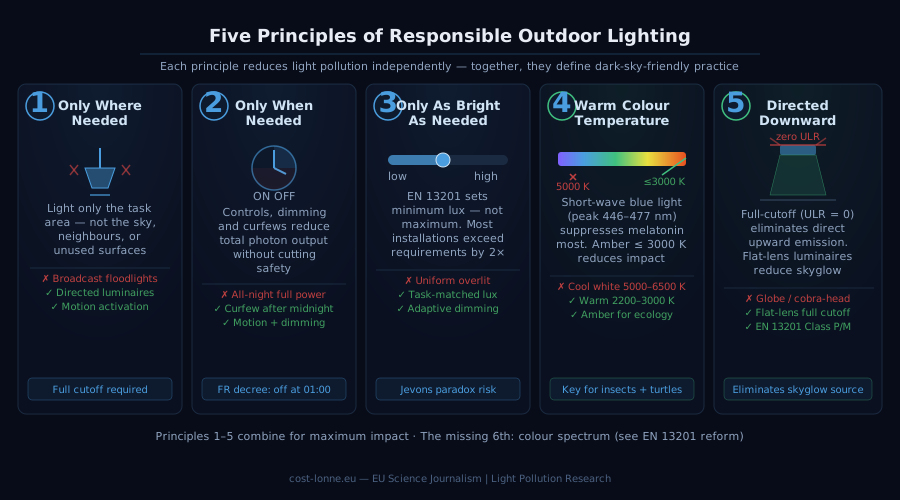
The International Dark-Sky Association and the Illuminating Engineering Society of North America published their joint technical report on responsible outdoor lighting in 2011. The Five Principles it codified are now the closest thing to a global baseline for lighting quality discussion: light should be useful (serving a defined purpose), targeted (directed only where needed), low level (no brighter than the task requires), controlled (using timers, dimmers, or sensors), and warm-coloured (using the lowest effective CCT). Each principle maps to a measurable design parameter. None of them is unreasonable. All five are routinely violated by standard EU road lighting specifications.
The structural problem is this: all five principles are input specifications. They describe how a fixture should be designed and operated. Not one of them requires measuring what happens after installation. There is no principle that says: verify sky brightness at a reference point after twelve months of operation. There is no principle that says: reduce output if post-installation monitoring shows over-illumination. The framework has no feedback loop.
COST Action ES1204 — the Loss of the Night Network (LoNNe), active 2013 to 2017 across 27 European countries — produced research outputs across four working groups that collectively argue for exactly this missing dimension. LoNNe’s Working Group outputs addressed ecological lighting design criteria, measurement protocols, and monitoring methodology that go well beyond photometric standards. The network’s Lighting Design Training School produced materials explicitly linking lighting decisions to post-installation ecological outcomes — a connection absent from every current European standard.
Call it a sixth principle: Evidence-Based. Design according to the first five. Then measure. Report. Adjust. The Precautionary Principle, enshrined in EU environmental law under Article 191 TFEU, provides the legal basis for exactly this approach: where scientific evidence of harm exists but the dose-response relationship is uncertain, the burden of proof lies with those introducing the stressor, not those seeking protection from it. ALAN is an environmental stressor. The evidence of harm is substantial. The Precautionary Principle, applied consistently, would require post-installation monitoring as a condition of planning consent for new outdoor lighting installations — not as best practice, but as a legal requirement. No EU member state has implemented this. Yet.
Fixture Design: The Technical Core
Three design decisions — shielding geometry, CCT, and upward flux — determine approximately 80% of a fixture’s light pollution impact.
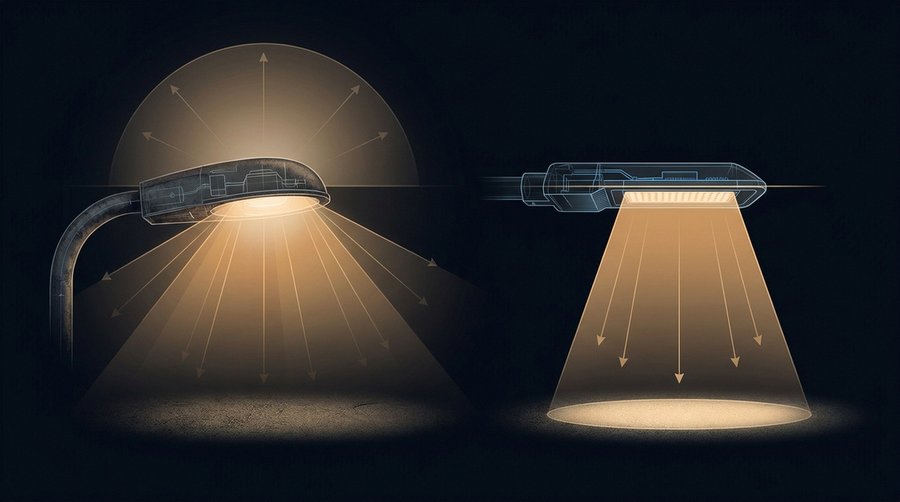
Shielding geometry is the foundational variable. The IES TM-15 BUG rating system classifies luminaires on three axes: Backlight (light directed behind the fixture), Uplight (light directed above horizontal), and Glare (light at high angles in the forward hemisphere that causes disability or discomfort glare). For a light pollution procurement target, the relevant specification is BUG B0/U0/G1 or better: zero upward light, zero backlight beyond the target area, limited forward glare. A full cutoff designation alone is insufficient because it captures only the uplight component.
The three glare types matter for different reasons. Disability glare — from sources in the direct visual field — impairs vision by scattering within the eye, reducing contrast on the task ahead. It is the form most documented in road safety research. Discomfort glare causes visual fatigue and psychological discomfort without necessarily reducing measured visual performance. Blinding glare — the extreme of disability glare at very high luminances — is rare in street lighting but common in sports floodlighting and vehicle headlights. Fixture design that eliminates uplight does not automatically eliminate glare: a perfectly shielded fixture at the wrong mounting height and angle can produce severe disability glare while emitting nothing above horizontal.
CCT is the single most consequential spectral decision. France’s Arrêté of 27 December 2018 is, as of 2024, the only national outdoor lighting law in the EU that specifies a maximum CCT: 3000 K for all newly acquired outdoor luminaires. The scientific basis is well-established. Melanopsin, the photopigment in intrinsically photosensitive retinal ganglion cells (ipRGCs), has peak sensitivity at approximately 480 nm — in the blue-cyan range. LEDs at 4000 K and above emit disproportionate power in this band compared to warm-white equivalents. Atmospheric Rayleigh scattering preferentially disperses blue-wavelength light, meaning a blue-rich source contributes more to skyglow per lumen than a warm source of identical output. The 3000 K threshold is not arbitrary: it falls at the point where the melanopic-to-photopic ratio begins to increase steeply with rising CCT, and where insect phototaxis attraction rises sharply.
France’s ULR cap of 1% for newly acquired luminaires is the only national numerical ULR limit in EU outdoor lighting law. EN 13201 contains no ULR requirement. This is the regulatory gap that allows a fully EN 13201-compliant M1-class installation to simultaneously violate France’s ULR cap on all three key metrics: CCT, uplight, and spectral quality. The gap is not a technicality. It is a structural failure in European lighting regulation that has persisted through the EN 13201:2015 revision. LoNNe explicitly recommended that minimum street lighting levels be reduced and that spectral requirements be incorporated — neither recommendation was adopted. For a detailed technical analysis of this gap, see our article on EN 13201 explained — and what Europe’s road-lighting standard leaves out.
Controls, Dimming, and Adaptive Lighting
Timers, dimmers, and motion sensors are the lowest-cost interventions with measurable impact — and they remain chronically underdeployed across European municipalities.
Three control tiers exist, each with different implementation costs and sky-brightness benefits.
The first tier is curfews: scheduled switch-off of non-essential lighting categories. France’s Arrêté of 27 December 2018 mandates specific cut-off times: façade lighting of non-residential buildings (under the connected 2013 arrêté that the 2018 decree reinforces) must be extinguished by 1 a.m. Commercial signage must switch off one hour after closing or by 1 a.m., whichever is later. Interior lighting of professional premises must be extinguished one hour after the last occupant departs. These are not aspirational targets. They are enforceable curfews with municipal oversight.
The second tier is dimming schedules. A graduated dimming approach — 100% output from dusk to midnight, 70% from midnight to 4 a.m., 40% from 4 a.m. to dawn — cuts total night-sky radiance contribution substantially. The relationship is not linear: sky brightness (skyglow) is driven by atmospheric scattering of upward-directed light, which behaves non-linearly with source intensity. A 50% reduction in direct luminous flux produces approximately 35 to 40% reduction in measurable sky-glow, not 50%, because the scattering function is not proportional across intensity levels. Stockholm’s graduated dimming pilot on cycle routes — reducing output by approximately 38% on qualifying sections — documented direct energy reductions consistent with this projection while maintaining measured luminance at or above required minimums.
The third tier is adaptive controls: motion-triggered responses, occupancy sensors, connected IoT systems. These represent the frontier of lighting control technology and can deliver further reductions where correctly specified. The caution is important: adaptive systems make lighting cheaper to operate per unit area, which historically leads to expansion of coverage — the Jevons mechanism again. Smart lighting that is specified to reduce total output rather than to maintain existing output at lower cost is effective. Smart lighting that is used to justify wider area coverage at the same total energy budget is counterproductive from a sky-brightness perspective.
For the health dimension of CCT and curfew timing — the relationship between outdoor light exposure at night and melatonin suppression in urban residents — see our companion article on light pollution and human health: the science of darkness, disrupted.
The LED Paradox: More Efficient, More Light
LEDs cut energy per lumen — then cities installed more lumens. The net result: brighter skies, not darker ones.
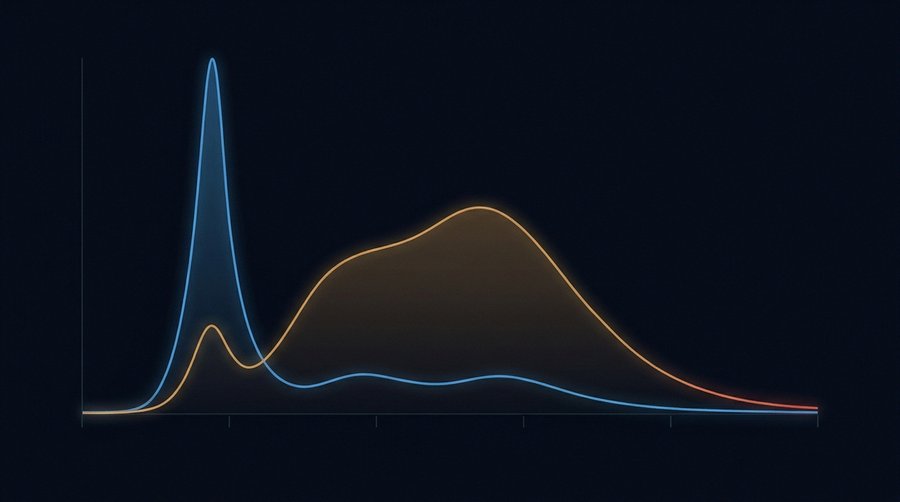
William Stanley Jevons observed in 1865, in The Coal Question, that improved steam engine efficiency had not reduced England’s coal consumption — it had increased it. More efficient engines made coal-powered work cheaper, which expanded demand across industries at a rate that outpaced the efficiency gain. His formulation: “it is wholly a confusion of ideas to suppose that the economical use of fuel is equivalent to a diminished consumption. The very contrary is the truth.” The Jevons Paradox has been the most reliable macroeconomic pattern in energy technology for 160 years. Lighting has reproduced it with particular fidelity.
Between 2010 and 2020, LED lamp costs in the European municipal market fell by approximately 60 to 80%. Running costs fell by a similar proportion. The rational municipal response: upgrade the existing network to LED (correct) and simultaneously expand coverage, increase lumen packages, extend operating hours, and add previously unlit areas, because the incremental cost of doing so was now low (catastrophic for sky brightness). Kyba et al. 2017 (Science Advances) documented the result: Earth’s artificially lit outdoor surface grew 2.2% per year from 2012 to 2016 — during the peak of the LED transition, not before it.
The Portugal case is the starkest national example in the European data. Supplementary material from Kyba et al. 2017’s VIIRS/DNB satellite analysis documented that Portugal, following a nationally coordinated LED retrofit programme in its public street lighting network, showed approximately 120% increase in total nighttime radiance in retrofitted areas — the largest relative increase of any EU member state in the measurement period. The mechanism is precisely as Jevons described: cheaper lumens justified not just equivalent replacement but expansion. For the full analysis of this case and the LED rebound evidence, see The LED Paradox: Jevons, Portugal +120%, and why efficiency backfired.
Kyba et al. (2023, Science 379, 265–268) extended the analysis using Globe at Night citizen-science data from 51,351 participants at 19,262 locations across 2011–2022. Sky brightness — the inverse of stellar visibility — increased at 9.6% per year, equivalent to doubling every eight years. Satellite measurements over the same period showed a decrease of 0.3% per year in European artificial light emissions as measured from orbit. The divergence is explained by two factors: horizontal emission from façade and advertising lighting (which does not appear in nadir-looking satellite data but directly drives skyglow) and the switch from sodium vapour to white LEDs, whose blue-rich emission scatters more efficiently in the atmosphere even at lower total watt-equivalent output.
The conclusion is not that LED technology is the problem. LED fixtures at 2700 K with BUG U0 ratings and properly specified dimming schedules are substantially better for sky brightness than the sodium lamps they replace. The problem is LED deployment without output caps, CCT constraints, ULR limits, or post-installation monitoring. Recommending LED retrofits without simultaneously mandating ULR caps and output limits is malpractice dressed as sustainability. The technology is neutral; the procurement specification determines whether the LED transition reduces or increases light pollution. Currently, across the majority of EU municipalities, it is increasing it.
Ecological Lighting Design
Wildlife-adapted lighting goes beyond warm CCT — it requires planned corridors of complete darkness integrated into landscape and transport infrastructure.
Three design responses exist for ecologically sensitive outdoor lighting, operating at increasing scales.
At the fixture level: wildlife-tuned spectral profiles. Sea turtle research — primarily from Florida Fish and Wildlife data and replicated in Mediterranean hatchling studies — establishes that disorientation in loggerhead and green turtle hatchlings occurs above approximately 480 nm with strong phototactic response; amber fixtures at 590 nm and above reduce hatchling disorientation by more than 90% compared to white LED equivalents of equal lux. For bats, the key variable is less the specific spectrum and more the existence of dark commuting corridors: light-averse species including Myotis daubentonii and all Rhinolophus species avoid lit routes regardless of CCT, making corridor darkness more important than fixture specification in those habitats. For invertebrates, phototaxis — the instinctive movement toward light sources — is most strongly driven by UV and blue wavelengths; amber and red-shifted sources reduce insect attraction by a factor of five to ten at equivalent lumen output.
At the planning level: Environmental Lighting Zones. The distinction between municipal lighting zones (residential, commercial, industrial — primarily concerned with light trespass on human occupants) and ecological lighting zones (defined by sensitivity of adjacent habitat) is not yet standard in EU planning law, but has been operationalised in several national contexts. Germany’s LAI 2012 guidelines — “Hinweise zur Messung, Beurteilung und Minderung von Lichtimmissionen,” published by the Länderausschuss für Immissionsschutz in October 2012 — define Immissionsrichtwerte (emission advisory thresholds) for light sources near biologically sensitive areas. These are advisory only: the LAI operates at the federal advisory level, and as of 2024, no German federal state (Bundesland) has transposed the 2012 guidelines into fully binding state law. The guidance exists; the legal enforceability does not.
EU Habitats Directive Annex IV lists 45 European bat species under the highest protection category — individual animals, roosts, and breeding sites cannot be deliberately disturbed. ALAN demonstrably disturbs roost connectivity and foraging behaviour in multiple Annex IV species. The logical implication — that lighting specifications near Natura 2000 sites should be regulated under existing EU species protection obligations — has not been translated into Commission guidance or member-state enforcement. The protection is on paper; the darkness required to make it real is not mandated.
At the landscape level: dark infrastructure. Sordello, Busson, Longcore and colleagues, writing in Landscape and Urban Planning (219: 104322, 2022), defined dark infrastructure as the intentional preservation or restoration of darkness within spatial planning documents — corridors, buffer zones, and stepping-stone habitats maintained free of artificial illumination specifically to preserve nocturnal landscape connectivity. The concept is not primarily about reducing existing light; it is about ensuring that new development and infrastructure does not eliminate the remaining dark networks that light-averse species depend on for movement. The Netherlands has been the most systematic national implementer. The Dutch “donkerte-netwerk” (darkness network) — developed after 2010 within national nature policy frameworks — identifies priority dark corridors along river systems, coastal dunes, and agricultural margins, providing formal recognition in spatial planning documents that prevents casual illumination during infrastructure projects. Germany, France, and Switzerland have begun developing analogous frameworks, in part stimulated by the Sordello et al. 2022 paper. No EU member state has made dark infrastructure planning a statutory requirement. For the full case study, see dark infrastructure: the Dutch Donkerte-Netwerk and Natura 2000 corridors and light pollution and wildlife: how ALAN destroys ecosystems.
Policy and Regulation in Europe
Europe has one national law with measured results, one guideline without legal teeth, and a continent-wide road standard with a critical blind spot.
France’s Arrêté of 27 December 2018 is the most comprehensive national outdoor lighting regulation in the European Union — and probably in the world. It covers four categories of outdoor light source: signs and advertising displays, façade lighting, exterior lighting of non-residential buildings, and road and public space lighting where applicable. Key numerical constraints: CCT capped at 3000 K for all newly acquired luminaires (the only national CCT limit in EU law); ULR limited to less than 1% in nominal installation condition (the only national ULR numerical limit in EU law); on-site maintenance ULR not to exceed 4%. Curfew requirements reinforce these spectral and flux limits: commercial signage must switch off by 1 a.m. (or one hour after closing); interior lighting of professional premises must switch off one hour after last occupation. The decree explicitly requires annual maintenance and cleaning cycles to prevent lumen depreciation that undermines spectral and output compliance.
The evidence of impact is documented through ANPCEN (Association Nationale pour la Protection du Ciel et de l’Environnement Nocturnes) monitoring. The national programme of labeled “Villes et Villages Étoilés” — communes certified for active light pollution management — shows member communes using approximately 33% less total outdoor lighting than the French national average. At the national scale, French government statistical data published in 2023 (Service de la donnée et des études statistiques, Ministère de la Transition Écologique) documents a 19% reduction in exposure to high-level light pollution across mainland France between 2014 and 2023, attributing the decline principally to the regulatory tightening since 2018 combined with energy-saving measures following the 2021 energy crisis. France is the only EU member state where the causal chain from regulation to measured sky-brightness improvement is documented. For the full policy detail, see France’s 2018 lighting decree: the policy that cut sky brightness.
Germany’s equivalent — the LAI 2012 guidelines — covers similar ground: illuminance and luminance thresholds per zone type, spectral guidance, curfew recommendations. The LAI (Länderausschuss für Immissionsschutz, the federal states’ joint advisory committee on emissions control) published the guidelines under the authority of the Federal Immission Control Act (BImSchG). They are explicit: this is advisory guidance, not a Bundesimmissionsschutzverordnung (statutory ordinance). Environmental protection authorities can reference the LAI thresholds in individual permitting decisions. They cannot enforce them against existing installations. No German Bundesland has adopted the guidelines as binding state law. The gap between the LAI 2012’s stated Immissionsrichtwerte and actual enforcement is, in practice, complete.
EN 13201 — the European standard for road lighting — occupies a different position. It is not a binding regulation but a harmonised standard: compliance with it is generally assumed to satisfy member states’ road-lighting obligations under procurement and public works directives. Its classification system (M1 through M6 for motorised roads; P1 through P6 for pedestrian areas; S-class supplementary; CE-class conflict areas) specifies maintained luminance, uniformity ratio, and threshold increment (Ti) for glare control. What it does not specify: any CCT requirement. Any ULR limit. Any biological impact assessment. A fixture that achieves M1 classification can simultaneously emit 15% of its flux above the horizontal, operate at 6000 K, and suppress melatonin at twice the rate of a correctly specified warm-white alternative — and be fully EN 13201-compliant.
This is the EN 13201 blind spot: the standard governs what roads look like from a driver’s perspective (luminance, contrast, glare), which is the right design objective for traffic safety, but it treats the sky and the surrounding ecosystem as out-of-scope. LoNNe’s published outputs included explicit recommendations to revise EN 13201 to incorporate CCT requirements and reduced minimum luminance levels. The EN 13201:2015 revision incorporated neither. The Flagstaff, Arizona lighting ordinance — the world’s first full-cutoff requirement, adopted in 1989, which enabled Flagstaff’s designation as the world’s first International Dark Sky City in 2001 — has no European equivalent at the national level. Its structure (mandatory full cutoff, CCT ceiling, annual monitoring) anticipates the regulatory architecture that Europe’s outdoor lighting framework still lacks.
From Citizen Data to Dark Sky Law
Citizen sky-brightness measurements have directly influenced municipal ordinances — the data chain from SQM to legislation is documented and replicable.
Globe at Night, operated by NOIRLab (the US National Science Foundation’s National Optical-Infrared Astronomy Research Laboratory), has collected naked-eye star-count observations from participants in over 180 countries since 2006. By 2023, the programme had accumulated more than 300,000 individual observations. The methodology is simple: observers match their sky against a set of magnitude chart templates showing successively fewer stars, then submit location and local time via smartphone. The aggregate dataset has become one of the primary sources for Kyba et al. 2023’s finding that sky brightness is increasing at 9.6% per year. The SQM (Sky Quality Meter) reading of a Bortle Scale Class 1 site is approximately 22 mag/arcsec² — the darkest measurable sky in Europe, now found only at designated reserves and in remote island or alpine locations.
The legislation chain from citizen data to municipal action is not theoretical. In France, ANPCEN’s network of SQM-equipped citizen observers provided the sky-brightness baseline data that communes referenced when drafting local implementation plans under the 2018 decree. The monitoring feedback loop — citizens establish baseline; municipality enacts curfews; citizens re-measure; municipality adjusts implementation — is the Monitoring-Evaluate-Adapt cycle that the IDA Five Principles lack as a sixth step. It is also, structurally, the Precautionary Principle operationalised: impose precautionary restrictions first, measure outcomes, calibrate further.
European Dark Sky designations follow a related logic. The network now includes Sternenpark Eifel in Germany, Pic du Midi in France (the continent’s highest professional observatory), Montsec in Catalonia, and Brecon Beacons in Wales, among others. Galloway Forest Park in Scotland, designated as Europe’s first International Dark Sky Park in November 2009 and the fourth worldwide, remains the benchmark for what measurable sky quality looks like in a managed protected area. These are not tourist attractions that happen to be dark. They are functioning scientific reference sites with documented SQM baselines, where changes in sky brightness over years and decades provide the long-term trend data that satellite measurements cannot reliably resolve. The data they generate has fed into European policy discussions and, in the French case, directly informed the decree that is now producing documented national reductions.
As of 2024, there is no binding EU directive on outdoor light pollution. The EU Biodiversity Strategy 2030 does not mandate ALAN limits. The Nature Restoration Law, adopted in 2024, does not reference artificial light at night as a restoration-relevant stressor. The gap is not a missing consensus — the science is clear, the policy tools are documented, the French precedent is available. The gap is political will at the EU level to treat the dark night sky as an environmental resource that falls within the scope of existing EU environmental law. It does not yet. See measuring light pollution: methods, data, and research tools for the full methodology of sky-brightness measurement, and Globe at Night: a citizen science tutorial for contributing to the dataset. For the European dark sky reserve network, see dark sky places in Europe: parks, reserves, and the science of protected night skies. And for those who want to monitor their own skies, our SQM buyer’s guide covers the instrument choices in detail.
Frequently Asked Questions
Does better street lighting actually reduce crime?
The evidence is weak and contested. Steinbach et al. (2015, Journal of Epidemiology and Community Health 69: 1118–1124) conducted a controlled interrupted time-series analysis of 62 local authorities in England and Wales, examining road traffic collisions and crime across areas that reduced, switched off, or maintained street lighting during 2000–2013. The finding: no significant association between any street lighting adaptation strategy and a change in night-time road collisions. No consistent evidence of increased crime from switching off or dimming. Light pollution researchers note that glare from over-bright lighting can reduce visibility for older pedestrians — producing the opposite of the intended safety effect. Better-designed and targeted lighting may improve safety; more lighting does not consistently do so.
Why doesn’t switching to LED automatically fix light pollution?
Because of the Jevons Paradox. Cheaper lumens lead to more lumens installed — more fixtures, higher lumen packages, wider coverage, longer operating hours — at the same or lower total energy budget. Portugal’s LED retrofit programme produced approximately 120% increase in satellite-measured nighttime radiance in retrofitted areas (Kyba et al. 2017 supplementary data), while being reported as an energy-saving success. Global sky brightness increased at 9.6% per year between 2011 and 2022 despite — and partly because of — the LED transition. LED technology can reduce light pollution if deployed with ULR caps, CCT ceilings, output limits, and dimming mandates. Without those constraints, it reliably makes light pollution worse.
What is the difference between EN 13201 and DarkSky Approved?
EN 13201 is Europe’s harmonised road-lighting standard. It specifies luminance, uniformity, and glare thresholds for traffic and pedestrian routes. It contains no CCT requirement, no ULR limit, and no spectral quality assessment. DarkSky Approved (the International Dark-Sky Association’s fixture certification programme) requires BUG U0 rating (zero upward light in nominal conditions), CCT at or below 3000 K, and full shielding across all angles. A fixture can achieve EN 13201 M1-class compliance and fail every single DarkSky Approved criterion simultaneously. The standards are not in conflict — they measure entirely different things. EN 13201 asks: does this lighting meet road visibility requirements? DarkSky Approved asks: does this lighting minimise pollution impact? Currently, European procurement defaults to EN 13201. It does not ask the DarkSky Approved questions.
How did France reduce its light pollution?
Through the Arrêté of 27 December 2018: a nationally enforceable decree requiring CCT ≤3000 K, ULR ≤1%, scheduled curfews for commercial signage and façade lighting, and annual maintenance cycles for all outdoor lighting installations. ANPCEN’s network of monitoring communes documented that certified “Villes et Villages Étoilés” use approximately 33% less total outdoor lighting than the French national average. At national scale, French government statistics show a 19% reduction in exposure to high-level light pollution since 2014, attributed primarily to the 2018 regulatory framework. France is the only EU member state where a national outdoor lighting law has produced documented, measured reductions in sky brightness. The mechanism is not technology — it is mandatory constraint.
What is dark infrastructure, and does it exist in my country?
Dark infrastructure is the intentional preservation of darkness as a spatial planning resource — corridors, buffer zones, and stepping-stone habitats maintained free of artificial illumination to preserve nocturnal landscape connectivity for light-averse species. Sordello, Busson, Longcore and colleagues formalised the concept in Landscape and Urban Planning (219: 104322, 2022). The Netherlands is the European leader: the Dutch “donkerte-netwerk” identifies priority dark corridors in national nature policy documents, providing legal protection against casual illumination during infrastructure development. Germany’s LAI 2012 guidelines reference equivalent concepts in advisory form. France and Switzerland have begun analogous frameworks. No EU member state has made dark infrastructure planning a statutory obligation. If you live near a Natura 2000 site in Germany, the Netherlands, or France, some form of advisory dark infrastructure recognition may already exist in regional planning documents — but enforcement depends entirely on local authority will.