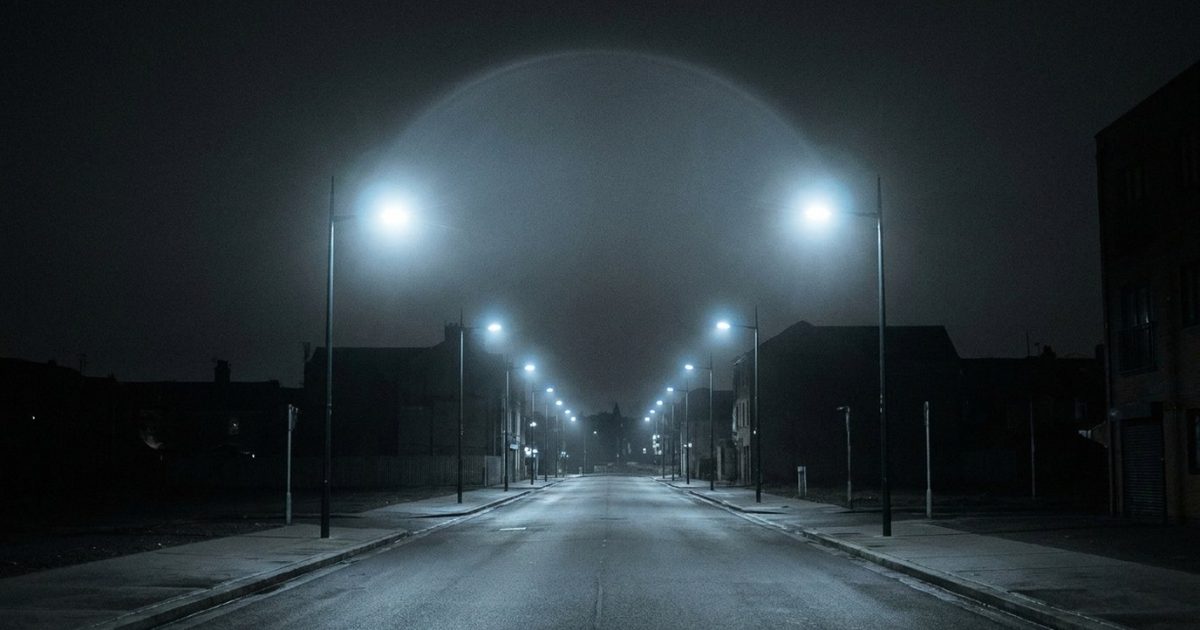
LEDs reduce energy per lumen by 60 to 80%. Global installed lumens rose anyway. Kyba et al. (2017, Science Advances 3:e1701528) tracked Earth’s artificially lit outdoor surface between 2012 and 2016 and found it expanding at 2.2% per year — during the peak of the LED transition. Kyba et al. (2023, Science 379:265–268) extended the analysis to 2022: sky brightness increasing at 9.6% per year, doubling every eight years. Portugal, following a nationally coordinated LED retrofit, saw approximately 120% increase in nighttime radiance in retrofitted zones (Kyba et al. 2017, supplementary data). That is not an efficiency failure. That is Jevons Paradox operating exactly as described in 1865. For the engineering and regulatory context that should accompany any LED deployment, see our guide on how to reduce light pollution.
William Stanley Jevons, 1865
The observation is 160 years old, and no energy technology has yet escaped it.
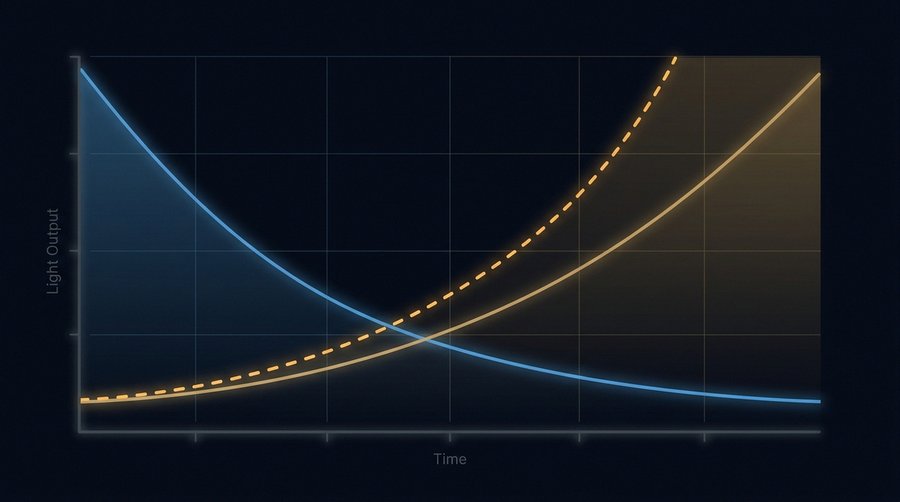
William Stanley Jevons published The Coal Question in 1865. The puzzle he examined: improved steam engine efficiency had not reduced England’s coal consumption. It had increased it. More efficient engines made coal-powered work cheaper per unit of output. That drove expansion — new industries, more machines, wider deployment — at a rate that outpaced the efficiency gain. His formulation has not been improved upon: “it is wholly a confusion of ideas to suppose that the economical use of fuel is equivalent to a diminished consumption. The very contrary is the truth.”
The mechanism is not complicated. Efficiency reduces the unit cost of a service. Lower unit cost expands demand. Expanded demand consumes more total resource than the efficiency saved. The paradox is that the more useful the efficiency gain — the more broadly the technology is adopted — the more powerful the rebound. Jevons documented it for coal. Economists have since documented it for fuel-efficient vehicles, household appliances, aviation, and industrial electricity. Lighting has reproduced it with particular fidelity, because light is cheap to produce, perceived as beneficial, and subject to almost no regulatory ceiling on quantity. LED is not an exception to this pattern. It is the most powerful instance yet — cost reduction steepest, deployment most universal, rebound correspondingly largest.
LED Transition in Europe: Cost Curve and Consequences
The cost collapse was real, the deployment was rational, and the unintended consequences were predictable — but went largely unregulated.
By 2010, municipal-grade LED street luminaires were beginning to achieve commercially viable payback periods against high-pressure sodium replacements. By 2015, LED had become the default choice in European public procurement. The International Energy Agency and Bloomberg NEF both document the LED price curve: cost per lumen of LED modules fell approximately 60 to 80% between 2010 and 2020 across the European market. Return on investment periods for LED street lighting retrofits dropped below five years in most member states — the threshold at which municipal finance departments approved capital expenditure without requiring central grants.
The EU Energy Efficiency Directive (2012/27/EU) reinforced this trajectory. It framed LED adoption as a primary tool for meeting public sector energy reduction targets. Municipalities replacing sodium lamps with LED counted the watt-for-watt reduction against their efficiency obligations. The directive did not require CCT limits. It did not require upward light ratio (ULR) caps. It did not require output documentation beyond watt reduction. LED was, in regulatory terms, categorically good — and more LED was more good.
The practical result: municipalities upgraded to LED and simultaneously expanded coverage. Previously unlit access roads received luminaires. Car parks kept lit past midnight. Lumen packages specified above the maintained minimum because the cost of over-specification had collapsed. In many retrofit programmes, the replacement luminaire was specified at a higher total luminous flux than the sodium original — a higher-output LED cost no more than a lower-output one with longer service intervals. For the specific regulatory gap that permitted this under full EN 13201 compliance — no CCT floor, no ULR cap — see the technical analysis in EN 13201 explained.
Portugal: The Starkest National Case
One country. National-scale LED retrofit. Approximately 120% increase in measured nighttime radiance.

Portugal executed one of the most comprehensive nationally coordinated LED retrofit programmes in the EU during the period Kyba et al. (2017, Science Advances 3:e1701528) examined via Visible Infrared Imaging Radiometer Suite Day/Night Band (VIIRS DNB) satellite data, covering 2012 to 2016. The supplementary country-by-country radiance analysis from that paper documents Portugal showing approximately 120% increase in total nighttime radiance in retrofit zones — the largest relative increase of any EU member state in the measurement period.
Three mechanisms drove this. First, lumen package: replacement luminaires were frequently specified at higher total luminous flux than the sodium originals. A programme justified on efficiency grounds installed more lumens per fixture than the fixtures being retired. Second, geographic expansion: retrofit programmes with newly attractive economics extended into zones previously unlit or operating at reduced hours. Coverage grew. Third, spectral shift: high-pressure sodium emits predominantly in the yellow-orange band (around 589 nm). Atmospheric Rayleigh scattering disperses shorter wavelengths preferentially. White LEDs at 4000 K emit substantially more energy in the blue-cyan range than sodium equivalents of the same total lumen output — a fixture-for-fixture exchange from sodium to white LED increases skyglow even at identical luminous flux.
The satellite measurement understates the actual impact. VIIRS DNB is a panchromatic sensor with spectral response from approximately 505 to 890 nm — largely blind to the blue-cyan peak of white LED emission below 500 nm. The sensor that measured Portugal’s +120% increase could not fully see the portion of LED output most responsible for the skyglow that human eyes and citizen science instruments register. The true figure is likely higher. For the VIIRS measurement gap in full, see skyglow: causes, reach, and why it stretches 200 km.
Why Satellites Underreport: The VIIRS Blind Spot
The sensor that documented Portugal’s +120% is simultaneously blind to the LED wavelengths most responsible for skyglow.
Kyba et al. (2023, Science 379:265–268) resolved a striking divergence. Globe at Night citizen-science data from 51,351 participants at 19,262 locations across 2011 to 2022 showed sky brightness increasing at 9.6% per year. VIIRS satellite data over the same period showed Europe’s artificial light emissions decreasing by approximately 0.3% per year. Same planet. Opposite trends.
Three factors explain the gap. VIIRS DNB spectral response runs from roughly 505 to 890 nm; white LED emission peaks in the 440 to 480 nm blue-cyan band — largely below the satellite’s detection floor. A city-wide switch from sodium to LED can register as a radiance decrease in satellite data while sky brightness as observed from the ground increases. Second, horizontal emission from façade lighting, illuminated advertising, and glazed interiors is invisible to a nadir-pointing sensor but drives skyglow directly. Third, Rayleigh scattering amplification: the blue-rich LED spectrum scatters more efficiently per lumen than the warm sodium spectrum. Citizen science sees what the satellite misses. For the full measurement methodology, see measuring light pollution: methods, data, and research tools.
What Actually Works: Counter-Jevons
Efficiency without output constraint is not a solution. It is the problem, deployed at scale.
The rebound is not inevitable. Jevons described a pattern conditional on unconstrained demand. Regulatory output caps break the condition. The evidence is France.
France’s Arrêté du 27 décembre 2018 is the only national outdoor lighting law in the EU combining CCT ceiling (3000 K for all newly acquired luminaires), numerical ULR cap (below 1% nominal, not to exceed 4% on-site), and enforceable curfews — commercial signage off by 1 a.m.; façade lighting extinguished by 1 a.m.; interior lighting switched off one hour after last occupation. The decree’s effect is documented: SDES (Ministère de la Transition Écologique) reports a 19% reduction in exposure to high-level light pollution across mainland France between 2014 and 2023. Full policy analysis in France’s 2018 lighting decree.
Four regulatory tools suppress the Jevons rebound:
Output caps: specify maximum total luminous flux per installation, not just minimum maintained luminance. This closes the over-specification default that drove Portugal’s radiance surge.
CCT floors: a 3000 K ceiling reduces atmospheric scattering contribution per lumen. Sanchez de Miguel et al. (2021, Remote Sensing 13:3313) documented the same spectral pattern globally: the shift from sodium to blue-rich LED drives skyglow increases disproportionate to the watt-equivalent change, confirmed across the India and China LED expansion programmes post-2015.
ULR limits: France’s 1% ULR cap is the only national numerical limit in EU law. EN 13201 — the continent’s harmonised road-lighting standard — has no ULR figure whatsoever. A fixture fully compliant with EN 13201 M1-class can simultaneously violate France’s ULR limit, CCT ceiling, and curfew requirements.
Post-installation monitoring: without sky brightness measurement after deployment, rebound proceeds undetected until the next Kyba survey documents it at satellite scale. Mandatory monitoring as a condition of planning consent is the tool no EU member state has yet made statutory. For the wildlife dimension of uncontrolled LED rollout, see dark infrastructure: the Dutch donkerte-netwerk and Natura 2000 corridors.
Global Implications: Not a European Problem
The Jevons rebound is documented wherever LED cost curves met unregulated deployment at scale.
Sanchez de Miguel et al. (2021, Remote Sensing 13:3313) analysed global LED rollout data using VIIRS and International Space Station photography. India and China’s post-2015 LED expansion programmes showed radiance and coverage patterns consistent with the European rebound — rapid reduction in watts per lumen, concurrent increase in total luminous flux, expansion of lit area. The WALO (World Atlas of Light Overconsumption) dataset shows the same directional trend across urban Southeast Asia, sub-Saharan Africa’s growing city centres, and Latin American metropolitan areas.
LED without output framework is not a solution to light pollution. It is the mechanism by which light pollution has been worsened while being reported as a sustainability achievement. A 2700 K warm-white LED with BUG U0 rating and a properly specified output cap is substantially better for sky brightness than the sodium lamp it replaces. The technology is neutral. The specification is not. For the ecological cost of this gap, see light pollution and wildlife: how ALAN destroys ecosystems and our detailed analysis of insects at streetlights.
Frequently Asked Questions
Why does LED lighting increase light pollution?
Because of the Jevons Paradox. Lower cost per lumen leads municipalities and developers to install more lumens — more fixtures, higher output packages, wider geographic coverage, longer operating hours — at the same or lower total energy budget. Portugal’s national LED retrofit produced approximately 120% increase in satellite-measured nighttime radiance (Kyba et al. 2017 supplementary data) while being reported as an energy-saving programme. Global sky brightness increased at 9.6% per year between 2011 and 2022 despite the LED transition (Kyba et al. 2023, Science 379). LED reduces light pollution only when deployed with output caps, CCT ceilings, ULR limits, and dimming mandates.
What is the Jevons Paradox in simple terms?
When a resource becomes cheaper to use per unit, total consumption rises rather than falls — because lower unit cost expands the scale of use faster than the efficiency saves. William Stanley Jevons observed this for coal and steam engines in 1865: more efficient engines increased England’s coal consumption. The same mechanism is documented for fuel-efficient vehicles, appliances, aviation, and LEDs. Making lighting cheaper does not reduce lighting. It expands it. Only regulatory output constraints prevent the rebound from dominating.
Did Portugal really increase its light pollution by 120%?
Approximately, yes. Kyba et al. (2017, Science Advances 3:e1701528) examined VIIRS DNB satellite data from 2012 to 2016 and documented Portugal showing approximately 120% increase in total nighttime radiance in retrofit zones — the largest relative increase among EU member states in the measurement period. The mechanisms: oversized lumen packages in replacement fixtures, geographic expansion of lit coverage, and the spectral shift from sodium to white LED (which scatters more efficiently in the atmosphere per lumen). VIIRS is partially blind to the blue LED spectrum, so the true sky brightness impact was likely higher than the recorded figure.
Can we have both LED efficiency and dark skies?
Yes — but only with regulatory output discipline applied at the same time. LED at 2700 K with BUG U0 rating, specified maximum luminous flux, and a dimming schedule after midnight is substantially better for sky brightness than the sodium lamp it replaces. France’s Arrêté du 27 décembre 2018 demonstrates this at national scale: CCT cap at 3000 K, ULR below 1%, enforceable curfews. SDES documents a 19% reduction in high-level light pollution exposure across mainland France since 2014. Efficiency inside a regulatory output framework — that is what counter-Jevons looks like.