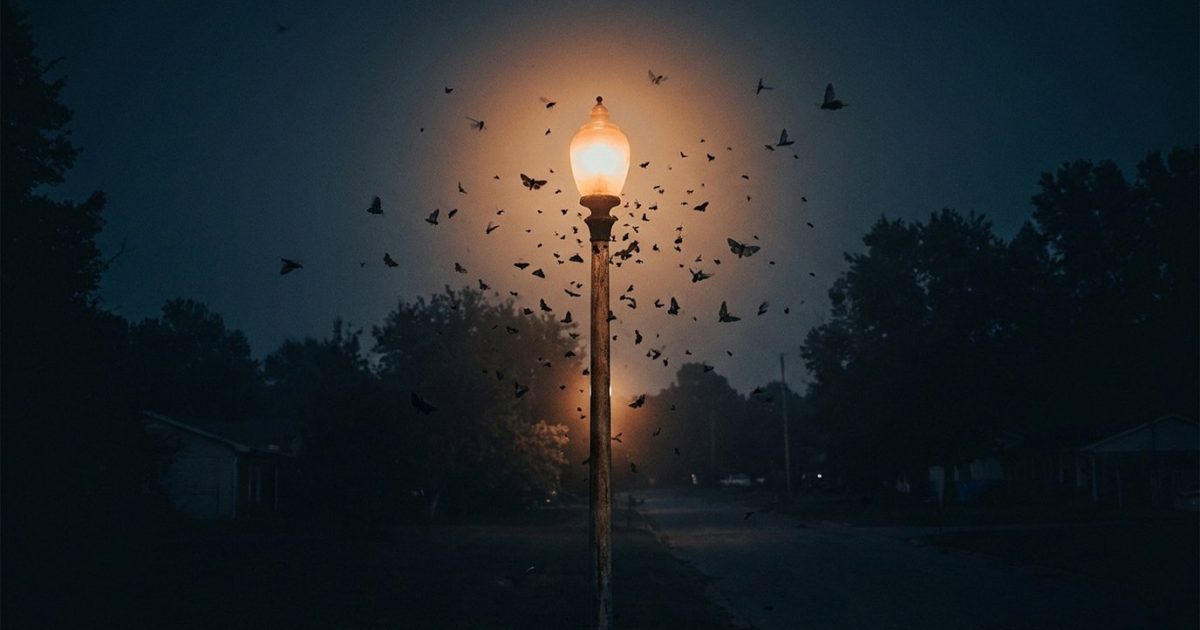
One streetlight. Several hundred insects per night — drawn in, exhausted circling, dead before dawn. Knop et al. (2017, Nature 548:206–209) quantified what happens at the ecosystem level: artificially lit Swiss meadows showed 62% fewer nocturnal pollinator visits and a 13% reduction in fruit set by season’s end. That loss did not stay confined to the night. Daytime pollination networks destabilised too. The cascade runs from a single lamp to the food web. For the broader ecology of how ALAN reshapes wildlife across taxa, see light pollution and wildlife: how ALAN destroys ecosystems.
The Fatal Attraction Mechanism — Phototaxis
Phototaxis is not a moth’s death wish. It is an ancient navigation system failing catastrophically in a world it was not built for.
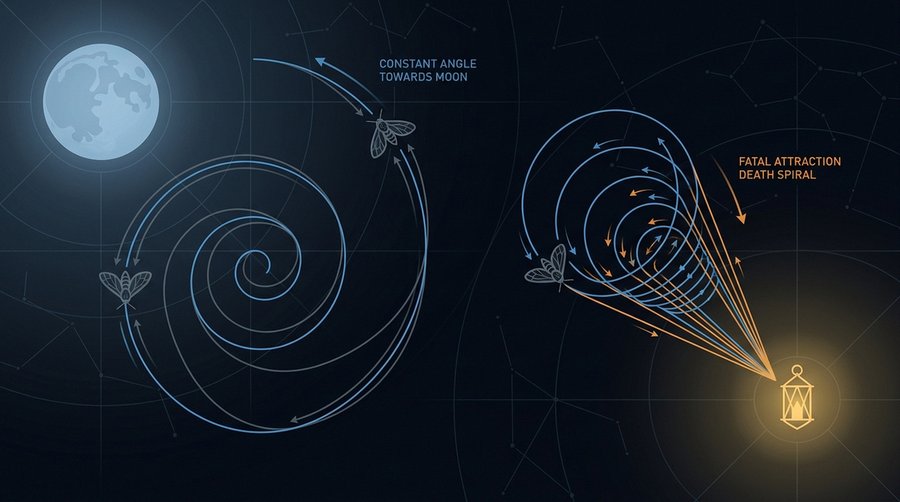
The behaviour has a name — transverse orientation — and an evolutionary logic. Nocturnal insects maintain a fixed angular relationship to a distant, effectively infinite light source: the moon, or the polarised sky. That fixed angle produces straight-line flight. A nearby point source — a streetlamp — is not at infinite distance. The insect attempting to maintain its fixed angle to a near source executes an inward logarithmic spiral. It is doing exactly what its nervous system was built to do. The environment changed. The behaviour did not.
Spectral composition governs how strongly this system fails. Insect compound eyes are maximally sensitive in the ultraviolet and short-wave blue range, typically 300–500 nm. Cool-white LEDs at 4,000 K and above produce substantial output in precisely this range. High-pressure sodium lamps, the warm-yellow predecessors now being replaced across Europe, were spectrally shifted away from peak insect sensitivity — an accidental protection that the LED transition is dismantling lamp by lamp. The research framework for understanding why wavelength matters is laid out in detail at ALAN — artificial light at night: the research framework.
One practical consequence: insects at a cool-white LED streetlight are preferentially sorted. Nocturnal species, UV-sensitive moths, and rare specialist pollinators are over-represented in what gets pulled in. The ecological community that persists around a lit site is already biased toward light-tolerant generalists. The specialists are the ones circling the lamp.
How Many Insects Die at a Single Light
Eisenbeis documented what actually happens at a rural German streetlamp across a summer night — and the numbers scale to a national catastrophe.
Gerhard Eisenbeis of the University of Mainz conducted field studies at streetlights in rural Germany that remain the foundational quantification for European insect mortality at artificial lights. Published as a chapter in Rich and Longcore’s Ecological Consequences of Artificial Night Lighting (Island Press, 2006), the work documented that a single stationary light source in a rural setting attracted and killed insects in the hundreds per night. Approximately one third of attracted insects die before morning — through exhaustion, thermal kill at the lamp, or predation by birds and bats that have learned to congregate at these artificial feeding stations.
The extrapolation is uncomfortable. Eisenbeis and Hänel (2009) estimated a conservative figure of approximately 100 billion insect deaths per summer for Germany’s road lighting network. That number requires a caveat: it rests on extrapolation from field counts to a national lamp inventory, and the uncertainty bounds are wide. Owens et al. (2020, Biological Conservation 241:108259) treated ALAN as a formally identified driver of insect decline — alongside habitat loss, pesticide use, and invasive species — and noted that the scale of insect mortality at artificial lights is systematically underestimated because monitoring infrastructure does not capture it. The insects dying at lamp posts are not in the field transects. They simply disappear.
The vacuum-cleaner effect compounds this. A single streetlight installed on the bank of a forested stream attracted and killed as many caddisflies as emerged from a 200-metre stretch of that stream across an entire season (Eisenbeis 2006). Lines of streetlights along roadsides function as continuous extraction devices for insect biomass from adjacent habitat — pulling emerging adults away from the zones where they would otherwise disperse, mate, and complete their life cycles.
The Pollination Crisis — Knop 2017
Nocturnal pollinators are not redundant backup for bees. They are a distinct and irreplaceable layer of the pollination network.

This is the finding that the insect-decline literature had been missing. Knop et al. (2017, Nature 548:206–209) ran a controlled field experiment across Swiss alpine meadows — some exposed to street-lamp-equivalent ALAN, some maintained in natural darkness. Nocturnal pollinator visits to flowering plants fell 62% in the lit plots. The fruit-set result was the surprise: by season’s end, fruit and seed production in the lit plots was down 13%.
Why does a nighttime effect produce a daytime result? Nocturnal and diurnal pollinators are not substitutes but complements. Specific plant-pollinator partnerships operate exclusively after dark — certain moth-flower relationships, beetle visitors, nocturnal hoverflies. When these visitors disappear from lit plots, the plants enter the day already underserved. The daytime pollinator community, visiting the same plants, cannot fully compensate for a disrupted first-contact rate. The 13% fruit-set reduction accumulated from a 62% nocturnal deficit. The cascade is real, it is measured, and it runs in both directions across the diel cycle.
The agricultural implication is underacknowledged. Supplementary data from the Knop study suggests that 20 to 30% of insect-pollinated crop species receive meaningful nocturnal pollination visits. Standard pollinator monitoring operates during daylight hours and does not detect this layer. The nocturnal pollination crisis is structurally invisible to the systems designed to document it.
Firefly Populations in Europe
Glow-worms cannot mate where it is not dark enough to see each other. That threshold is lower than a suburban street.
The common glow-worm (Lampyris noctiluca) operates on a tight lux budget. Flightless females emit a yellowish-green bioluminescent signal — peak emission around 550 nm — to attract flying males scanning overhead. Males detect this signal against a dark background. Research on ALAN effects on Lampyris noctiluca mate detection has found that males are significantly less likely to locate even the brightest imitation females at ambient light levels above approximately 7 lux — a level routinely exceeded on standard suburban footpaths. Females exposed to ALAN have been observed glowing for up to 15 consecutive nights without attracting a mate. Given that the female’s total reproductive window spans only a few weeks, ALAN exposure frequently means no mating at all.
Lewis et al. (2020, BioScience 70:157–167) surveyed firefly extinction threats globally and identified ALAN as the second most serious threat to firefly populations, after habitat loss and above pesticide use. In Europe, Lampyris noctiluca and related species including Lamprohiza splendidula are declining across their continental range. The Balkan peninsula and Slovenia retain the strongest populations; Western and Central European populations face pressure from ALAN combined with habitat loss and pesticide reduction in larval prey. The transition from low-pressure sodium streetlights — already relatively distant from peak male visual sensitivity — to broad-spectrum white LEDs has accelerated mate-signal interference in populations near road corridors.
Bioluminescence as a mating system has no redundancy. No acoustic backup, no chemical signal that substitutes when light fails. When the background is too bright, the signal disappears. The population does not adapt. It declines.
Spectral Solutions — Why Amber and Red Work
Insect eyes are not human eyes. Designing for human visual comfort while ignoring insect spectral sensitivity is where most LED specifications fail.
Longcore et al. (2015, Philosophical Transactions of the Royal Society B 370:20140125) systematically tested customised LED spectra against insect attraction curves for moths and honeybees and found that tuning LED output away from the UV and blue-green range — toward amber wavelengths above 590 nm — dramatically reduced arthropod attraction at equivalent lumen output. Amber LEDs at 2,200 K produce minimal output in the 300–500 nm range where insect sensitivity peaks. Field comparisons of amber-filtered LEDs against standard white LEDs have found reductions in attracted insect individuals of approximately 60%, with the largest reductions among ecologically sensitive groups: specialist moths, beetles, and nocturnal pollinators.
The 590 nm threshold is not arbitrary. It corresponds to the steep decline in the insect spectral sensitivity curve. The IDA and IUCN recommend CCT ≤3,000 K for lighting near sensitive habitats as a minimum; CCT ≤2,200 K with full-spectrum amber filtration is the recommended standard for Natura 2000 periphery and nature reserve buffer zones. This is already being implemented in the Netherlands’ Donkerte van de Wadden programme — protecting darkness in the Wadden Sea UNESCO World Heritage area — which applies amber lighting along road corridors adjacent to intertidal habitat. France’s 2018 lighting decree establishes spectral controls for sensitive zones, discussed at France’s 2018 lighting decree: what it requires and what it leaves out. For the EN 13201 standard’s blind spots on CCT, see EN 13201 explained: the road lighting standard that ignores ecology.
The technical knowledge exists. The question is procurement: most European municipal lighting tenders specify lumens and energy consumption. CCT limits and spectral filtration requirements are absent. The insect toll is not in the tender document.
What Cities Can Do
The tools exist. Full cutoff, amber CCT, dimming, and dark corridors — none of this requires new technology. It requires different specifications.
Four interventions have documented effectiveness for reducing insect mortality and protecting nocturnal pollinators at the municipal scale. First: full-cutoff fixtures that direct light downward only, eliminating lateral and upward emission that extends the lethal attraction zone beyond the immediate lamp area. Second: CCT ≤3,000 K for all residential and green-corridor lighting, with ≤2,200 K amber specified wherever lighting abuts Natura 2000 boundaries or designated ecological corridors. Third: adaptive dimming — reducing output by 50–80% between midnight and 5 a.m., when human traffic is minimal and insect activity is highest. Fourth: strategic non-illumination of habitat-adjacent road sections, creating functional dark corridors that allow insect dispersal and pollinator movement between habitat patches — the dark infrastructure principle applied to urban entomology, covered at dark infrastructure: the Dutch Donkerte-Netwerk and Natura 2000 corridors.
The EU Habitats Directive 92/43/EEC lists numerous butterfly species in Annex IV — including Maculinea blues, large copper (Lycaena dispar), and Apollo (Parnassius apollo) — affording them the highest individual protection. ALAN demonstrably disrupts the behaviour of these species at intensities common in peri-urban zones. The legal implication — that lighting specifications near Annex IV Lepidoptera sites should be constrained by existing Directive obligations — has not been drawn by any competent authority. The protection is on paper. The lamps are on the ground.
The insect monitoring community and the lighting industry operate in entirely separate regulatory silos. Entomologists document the decline. Engineers specify the lamps. Until CCT limits and spectral filtration appear as standard requirements in EU public lighting tenders — not optional sustainability criteria — the lamp posts will keep killing. For the sibling piece on how ALAN affects birds in the same Silo 2, see light pollution and birds: migration, collision, and the Shell L15 experiment.
Frequently Asked Questions
How many insects die at a single streetlight each night?
Field counts by Eisenbeis (2006) in rural Germany documented hundreds of insects killed per night at individual streetlights, with approximately one third dying before morning through exhaustion, thermal kill, or predation. Extrapolating to Germany’s road lighting network, Eisenbeis and Hänel (2009) estimated a conservative figure of approximately 100 billion insect deaths per summer — a number with wide uncertainty bounds but consistent with the mechanistic evidence.
Are LED streetlights worse or better for insects than sodium lamps?
Worse, in most current deployments. High-pressure sodium lamps emitted primarily in the yellow-orange range (peak ~589 nm), relatively distant from peak insect UV sensitivity. The transition to broad-spectrum white LEDs at 4,000–6,500 K has shifted output directly into the blue-UV range where insects are maximally attracted. Amber LEDs at ≤2,200 K with spectral filtration can outperform sodium on ecological grounds — but most European municipalities replaced sodium with cool-white LEDs, making the LED transition net negative for insect communities near street lighting.
Can amber lighting really protect pollinators?
Yes. Longcore et al. (2015, Philosophical Transactions of the Royal Society B) showed LED lamps tuned away from UV and blue wavelengths reduce arthropod attraction substantially at equivalent lumen output. Field comparisons found approximately 60% fewer insect individuals at amber-filtered lamps compared to white LED equivalents. The protection is not absolute, but the reduction across ecologically sensitive moth, beetle, and pollinator communities is reproducible.
Does turning off lights at night save insects?
Immediately. Insect activity around a de-lit streetlight recovers within hours of lamp-off. Adaptive dimming to near-zero between midnight and 5 a.m. achieves similar results during peak insect activity with minimal impact on human safety. The nocturnal pollination data from Knop et al. (2017) implies that even partial restoration of dark periods in agricultural landscapes would produce measurable gains in fruit set within a single growing season.