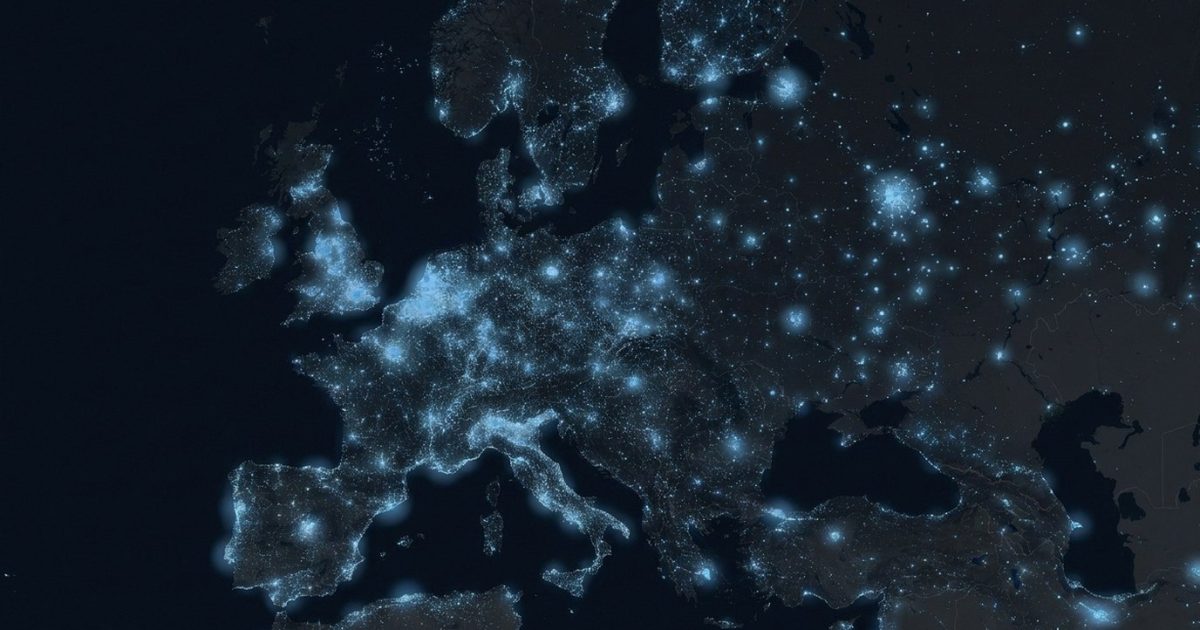
ALAN — artificial light at night — is the scientific term for every photon emitted by human infrastructure after dark, regardless of whether it serves a useful purpose. The distinction from light pollution is not pedantic. It is methodological. This guide traces how the term emerged from a fragmented pre-2000 literature, how COST Action ES1204 LoNNe consolidated it into a shared European research vocabulary, why the difference between ALAN and light pollution matters for experiment design, and where the field is pushing next. For the foundational overview of what light pollution is and how it affects ecosystems and human health, start with our pillar article on light pollution: science, ecology, and solutions.
From “Light Pollution” to ALAN
Before ALAN became the research standard, the field had no shared variable. Astronomers, ecologists, and health researchers were measuring the same phenomenon with incompatible vocabularies.
The phrase light pollution entered scientific use in the 1970s, primarily through the astronomical community. The concern was straightforward: artificial illumination from cities was degrading the quality of telescope sites. Astronomers quantified sky brightness in magnitudes per square arcsecond, wrote papers about observatory site selection, and lobbied for lighting ordinances near major observatories. The discourse was almost entirely instrumental — light pollution was a problem for optical astronomy, measured in those terms, addressed in those terms.
The ecological and health research communities arrived later. By the early 2000s it was clear that nocturnal species were responding to artificial light at scales far beyond telescope sites — migrating birds, sea turtle hatchlings, nocturnal insects. But ecologists lacked a precise measurable quantity. Light pollution as used by astronomers was a sky-brightness concept. What an ecologist needed was a quantity that described the light environment experienced by an animal at ground level, in a meadow, at a forest edge, or in a bedroom. Not sky brightness. Irradiance, spectral composition, duration, and spatial extent.
The formal first use of ecological light pollution as a defined scientific concept appeared in Longcore and Rich (2004), published in Frontiers in Ecology and the Environment (vol. 2, pp. 191–198). The paper explicitly distinguished the astronomical sky-brightness problem from the broader ecological problem of altered light regimes across terrestrial and aquatic ecosystems — ecosystems that had no particular relationship to telescope fields of view. It was the first systematic argument that artificial light at night constituted an environmental stressor in its own right, decoupled from the astronomy framing that had dominated the prior three decades. Six years later, Hoelker et al. (2010), published in Trends in Ecology and Evolution (vol. 25, pp. 681–682), made the biodiversity case explicit: approximately 30% of vertebrates and over 60% of invertebrates are primarily nocturnal, making ALAN a threat to the majority of animal species by lifestyle category, not merely a subset. The IGB Berlin group — Franz Hoelker chief among them — gave the field the scope argument it had been assembling piecemeal.
COST Action ES1204 LoNNe (Loss of the Night Network), running from 2013 to 2017 across 28 participating countries, formalised the consolidation. By naming its interdisciplinary conference series Artificial Light at Night (ALAN) and building an ALAN literature database, LoNNe converted a descriptive phrase into an operational term shared across ecology, chronobiology, lighting engineering, and atmospheric physics. The same word now meant the same measurable quantity to the road-lighting engineer in the Netherlands and the moth ecologist in Switzerland. That terminological convergence is the quiet administrative achievement behind everything that followed.
Why the Distinction Matters Scientifically
ALAN is descriptive. Light pollution is normative. For clean experimental science, you need the former.
The distinction is not semantic hairsplitting. It has consequences for study design, regulatory language, and public communication — and conflating the two creates problems in all three.
Light pollution implies harm. It is a pollution frame: something being added to an environment where it causes damage. That framing is accurate in many contexts — a street lamp shining into a bat roost corridor is, by any reasonable standard, causing ecological harm. But a well-shielded, warm-spectrum LED that illuminates a road crossing with no upward spill, no light trespass into adjacent habitat, and no measurable sky-brightness contribution at a nearby monitoring site is still ALAN. Every photon emitted after dark by human infrastructure is ALAN, definitionally. Whether it constitutes pollution is a separate empirical question, one that requires measurement.
This distinction enables dose-response research. If you want to know at what irradiance threshold melatonin suppression becomes clinically significant, you need to measure ALAN as a continuous variable across a range of intensities — not classify all outdoor lighting as pollution and all non-lighting as absence of pollution. The Brainard et al. (2001) action spectrum study that established melanopsin sensitivity at 480 nm could not have been conducted with a binary pollution/no-pollution variable. It required precise photometric and radiometric measurement of ALAN across a range of wavelengths and intensities. The conceptual framework enabled the experimental design.
Confound control is the second payoff. In ecological field studies, ALAN co-varies with urbanisation, traffic, noise, air pollution, and heat island effects. Teasing apart the specific contribution of light from the full urban stressor package requires treating ALAN as a precisely measured independent variable with quantified spectral composition, angular distribution, and timing. Studies that use “light pollution” as a binary exposure variable — site is urban vs. rural — cannot isolate the light effect from the urbanisation effect. Studies that measure ALAN as lux, as melanopic irradiance, or as sky brightness in mag/arcsec² can. The terminology signals the methodology. And the methodology determines what the results actually mean.
Regulators, finally, need ALAN rather than light pollution because they write thresholds into law. A municipal lighting ordinance cannot enforce “no light pollution” — the term has no operational definition suitable for a compliance test. It can enforce “no more than 1 cd/m² of luminous intensity above the horizontal plane within 500 metres of a Natura 2000 boundary”. That is an ALAN specification. The normative concept motivates the regulation; the descriptive concept enables it.
The Five Dimensions of ALAN
ALAN manifests as five distinct physical phenomena — skyglow, glare, light trespass, clutter, and over-illumination. The term ALAN holds them together as a single research variable.
One of ALAN’s analytic strengths is that it encompasses what the light pollution literature traditionally treats as separate categories. Skyglow — the diffuse brightening of the night sky above inhabited areas from scattered light — is the form most visible from distance and the one that most concerned early astronomical researchers. It extends measurably 200 km from large urban centres under clear atmospheric conditions. Glare is the discomfort or vision impairment caused by excessive luminance in the direct field of view; light trespass is light falling where it is neither needed nor wanted. Clutter describes the visual confusion of excessive grouped sources — the dominant form in commercial zones. Over-illumination is simply the deployment of more light than the task requires.
Each of these has different sources, measurement units, ecological consequences, and policy remedies. Skyglow is measured in mag/arcsec² or in the artificial-to-natural luminance ratio (ALR); glare in disability glare threshold increment (TI) or unified glare rating (UGR); light trespass in lux at a specific receptor point. For a deep technical treatment of skyglow specifically — its atmospheric propagation, spectral composition, and the 200 km reach — see our companion article on skyglow: causes, reach, and why it stretches 200 km. And for the newest category that fits uncomfortably into the five-form taxonomy, see our article on satellite constellations and light pollution: Starlink, Kessler, and the new sky.
The ALAN framework matters here because it allows researchers to describe a study’s light exposure in terms that translate across all five forms. A field ecologist monitoring bat corridor use reports lux at the corridor surface. A health epidemiologist reports outdoor ALAN in nW/cm²/sr from satellite radiance maps. An astronomer reports SQM readings in mag/arcsec². These are different quantities measuring different physical things — but they are all operationalisations of the same concept. ALAN is the umbrella that makes them comparable.
How ALAN Is Measured — and Where SQM Alone Falls Short
ALAN research uses four instrument classes, each capturing a different slice of the problem. No single device tells the whole story.
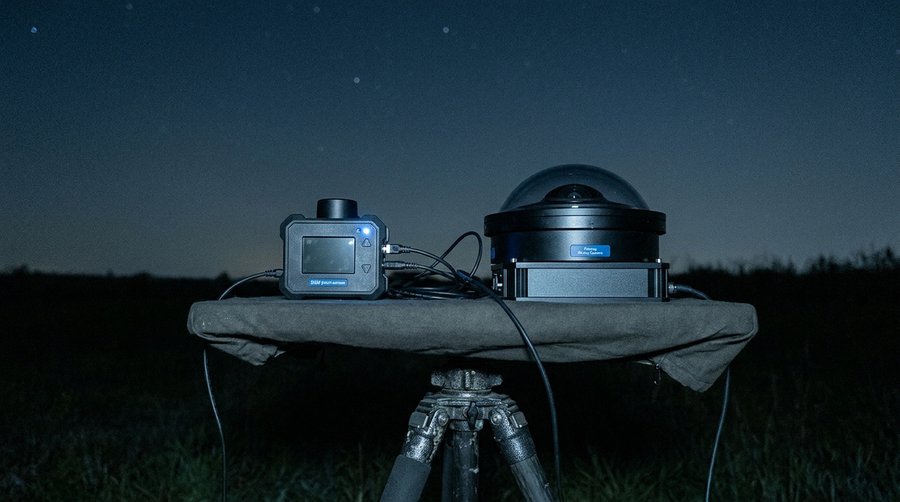
Measurement is where the ALAN framework gets complicated, because the phenomenon is spectrally, spatially, and temporally complex in ways that no single instrument captures fully. For a comprehensive treatment of measurement methods, see our article on measuring light pollution: methods, data, and research tools and the SQM buyer’s guide. Here the focus is on what makes ALAN measurement different from simple sky-brightness monitoring.
The Sky Quality Meter (SQM), produced by Unihedron, is the most widely deployed field instrument for ALAN monitoring. It reports zenith sky brightness in mag/arcsec² and costs around EUR 100–150. LoNNe intercomparison campaigns standardised on the SQM-L variant (20° FWHM acceptance angle) for research-grade work. The limitation: the SQM filter is centred near 550 nm, calibrated for the sodium-vapour lamp era. White LED sources emit a substantial blue component below 505 nm that the SQM cannot detect. An LED-retrofitted street undergoing transition from high-pressure sodium may show little change in SQM readings while adding considerable blue irradiance to the local environment — blue irradiance that suppresses melatonin in vertebrates, attracts phototactic insects, and contributes to sky brightness through Rayleigh scattering more efficiently than longer-wavelength light.
Hänel et al. (2018), published in the Journal of Quantitative Spectroscopy and Radiative Transfer (vol. 205, pp. 278–290), benchmarked five instrument classes at LoNNe-affiliated field sites and concluded that calibrated fisheye DSLR cameras with characterised spectral response provide the best balance of spatial coverage and spectral information. A single 180° fisheye exposure yields sky brightness across the full hemisphere in three colour channels — capturing the blue component the SQM misses. All-sky cameras, calibrated spectroradiometers, VIIRS Day/Night Band satellite data, and the SQM each contribute something the others cannot; LoNNe’s intercomparison design was specifically built around this multi-instrument logic.
A distinct ALAN measurement challenge is indoor exposure. Circadian health research requires measuring the light environment at the retina of a subject sleeping in an urban bedroom — not the sky brightness outside. Melanopic irradiance (in the CIE S 026 framework, expressed as melanopic equivalent daylight illuminance, m-EDI) at a specified receptor height is the relevant quantity. This is an ALAN measurement, but it has no satellite analogue and no meaningful SQM reading. The research that linked ALAN to melatonin suppression thresholds (Brainard et al. 2001; Cajochen’s Basel group across multiple studies) used controlled radiometric exposure rigs, not field photometers. Indoor and outdoor ALAN share a theoretical framework but diverge completely in methodology.
ALAN in the Research Literature
Three disciplines converged on the same measurement problem from different directions — and the ALAN framework was the point of convergence.
The ecological literature’s most-cited ALAN study remains Knop et al. (2017), published in Nature. Street-lamp equivalent ALAN reduced nocturnal pollinator visits to Swiss meadow plants by 62%, with a 13% reduction in fruit set by season’s end. The finding mattered not only because of its magnitude but because it demonstrated that ALAN’s ecological consequences were not confined to the lit area: the disruption to nocturnal pollination networks propagated into the daytime pollinator community, destabilising relationships that had no direct ALAN exposure. The chain connects a lamp specification to an agricultural ecosystem output — exactly the kind of systems-level consequence the early Longcore and Rich framing had predicted but not yet measured. For the full ecological picture, see our pillar on light pollution and wildlife.
The health literature’s ALAN thread runs through a different set of measurements entirely: retinal irradiance, melatonin suppression thresholds, and epidemiological cohort data on circadian disruption. The IARC Group 2A classification of night-shift work as a probable carcinogen (2007, retained 2019 in Monograph 124) draws on the same ALAN concept — measured as occupational light exposure at the eye during night hours. Schernhammer and colleagues’ Nurses’ Health Study cohorts quantified exposure in years of rotating night shifts, a rough but epidemiologically tractable proxy for cumulative ALAN dose. Connecting the occupational exposure literature to the street-lighting literature requires the shared ALAN variable that both describe in incompatible units. For the full mechanistic account of how artificial light at night disrupts human biology, see our article on light pollution and human health.
The atmospheric measurement literature contributed the satellite-scale view. Kyba et al. (2017, Science Advances) tracked Earth’s lit surface area growing at 2.2% per year between 2012 and 2016 using VIIRS Day/Night Band data. Kyba et al. (2023, Science 379: 265–268) then showed, via Globe at Night citizen-science stellar-visibility data from 51,351 observations at 19,262 locations, that sky brightness was increasing at 9.6% per year over 2011– 2022 — a figure far larger than the satellite measurement because ground-based human vision can detect the blue wavelengths that VIIRS cannot. The divergence between the two measurements is a direct consequence of the LED transition’s spectral shift: ALAN grew faster than the satellite tracking it could see. The LoNNe framework — which had built multi-spectral measurement into its intercomparison design specifically because single-band instruments miss blue light — had anticipated this problem before the satellite data confirmed it.
Where ALAN Research Is Going
Sub-lux sensitivity, multi-spectral satellites, epigenetic transmission, and the uncharted territory below surface level — the next phase of ALAN research is already running.
The frontier of ALAN research is moving in several directions simultaneously, and the shared terminology that LoNNe helped establish is what makes cross-disciplinary exchange possible as it does.
Sub-lux ecology is perhaps the most important current frontier. Most ALAN thresholds documented in the literature — the 1 lux disorientation threshold for sea turtle hatchlings, the 0.3 lux singing-time advance in urban blackbirds — were established at light intensities that correspond to fairly proximate lamp positions. The question of ecological effects at 0.01 lux — the diffuse skyglow levels found in dark rural areas, well below what any instrument was measuring systematically until recently — is now being addressed with sensitive calibrated cameras capable of measuring sky brightness at those levels. If the dose-response curve continues below 0.1 lux, the population of unlit landscapes affected by ALAN expands dramatically.
Below-ground ALAN effects represent a second frontier. Research from IGB Berlin on earthworms (Lumbricus terrestris) showed suppressed surface activity and foraging at 10 lux — with direct consequences for soil carbon cycling and structure formation. The connection between ALAN-reduced earthworm activity and the expansion of invasive ragweed, documented in a 2024 BMC Ecology and Evolution study, illustrates how a lighting specification can propagate through soil ecology into a public health outcome. For the broader ecological context on underground ALAN effects, including soil organisms and plant phenology, see our wildlife and ecosystems article.
Satellite constellation ALAN is the newest structural challenge. Starlink and competing large constellations add a diffuse, variable component to the night sky that is not emitted from fixed ground-based infrastructure and cannot be regulated by municipal lighting ordinances. The spectral and angular characteristics of satellite-reflected sunlight during twilight and pre-dawn hours are being characterised as the constellation count grows. This is not a solved problem, and it is not analogous to any previous ALAN source. For a detailed treatment, see our article on satellite constellations and light pollution.
Hänel et al. 2018’s multi-spectral camera methodology points toward the next generation of ALAN monitoring networks: automated, spectrally resolved, hemispheric, capable of tracking the LED transition’s blue shift in real time. Combined with citizen-science density data from Globe at Night — which Kyba 2023 demonstrated can produce publishable trend data at scale — the measurement infrastructure for the next phase of ALAN research is more capable than anything LoNNe had available in 2013. What it still lacks is the regulatory framework that would convert measurement into enforceable standards. That is the next chapter. Whether EU policy writes it depends in large part on whether the scientific consensus built around ALAN as a shared term translates into shared political will. On the evidence so far, that translation is slow. The research is not.
Frequently Asked Questions
Is ALAN the same as light pollution?
Not exactly. ALAN — artificial light at night — is every photon emitted by human infrastructure after dark, regardless of effect. Light pollution is the subset of ALAN that causes measurable harm: spilling into unintended areas, contributing to skyglow, disrupting circadian biology, or impairing ecosystems. A well-shielded, warm-spectrum LED at appropriate intensity is ALAN. It becomes light pollution when it crosses a threshold of harm. Researchers prefer ALAN because it is quantifiable; regulators use light pollution because it implies an obligation to act.
Who first defined ALAN as a scientific term?
The phrase artificial light at night appears in earlier ecological literature, but the first systematic definition of ALAN as a distinct research concept — separate from the astronomical sky-brightness framing — is generally attributed to Longcore and Rich (2004) in Frontiers in Ecology and the Environment, which introduced the term ecological light pollution and framed ALAN as an environmental stressor affecting terrestrial and aquatic ecosystems. Hoelker et al. (2010) in Trends in Ecology and Evolution extended the biodiversity argument. COST Action ES1204 LoNNe (2013–2017) formalised the term across disciplines by naming its conference series and literature database around ALAN.
How does ALAN differ from skyglow?
Skyglow is one of ALAN’s five manifestations — the diffuse brightening of the night sky above populated areas caused by light scattering off atmospheric particles. ALAN is the broader category that includes skyglow, glare, light trespass, clutter, and over-illumination. You can measure ALAN at ground level in a bat roost corridor at 0.3 lux without any measurable skyglow contribution from that specific fixture. Skyglow is cumulative and regional; ALAN is local and source-specific. Both are measured in different units for different purposes.
Where can I find ALAN data for my country?
Several sources provide country-level ALAN data. The World Atlas of Artificial Night Sky Brightness (Falchi et al. 2016, Science Advances) provides continent-scale sky brightness maps derived from VIIRS satellite data calibrated against 35,000 ground measurements — available at lightpollutionmap.info. Kyba et al. 2017 and 2023 provide trend data. Globe at Night (globeatnight.org) offers citizen-science observations searchable by location. National SQM monitoring networks, many established by LoNNe alumni, provide finer-grained ground data in several EU countries including Germany, Spain, Italy, and the Czech Republic. For the measurement methodology behind these data sources, see our research methods article.