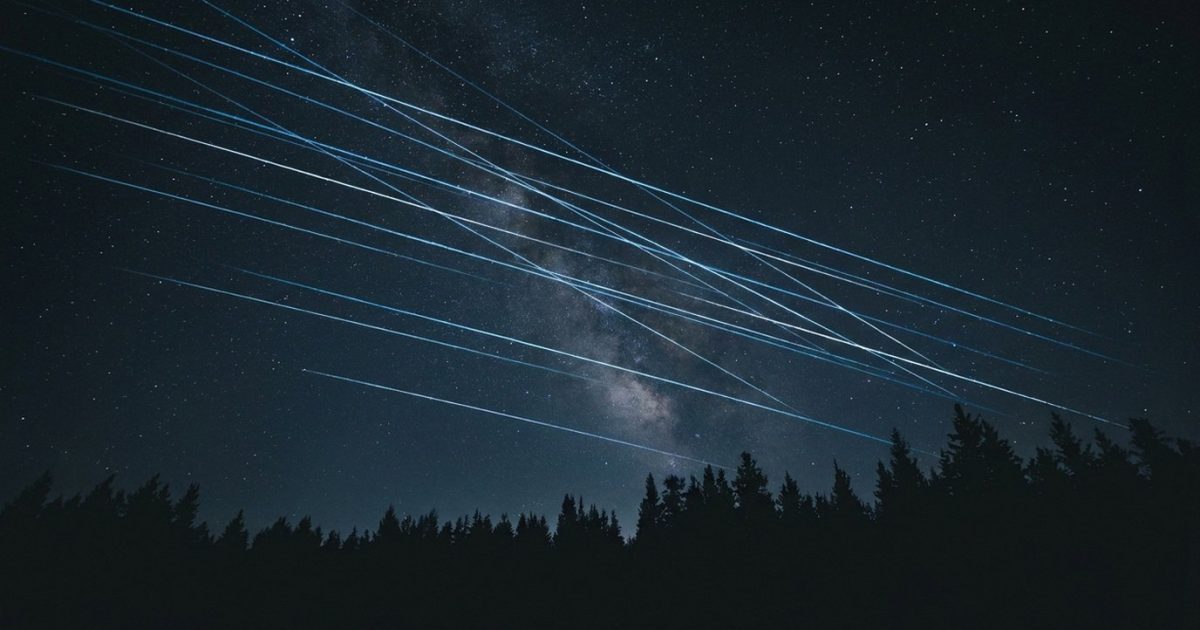
By early 2025, SpaceX had more than 6,000 Starlink satellites in orbit — a single company’s constellation exceeding the entire pre-2019 population of active spacecraft. Add Eutelsat OneWeb’s 654 operational satellites and Amazon’s growing Kuiper network, and the number of reflective objects crossing the night sky during twilight has transformed from an astronomical curiosity into a documented and unregulated source of ALAN: artificial light at night. The International Astronomical Union established the Centre for the Protection of the Dark and Quiet Sky from Satellite Constellation Interference (CPS) in April 2022. Four years on, satellite brightness remains entirely voluntary to mitigate. For the foundational context on how light pollution operates and what it costs ecosystems and human health, see our overview at light pollution: science, ecology, and solutions.
How Many Satellites Are Up There Now
The active satellite population crossed a qualitative threshold in 2023 and has not stopped growing.
Numbers move fast in this space. As of early 2025, Jonathan McDowell’s space-track database at planet4589.org — the most widely cited independent catalogue — counted approximately 6,000 to 6,400 active Starlink satellites in low Earth orbit (LEO), with total launched satellites well above 7,000. The operational figure matters more than the launched total: satellites that have manoeuvred to their working orbital shells are the ones visible during twilight, reflecting sunlight toward the ground while Earth’s shadow has not yet reached them.
Eutelsat’s OneWeb network reached its planned Gen 1 constellation of approximately 648 to 654 operational satellites in 2024. Amazon’s Project Kuiper — rebranded as Amazon Leo in November 2025 — had 239 satellites in orbit as of April 2026, with plans for 3,236 total and a regulatory deadline requiring half deployed by July 2026. China’s Guowang constellation, operated by SatNet, has FCC-equivalent filings for 12,992 satellites in LEO; operational deployment remains in early stages. EU’s IRIS² programme — 264 LEO satellites plus 18 in medium Earth orbit — signed its concession contract in late 2024 with launches projected for 2029.
The planned figures are the more alarming lens. If all currently licensed constellations deploy fully: SpaceX Starlink Gen2 alone has FCC approval for 7,500 of a filed 29,988. Amazon Leo 3,236. OneWeb Gen 2 expanding with a further 340 Airbus-built satellites contracted in January 2026. Guowang 12,992. Against the backdrop of roughly 10,000 active satellites across all operators at the time of writing, these expansions would raise the orbital population by an order of magnitude within a decade. Lawler, Boley, and Rein (2022, Astronomical Journal 163:21) modelled the impact of approximately 65,000 satellites across filed constellations and found that latitudes near 50° north and south — covering most of Europe — would experience the worst observable light pollution from megaconstellations. Stockholm sits at 59°N. London at 51°N. Paris at 48°N. The geography is not neutral.
Why Satellites Are an ALAN Problem
Satellites are an ALAN source not because they emit light but because they reflect it — and reflection geometry ensures maximum brightness at exactly the time most humans are outdoors.
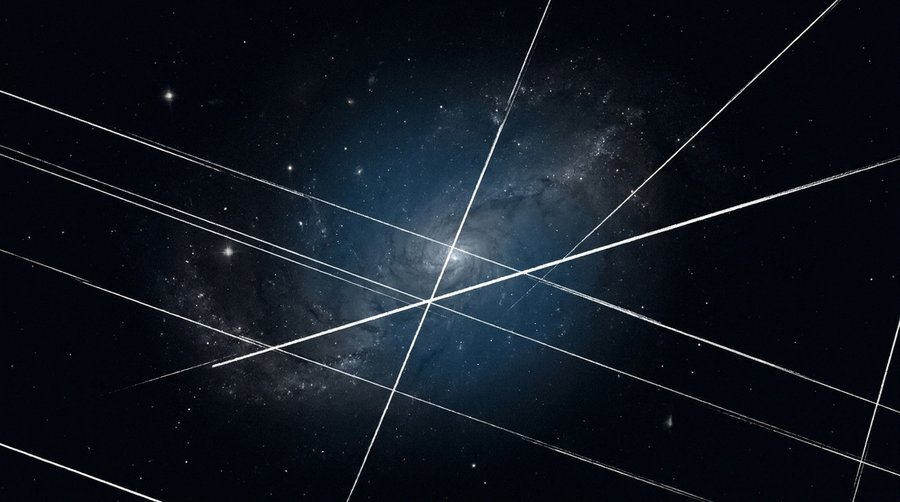
The physics is straightforward. Satellites in low Earth orbit travel at roughly 7.5 km/s and orbit between 340 and 600 km altitude for most major constellations. During the hours immediately after sunset and before dawn — when the observer’s ground is in shadow but the satellite is still in sunlight — the spacecraft acts as a mirror, reflecting solar energy directly toward the ground. This is the twilight zone of maximum satellite visibility. The lower the orbital altitude, the faster the satellite drops into Earth’s shadow, limiting the window. But in the summer months at temperate latitudes, astronomical twilight persists for hours, and the satellite visibility window extends deep into what should be dark observing time.
The visibility at zenith for a standard Starlink V1 satellite was measured at approximately V magnitude 3 to 4 — roughly as bright as a middle Pleiades star, easily visible to the naked eye. Mallama (2021, arXiv:2101.00374) measured the mean apparent V magnitude of VisorSat-design Starlinks at 5.92 at a standardised 550 km range, approximately 1.3 magnitudes fainter than the unmodified design. Original Starlinks were routinely 4.7 magnitude — approaching naked-eye conspicuousness even at operating altitude. The V2 Mini generation, introduced from 2023, performs substantially better — near but not consistently below the V magnitude 7 threshold the IAU CPS identified as the minimum for large survey instruments .
The streak problem for astronomy is distinct from the naked-eye visibility problem. Vera C. Rubin Observatory’s Legacy Survey of Space and Time (LSST) uses a 8.4 m primary mirror to survey the entire southern sky every few nights. Tyson et al. (2020, modelling ~40,000 LEO satellites) found approximately 10% of all LSST exposures would contain at least one satellite trail — rising to the majority during twilight periods. A satellite trail saturates pixels and bleeds charge into adjacent rows — photometric data for any source in the bleed path is lost. Recovery algorithms exist but are incomplete.
Barentine et al. (2023, Nature Astronomy) quantified the aggregate diffuse contribution. By 2030, intact satellites would add approximately 1% to zenithal sky brightness — modest alone. Debris adds the rest: the combined sky could be 12% brighter than the natural dark-sky reference by 2030. For Rubin Observatory in Chile, 7.5% brighter means nearly a year of additional survey time. For dark sky reserves — measured by the same SQM-based methodology explained in measuring light pollution: methods, data, and research tools — it means baseline readings that were once achievable may no longer be, and the certified network across Europe described in dark sky places in Europe faces a threat from above that lighting ordinances cannot address.
The IAU Response and What CPS Does
The IAU established a dedicated centre in 2022 — but coordination is not the same as enforcement, and the CPS has no authority to compel satellite operators to do anything.
Following the first Starlink launch in May 2019, when early satellites proved far brighter than anticipated, the International Astronomical Union issued an urgent statement within weeks. The response escalated: by April 2022, the IAU and the SKA Observatory (SKAO) co-founded the Centre for the Protection of the Dark and Quiet Sky from Satellite Constellation Interference. Hosted jointly by NOIRLab in Tucson and SKAO in Manchester, the CPS coordinates more than 400 affiliated members and operates through four working groups: SatHub (data and observation tools), Industry (direct engagement with satellite operators), Policy, and Community.
SpaceX cooperated with early mitigation research. DarkSat — a prototype with low-albedo black paint applied to the antenna array — launched in January 2020 and was studied by Tregloan-Reed et al. (2021, Astronomy & Astrophysics), who found DarkSat approximately 2 times dimmer than standard Starlinks in optical bands. The thermal problems that DarkSat’s coating created led SpaceX to pivot to VisorSat: a deployable sunshade or visor appendage that reduces reflected sunlight without affecting thermal balance. VisorSat was adopted for all Starlinks launched from mid-2020 through mid-2021, producing the ~5.92 V magnitude result Mallama measured. The V2 Mini design improvement — a highly reflective dielectric mirror film redirecting sunlight away from ground observers — brought mean mitigated magnitudes near the V mag 7 threshold.
The honest assessment: these mitigations are real but insufficient. The IAU CPS recommendation is that no satellite should be visible to the naked eye — roughly V magnitude 7 as a threshold — and that no satellite should exceed V magnitude 7 at orbits below 600 km. As of early 2025, V2 Mini Starlinks averaged 7.1 in characterisation studies, meaning some fraction remain above the threshold. V1 satellites and VisorSats are still in orbit, still brighter. OneWeb satellites show similar magnitudes to unmitigated Starlink V1. Amazon Leo’s first production satellites showed brightness raising concerns among astronomers in 2024 and 2025 characterisation measurements. The mitigation technology works directionally. It does not solve the problem at planned constellation scales. For the broader context on ALAN sources, see ALAN: the research framework for artificial light at night, and for how skyglow accumulates from multiple sources, see skyglow: causes, reach, and why it extends 200 km.
Kessler Syndrome — The Long Tail Problem
The worst-case satellite light pollution scenario is not 6,000 satellites — it is millions of fragments from a collision cascade that no one can clean up.
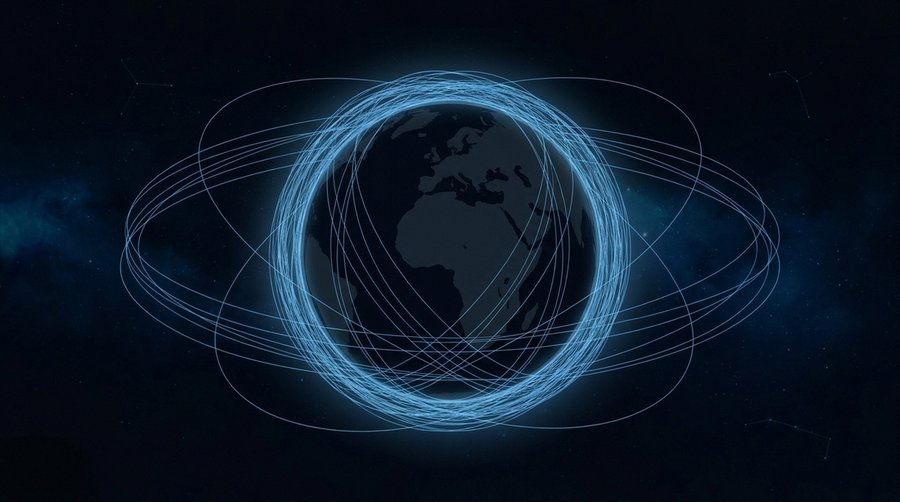
In June 1978, NASA scientist Donald J. Kessler and his colleague Burton Cour-Palais published a six-page paper in the Journal of Geophysical Research (83, A6: 2637–2646) titled “Collision Frequency of Artificial Satellites: The Creation of a Debris Belt.” The argument was clean. If the number of objects in a specific orbital shell reaches a critical density, collisions between those objects generate more fragments than atmospheric drag can remove. Each collision produces debris. Each debris fragment creates additional collision risk. The cascade is self-sustaining — a runaway process requiring no further satellite launches to continue.
Kessler estimated the process could begin within decades and become a serious constraint on space access within the following century. That was before the megaconstellation era. ESA’s Space Environment Report 2024 documented approximately 140 million objects larger than 1 mm in low Earth orbit — the size threshold above which a fragment can cause catastrophic damage to a satellite or spacecraft. Of these, roughly 1 million exceed 1 cm. Only about 54,000 objects larger than 10 cm are tracked. The rest are invisible to ground-based radar.
The Kessler scenario matters for light pollution because debris reflects sunlight too. A 1 cm aluminium fragment at 550 km altitude, tumbling on an uncontrolled trajectory, has no mirror film and no VisorSat. It reflects whatever sunlight hits it, unpredictably, across its full surface area. Barentine et al.’s 2023 finding that debris contributes more to projected sky brightening than intact satellites by 2030 is the quantitative expression of this: even if every satellite company complied fully with IAU CPS brightness guidelines, the debris population from previous fragmentation events — and the inevitable future ones — would continue brightening the sky for decades. Conjunction analysis and active debris removal are technically feasible but have not been deployed at scale. The orbital commons has no commons governance. ESA’s 2024 report recorded a net growth of the space debris population despite improved mitigation efforts, noting that a lack of compliance and remediation drove the increase.
How Satellite Brightness Is Measured
V magnitude — the astronomical brightness scale calibrated to the human eye — is the primary metric for satellite visibility assessment.
The V magnitude scale runs counterintuitively: smaller numbers mean brighter objects. The Sun is V magnitude −26.7. The full Moon −12.7. Venus at maximum −4.7. The faintest naked-eye stars under a dark sky are around magnitude 6.5 to 7. A satellite at V magnitude 3 is easily visible — roughly as bright as the star Mirfak in Perseus. A satellite at V magnitude 7 is at the very limit of unaided vision under excellent conditions and invisible from light-polluted sites.
Photometric measurement of satellites uses the same instruments as stellar photometry: calibrated CCD cameras or CMOS sensors on telescopes or automated tracking stations. The SatPhotometric Network — associated with the IAU CPS SatHub working group — has collected observations from multiple independent observatories to build a brightness database. Pomenis Observatory in Arizona and several European stations have contributed to systematic characterisation campaigns.
Geometry matters. A satellite’s apparent brightness varies with phase angle — the angle between the sun, satellite, and observer — and with distance. Mallama’s brightness measurements are standardised to a 550 km range; a satellite at 340 km appears significantly brighter than at 550 km for the same surface area and reflectivity. The zenith versus horizon contrast is relevant: a satellite crossing directly overhead is closer and subtends a different phase geometry than one at 30° elevation. Tregloan-Reed et al.’s 2021 study of DarkSat measured multi-wavelength magnitudes from Sloan r’ and g’ filters, confirming that reflectivity reductions are spectrally non-uniform — the black coating was more effective at optical wavelengths than in the near-infrared, complicating estimates of total impact on broadband sky brightness. These measurement details feed directly into the framework described in depth at measuring light pollution: methods, data, and research tools.
The Regulatory Landscape — and Why There Isn’t One
No international body has the authority to set or enforce satellite brightness limits. That is not an oversight. It is the current legal structure of space, and it has no self-correcting mechanism.
In the United States, the Federal Communications Commission (FCC) is the primary licensing authority for commercial satellite operators including SpaceX and Amazon Leo. The FCC’s mandate covers spectrum coordination and orbital debris mitigation — not light pollution or sky brightness. When the International Dark-Sky Association challenged the FCC’s approval of SpaceX’s Gen2 Starlink licence on light-pollution grounds, the DC Circuit Court upheld the FCC decision, finding that the Commission had acted within its statutory remit. The FCC’s categorical exclusion from environmental review for satellite licensing has been affirmed by courts. Satellite brightness does not fall within the FCC’s legal mandate as currently framed.
The International Telecommunication Union (ITU) coordinates radio spectrum and orbital slots globally — the two resources satellites consume from a regulatory standpoint. The ITU has no jurisdiction over satellite optical brightness or visual interference with ground-based astronomy. No other UN body does either.
EU’s IRIS² will be the first European sovereign LEO constellation, governed under EU Space Regulation frameworks. Whether the European Commission will impose brightness requirements on IRIS² satellites — or on other operators seeking EU radio spectrum coordination — remains an open question. IRIS² contracts were signed in 2024 with launches projected for 2029. The window to build brightness standards into the design specification is closing.
The IAU CPS can recommend, publish, and coordinate. It cannot regulate. Satellite companies engage voluntarily. SpaceX has engaged more than most — the VisorSat and V2 Mini programmes exist because of that engagement. Whether Amazon Leo, Guowang, and future operators will do the same is not guaranteed by any existing legal mechanism. The night sky, including the dark sky reserves detailed in dark sky places in Europe, is an unowned commons. Individual nations can designate reserves on their own territory. No nation can designate the orbital shells above them. The regulatory gap is not technical. It is jurisdictional by design. For how this connects to broader failures of light pollution regulation — on the ground — see how to reduce light pollution: engineering, policy, and ecological design. And for what the loss of the night sky means culturally and psychologically, see noctalgia: the language of losing the night sky.
Frequently Asked Questions
How many Starlink satellites are visible at night?
It depends on your location and the time after sunset. During a Starlink launch window — the first few days after a batch deployment, before satellites have manoeuvred to their operational altitude — trains of 20 to 60 satellites may be visible crossing the sky in formation, bright enough to see easily with the naked eye. At operational altitude, individual Starlinks range from V magnitude 4.7 (original design) to roughly 7.1 (V2 Mini with mitigation), meaning some are naked-eye objects and others require dark skies and careful attention. From a typical European city with significant light pollution, most operational Starlinks at operational altitude are not conspicuous. From a dark sky reserve, they are. Lawler et al. (2022) modelled that observers at 50° latitude — covering most of northern Europe — would see the worst megaconstellation interference of any latitude band globally.
Can satellite light pollution be reduced?
Partially. SpaceX’s progression from standard Starlinks to DarkSat (2020), VisorSat (2020–2021), and V2 Mini (2023 onward) demonstrates that design changes reduce brightness — V2 Mini satellites average around V magnitude 7.1 in characterisation studies, near the IAU CPS threshold of V magnitude 7. The mitigation is real but incomplete: brightness varies with geometry, earlier-generation satellites remain in orbit, and no other major operator has matched SpaceX’s mitigation investment. Space debris — a separate but related problem — reflects sunlight regardless of design choices and cannot be mitigated retroactively. The IAU CPS is the coordinating body for mitigation research and operator engagement, but compliance is voluntary.
What is the Kessler Syndrome?
Kessler syndrome refers to the runaway collision cascade first modelled by NASA scientist Donald Kessler and Burton Cour-Palais in a 1978 paper in the Journal of Geophysical Research. If enough objects occupy a given orbital shell, a single collision generates fragments that cause further collisions, which generate more fragments — a self-sustaining cycle. ESA’s 2024 Space Environment Report tracked approximately 140 million objects larger than 1 mm in low Earth orbit. Kessler syndrome is relevant to light pollution because debris fragments reflect sunlight without any mitigation measures. Barentine et al. (2023) found that debris — not intact satellites — accounts for the larger share of projected sky brightening by 2030.
Are there international regulations on satellite brightness?
No. The FCC licenses US satellite operators on spectrum and debris criteria — not sky brightness. The ITU coordinates spectrum and orbital slots globally — not optical interference. The IAU CPS, established in April 2022, coordinates research and voluntary engagement with operators but has no regulatory authority. No UN body has legal jurisdiction over satellite visual brightness. Individual operators — most notably SpaceX — have engaged voluntarily with the astronomical community. Whether that engagement extends to all current and future constellation operators, under no legal compulsion, is an open question.
Sources
- Lawler, Boley, and Rein (2022, Astronomical Journal 163:21)
- Mallama (2021, arXiv:2101.00374)
- Tregloan-Reed et al. (2021, Astronomy & Astrophysics)
- Kessler and Cour-Palais (1978, Journal of Geophysical Research 83:2637)
- Barentine et al. (2023, Nature Astronomy)
- IAU CPS — Centre for the Protection of the Dark and Quiet Sky
- Jonathan McDowell space-track database