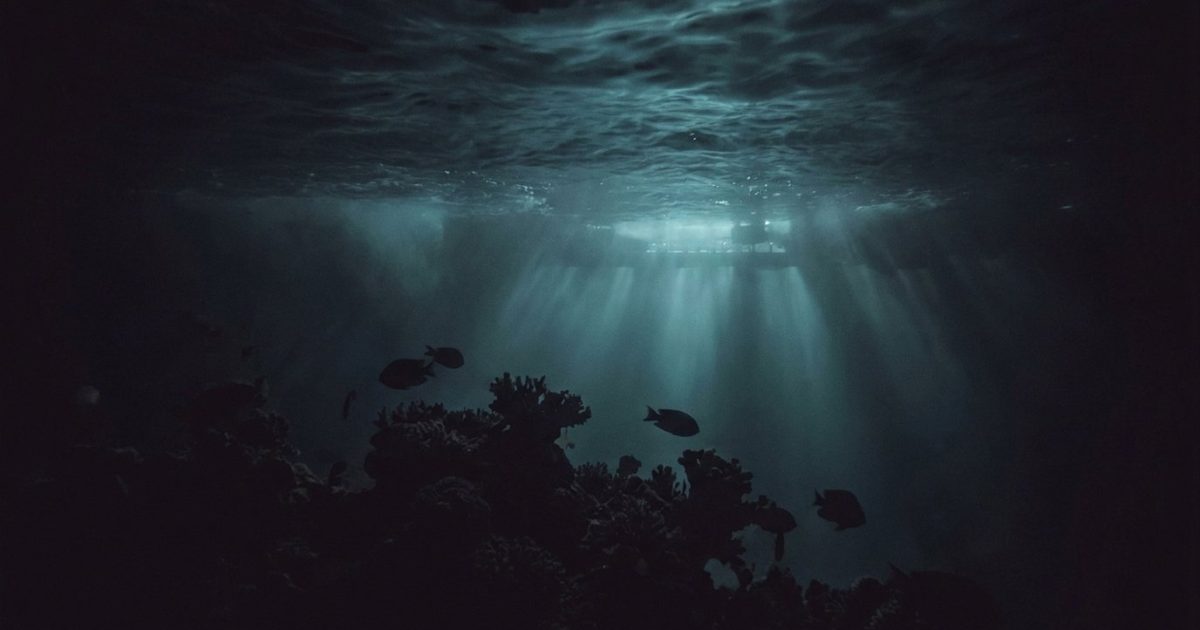
Coastal ALAN penetrates several metres into the water column, shifts predator-prey encounter rates, desynchronises coral spawning cycles, and extends the effective day length for photosynthetic organisms at the seafloor. The research base is younger than terrestrial ALAN ecology — and European coastlines, among the most heavily lit in the world, remain substantially undermonitored. For the ecological context of how artificial light disrupts wildlife systems on land and at sea, the parent overview is light pollution and wildlife: how ALAN destroys ecosystems.
How Artificial Light Travels Through Water
Water does not block coastal ALAN — it filters it spectrally, transmitting blue and green wavelengths deepest while attenuating red almost immediately, with penetration depths of 5 to 20 metres in typical coastal conditions.
The physics are straightforward. Seawater absorbs light selectively by wavelength. Red light (wavelengths above 600 nm) is absorbed within the first metre or two. Green and blue wavelengths (400–550 nm) penetrate far deeper: in clear offshore water, blue light reaches 50 to 100 metres. In coastal and estuarine environments — where dissolved organic matter and suspended particles increase turbidity — that range drops to 5 to 20 metres. Still enough to reach spawning grounds, seagrass beds, juvenile fish nurseries, and the benthic communities that structure coastal food webs.
The measurement framework used in aquatic light research is PAR (Photosynthetically Active Radiation), which captures the 400–700 nm band relevant to both plant photosynthesis and animal photoreception. Coastal ALAN produces localised light domes above the water surface that extend horizontally several hundred metres from the shoreline — an effect measurable from satellite and confirmed by field surveys at harbours, marinas, and resort waterfronts across the Mediterranean and North Sea coasts. Once light enters the water column, it does not stay local: refraction and scattering spread the illumination laterally, meaning a single well-lit waterfront can create a measurable artificial photoperiod across a substantial inshore area.
This spectral selectivity matters biologically. The wavelengths that penetrate deepest in coastal water — blue and green — are precisely the wavelengths most biologically active for coral photoreception, fish visual predation, and phytoplankton photosynthesis. Coastal ALAN is not merely a surface phenomenon. It is an underwater one.
Coral Reefs and Spawning Synchrony
Sustained ALAN exposure causes gametogenesis collapse in broadcast-spawning corals — both cold-white and warm-white LEDs disrupt the lunar cue that coordinates mass spawning events.
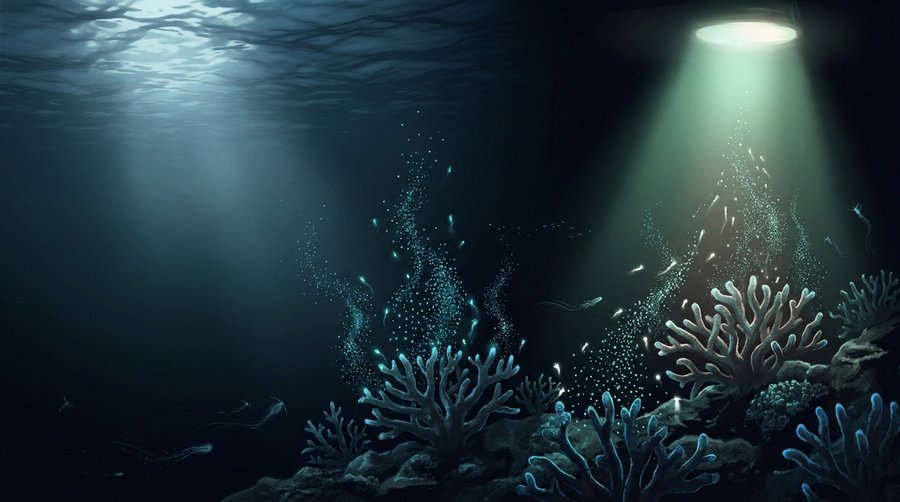
Coral mass spawning is calibrated to moonlight. In broadcast-spawning species, gamete release must be synchronised across a reef within a window of hours for fertilisation to succeed — the gametes of one colony need to encounter those of another while both are still viable. The timing signal is the dimming of moonlight in the nights following a full moon, a cue more precise than water temperature and more seasonally consistent than daylength. Artificial light masks this cue.
Levy et al. 2021 (Current Biology 31:413–419, published online November 2020) demonstrated this collapse experimentally. Two Acropora species — A. millepora and A. digitifera — were exposed to LED lighting throughout the night for three months. Both cold-white (5,329 K) and warm-white (2,719 K) LEDs produced the same result: delayed gametogenesis, asynchronous gamete maturation across colonies, and failure to achieve the spawning synchrony that only the natural moonlight-control group achieved. The irradiance used — 0.5 to 0.75 µmol quanta m‑² s‑¹ — represents ecologically realistic ALAN levels measured at coral reefs near urbanised coastlines.
The warm-white LED finding is not a footnote. It matters because warm-white sources (2,700–3,000 K) are the primary recommendation of marine-adjacent lighting guidelines that currently exist — including France’s 2018 decree. Levy et al. 2021 shows that even these spectral improvements do not protect broadcast spawning. For Acropora, the relevant signal is moonlight intensity, not spectral colour. Any ALAN bright enough to mask the lunar cycle disrupts spawning, regardless of colour temperature.
Mediterranean coral communities face a compounded problem. Cladocora caespitosa, the only reef-building coral endemic to the Mediterranean and already endangered by warming seas and eutrophication, is not yet studied under ALAN conditions. The Red Sea and Indo-Pacific are the primary research regions for coral ALAN work. European coastlines — where coastal ALAN density is among the world’s highest — have produced almost no field data. That gap is not evidence of safety. It is evidence of a research backlog. For the dark sky coastal protection framework that begins to address this, see dark sky places in Europe: parks, reserves, and the science of protected night skies.
Salmon, Seabass, and Coastal Predation
ALAN at the water surface makes juvenile salmonids visible to visual predators while their evasion behaviour remains calibrated to darkness — and late-night lighting raises predator density by a factor of nearly four.
Atlantic salmon (Salmo salar) juveniles migrating through river mouths and estuaries depend on darkness for predator avoidance. Under natural conditions, piscivorous fish that hunt by vision cannot efficiently detect small, fast-moving smolts in low light. ALAN removes this cover. The juveniles’ schooling and evasion behaviour is calibrated to expected darkness; the predators’ foraging efficiency is enhanced by illumination.
Nelson et al. 2021 (Transactions of the American Fisheries Society 150:147–159) quantified this at a lit riverine crossing in California’s Sacramento River. Predator density in the presence of ALAN was predicted to increase by a factor of 3.96 compared to unlit conditions during the late-night period, three to five hours after sunset. The effect was not constant across the night — early-night periods showed no significant change — but the late-night amplification is directly relevant to migrating smolts, whose downstream movement peaks during those hours. Predation risk increased with lux level, producing a dose-response relationship between light intensity and exposure.
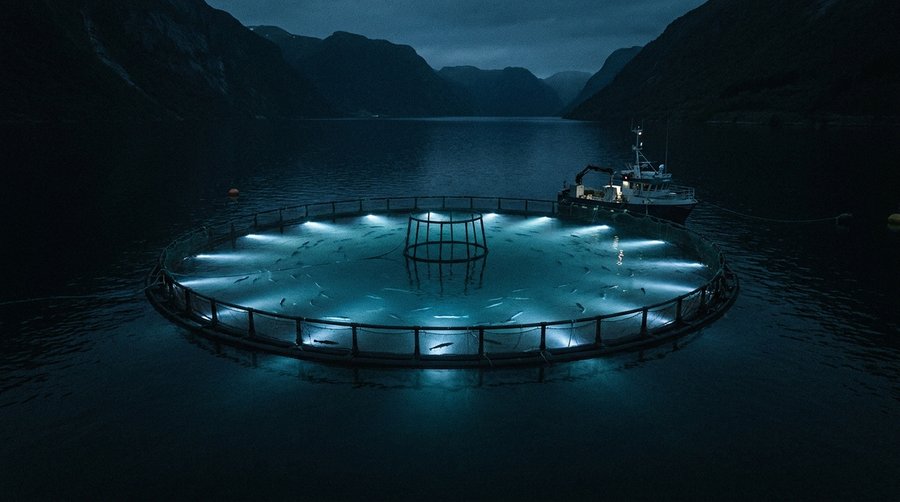
Davies and Smyth 2018 (Global Change Biology 24:872–882) established ALAN as a global change stressor with documented consequences for aquatic predator-prey dynamics, noting that the most vulnerable life stages are those, like salmon smolts at river crossings, where darkness has historically provided a refuge from visual predation. Norwegian aquaculture operations in semi-enclosed coastal fjords have documented equivalent problems: nighttime illumination of handling and maintenance facilities at cage sites creates ALAN halos that expose adjacent fish to elevated predation risk during the hours when visual hunting would otherwise be impractical.
Mediterranean seabass (Dicentrarchus labrax) and European sea bass farming in coastal lagoons present the same structural problem with less documentation. The species is highly valued commercially and behaviorally sensitive to light; the aquaculture and wild fishery ALAN interaction is an open research question, not a closed case. The mechanistic parallel to Atlantic salmon is clear — the evidence base is not yet there.
Harmful Algal Blooms and Extended Photoperiods
Coastal ALAN extends the effective day length for aquatic photosynthesisers, selectively benefiting bloom-forming cyanobacteria in already-eutrophied coastal systems — a co-driver of harmful algal blooms that is rarely mentioned in EU nutrient policy.
Phytoplankton and cyanobacteria use light as a primary resource. More light, for longer, means more primary production. In oligotrophic offshore waters, ALAN is unlikely to tip the balance — light is not the limiting factor when nutrients are scarce. In eutrophied coastal systems — where nitrogen and phosphorus from agricultural runoff are already in excess — ALAN-extended photoperiods provide the additional energy input that pushes bloom-forming species over competitive thresholds.
Benthic cyanobacteria in Mediterranean coastal lagoons have been documented producing nuisance blooms correlated with marina and waterfront lighting (Venice Lagoon and Adriatic coastal monitoring studies). The Baltic Sea provides the most visible European case: already heavily eutrophied, with warm summer conditions and south Baltic coastal ALAN among the densest in Europe, the region produces summer cyanobacterial blooms — including toxin-producing Microcystis aeruginosa and Nodularia spumigena — that close beaches, kill fish, and pose health hazards to humans and domestic animals. ALAN is not the primary driver of Baltic HABs; agricultural nutrient loading is. But ALAN reliably amplifies the bloom conditions that nutrients create, by extending the daily growth window for photosynthetic organisms that are already competitively advantaged.
The pelagic zone compounds this. Diel vertical migration (DVM) — the daily movement of zooplankton from deep water to the surface at night and back down at dawn — is a key mechanism regulating the grazing pressure that keeps phytoplankton in check. ALAN disrupts DVM, reducing nighttime ascent and therefore reducing the zooplankton grazing that would otherwise suppress bloom formation. The double effect — extended ALAN photoperiod for phytoplankton plus reduced grazing by ALAN-disrupted zooplankton — creates conditions selectively favourable to harmful bloom formation. This mechanism is described in the marine ALAN review literature but has not yet been incorporated into EU coastal eutrophication management frameworks.
The EU Regulatory Gap
Neither the Water Framework Directive 2000/60/EC nor the Marine Strategy Framework Directive 2008/56/EC contains a light parameter — coastal ALAN is not regulated as a water quality or marine environment factor anywhere in EU law.
The EU Water Framework Directive (2000/60/EC) establishes chemical and ecological quality standards for water bodies across Europe. Its priority substance list, environmental quality standards, and ecological status criteria cover nutrients, heavy metals, pesticides, and a range of specific pollutants. Light is not among them. The directive’s ecological quality criteria for rivers and coastal waters include biological indicators — fish, invertebrates, phytoplankton, macroalgae — but the light environment that structures the behaviour and phenology of those organisms is not assessed.
The Marine Strategy Framework Directive (2008/56/EC) requires member states to achieve Good Environmental Status (GES) in EU marine waters and covers pollution by substances, noise, and litter. It does not define light as a pollutant. Artificial light is absent from every GES descriptor. The directive that most directly governs what enters European coastal water bodies has no mechanism to address ALAN, even as the evidence base for ALAN’s marine ecological effects — from coral spawning to diel vertical migration disruption — accumulates in peer-reviewed literature.
The practical consequence is that resort lighting, marina infrastructure, and harbour installations along every EU coastline operate with no water-law obligation to consider underwater light penetration, spectral composition, or photoperiod effects on adjacent marine ecosystems. At the national level, scattered responses are emerging. The Trilateral Dark Sky Initiative for the Wadden Sea World Heritage Site — signed at the 14th Trilateral Governmental Conference in November 2022 by representatives of the Netherlands, Germany, and Denmark — commits the three countries to reducing ALAN over the Wadden Sea ecosystem. The Interreg-funded DARKER SKY project (North Sea Region, ERDF) is developing monitoring methodologies and municipal co-design tools. Some French coastal communities have extended their Arrêté curfews to waterfront areas beyond the decree’s minimum requirements. For the policy architecture that produced France’s decree, see France’s 2018 lighting decree: what it requires and proved. For the infrastructure engineering approach to dark corridors, see dark infrastructure: the Dutch Donkerte-Netwerk and Natura 2000 corridors.
These are local and regional initiatives against a continental-scale problem. The EU Water Framework Directive was last substantively revised before underwater ALAN ecology existed as a research field. Updating its quality parameters to include light regime — or embedding ALAN assessment in the Marine Strategy Framework GES descriptors — would require no new institutional infrastructure. It would require a political decision that the evidence now clearly supports. That decision has not been made. For the broader regulatory picture, see how to reduce light pollution: engineering, policy, and ecological design and EN 13201: what European road lighting standards actually cover.
Frequently Asked Questions
How deep does artificial light penetrate seawater?
In clear offshore water, blue and green wavelengths penetrate to 50–100 metres. In coastal water — where dissolved organic matter and suspended particles reduce transparency — the effective depth is typically 5 to 20 metres. Red wavelengths (above 600 nm) are absorbed within the first metre or two regardless of water clarity. The biologically relevant range is the coastal and estuarine zone, where 5 to 20 metres of ALAN penetration reaches spawning grounds, seagrass beds, and juvenile fish nurseries. The measurement standard used in research is PAR (Photosynthetically Active Radiation), 400–700 nm.
Are Mediterranean coral species at risk from ALAN?
Cladocora caespitosa — the only reef-building coral endemic to the Mediterranean — is endangered and has not been studied under ALAN conditions. Research on Acropora species (Levy et al. 2021 Current Biology) demonstrated that both cold-white and warm-white LED exposure throughout the night for three months caused gametogenesis collapse and spawning desynchrony. Mediterranean coastal ALAN density is among the highest in the world, and C. caespitosa populations in the Adriatic and Tyrrhenian seas are adjacent to some of Europe’s most intensely lit coastlines. The research gap is large; the risk is real but unquantified.
Why isn’t coastal light regulated under EU water law?
Neither the Water Framework Directive (2000/60/EC) nor the Marine Strategy Framework Directive (2008/56/EC) defines light as a pollutant or includes ALAN in its quality parameters. Both directives were established before underwater ALAN ecology was a recognised research field. The scientific evidence base for ALAN’s marine effects has grown substantially since 2010, but updating these directives requires a formal revision process and political will at the Council and Parliament level. The Wadden Sea Trilateral Dark Sky Initiative and the Interreg DARKER SKY project demonstrate regional coordination is possible — but neither instrument creates binding water quality obligations.