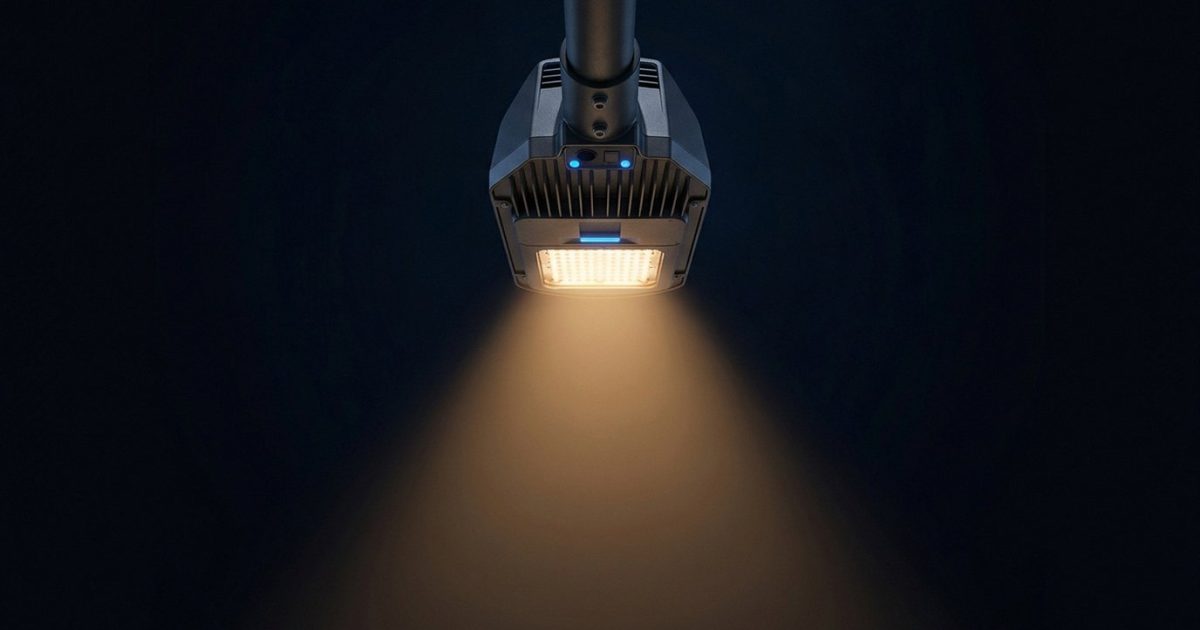
EN 13201 is Europe’s harmonised road-lighting standard — the document that defines what a compliant street lamp must deliver in terms of luminance, uniformity, and glare control. It does not set a correlated colour temperature floor. It does not cap the fraction of flux emitted above the horizontal. It contains no spectral requirement of any kind. The result: an M1-compliant street lamp can operate at 6500 K, emit 15% of its total flux toward the sky, and be fully within the standard while simultaneously suppressing melatonin at twice the rate of a warm-white equivalent, disrupting migratory birds, and contributing disproportionately to skyglow through Rayleigh scattering. For the broader policy picture, see our guide to reducing light pollution.
What EN 13201 Is — and How It Got Here
EN 13201 is a CEN harmonised standard, not an EU regulation — compliance is voluntary, but it functions as the default procurement baseline for road lighting across Europe.
The standard was first published in 2003 by the European Committee for Standardisation (CEN). That original version comprised four parts: EN 13201-1 (guidelines on selection of lighting classes), EN 13201-2 (performance requirements), EN 13201-3 (calculation of performance), and EN 13201-4 (methods of measuring lighting performance). It was prepared by CEN Technical Committee 169, formally titled Light and lighting.
The intellectual precursor was CIE 115, the International Commission on Illumination’s technical recommendation on road lighting, which had defined the photometric class system that EN 13201 formalised. EN 13201:2015 — the current version and the last major revision — explicitly references CIE 115:2010. The 2015 revision restructured Part 1 as a Technical Report (CEN/TR 13201-1), updated Parts 2, 3, and 4, and added EN 13201-5, covering energy performance indicators — a concession to EU energy efficiency directives seeking to document kilowatt-hour savings alongside photometric performance.
Under the EU’s New Legislative Framework, EN 13201 is a voluntary standard. In practice, however, public procurement directives and member-state road authority specifications routinely treat EN 13201 compliance as the default technical requirement for street lighting contracts. The presumption of conformity that harmonised standards carry makes EN 13201 the path of least resistance for manufacturers and procurers alike. Voluntary in law; obligatory in practice.
The Classification System — M, P, CE, and S Classes
EN 13201’s four class families all share the same structural gap: they measure what reaches the road surface, not what escapes above it.

The M classes — M for motorised traffic routes — express requirements in terms of road surface luminance (what a driver perceives as the brightness of the carriageway), not illuminance. Six classes run from M1 to M6. M1 requires a maintained average luminance of 2.00 cd/m² — applied to arterial roads with heavy, fast traffic. M2 requires 1.50 cd/m². M3, 1.00 cd/m². M4, 0.75 cd/m². M5, 0.50 cd/m². M6, the lowest specification, requires 0.30 cd/m² — for minor routes with low speed and vehicle density.
The P classes — P for pedestrian and low-speed areas — express requirements in maintained illuminance (lux). P1 requires 15.0 lux. P2, 10.0 lux. P3, 7.5 lux. P4, 5.0 lux. P5, 3.0 lux. P6, 2.0 lux. CE classes (CE for conflict areas) cover junctions and roundabouts; S classes (supplementary) cover service roads and ancillary areas. None of the four class families specifies a ULR limit, a CCT requirement, or any spectral criterion.
A fixture with ULR of 15% and a fixture with ULR of 0% can both achieve identical M1 ratings, provided their road-surface photometric output is equivalent. The upward light ratio — the dominant driver of skyglow — is simply not a parameter in EN 13201.
What the Standard Specifies
EN 13201’s photometric parameters are coherent for road-user visibility — which is precisely why the ecological and astronomical gaps are structural rather than accidental.
For M classes, EN 13201-2 defines four primary parameters. Average maintained luminance (L) is the headline requirement. Overall uniformity (Uo) is the ratio of minimum to average luminance: M1 requires Uo ≥ 0.40, falling to 0.35 for M5–M6. Longitudinal uniformity (Ul) measures the ratio of minimum to maximum luminance along each traffic lane: M1 requires Ul ≥ 0.70, M6 only 0.40. Threshold increment (Ti) is the disability glare metric: the maximum permitted is 10% for M1–M2, rising to 20% for M6.
The maintenance factor bridges design intent and real-world performance. Luminaires lose output over time — lamp lumen depreciation (typically expressed as an L-rating: L80 means 80% of initial flux remains after rated hours), luminaire dirt accumulation, and control gear degradation. EN 13201-3 folds these into a single maintenance factor. A typical value of 0.70 to 0.80 means commissioning output must be 25 to 43% above the minimum maintained requirement — which is one structural driver of chronic over-illumination.
What EN 13201 measures is what bounces back from the road surface into a driver’s eyes. Skyglow, uplight, light trespass into bedroom windows, biological disruption of nocturnal species — none of these are inputs or outputs of the EN 13201 calculation. That is a faithful reflection of what CEN/TC 169 was mandated to optimise: road-user visibility. The problem is that this mandate was never extended to include the sky.
Three Blind Spots — CCT, ULR, Spectrum
No CCT floor, no ULR cap, no spectral requirement — three omissions that allow full EN 13201 compliance alongside maximum light pollution impact.
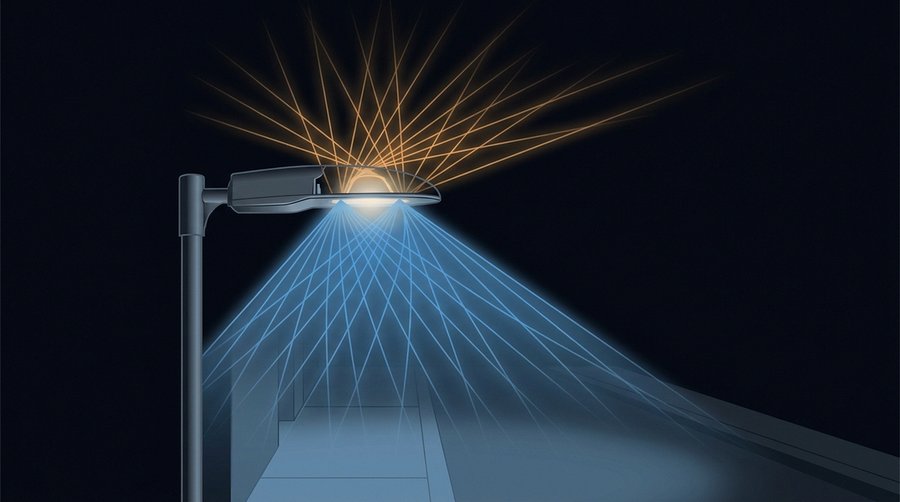
The CCT gap is the most consequential. A 6500 K cool-white LED achieves M1-class compliance with exactly the same calculation method as a 2700 K warm-amber equivalent. EN 13201-2 contains zero reference to correlated colour temperature. Yet CCT drives the broadest downstream consequences. Melanopsin — the photopigment in intrinsically photosensitive retinal ganglion cells (ipRGCs) — has peak sensitivity at approximately 480 nm, precisely the spectral range where cool-white LEDs above 4000 K emit disproportionate power. The melanopic-to-photopic ratio rises steeply above 3000 K. Rayleigh scattering in the atmosphere preferentially disperses shorter wavelengths: blue-rich sources contribute more to skyglow per lumen than warm sources of identical total output. France’s Arrêté du 27 décembre 2018 capped CCT at 3000 K for all newly acquired outdoor luminaires — the only national CCT ceiling in EU road lighting law. EN 13201 offers no equivalent.
The ULR gap is the most direct. EN 13201 contains no uplight specification of any kind. France’s Arrêté requires nominal ULR below 1%. The DarkSky Approved programme from DarkSky International requires a BUG U0 rating — zero measured upward light — alongside CCT at or below 3000 K. An M1-compliant installation could emit 15% of its flux skyward: fifteen times France’s ULR ceiling, categorically incompatible with DarkSky Approved. For the full France policy analysis, see France’s 2018 lighting decree.
The spectral gap is the least-discussed but potentially the most ecologically significant. No melanopic contrast limit. No insect phototaxis constraint. No bird-safe spectral specification. Insect phototaxis is most strongly driven by UV and blue wavelengths; switching from 4000 K to 3000 K reduces insect attraction by a factor of three to five at equivalent lumen output. For migratory birds, cool-white illumination at 4000 K and above disrupts magnetic compass orientation — documented by Mouritsen et al. (2014, 2018, Nature). A compliant installation can simultaneously destroy astronomical darkness, disorient migrants, and suppress human melatonin. The standard says nothing about any of it. For bird evidence, see light pollution and birds; for the melatonin pathway, see melatonin and ipRGC suppression.
Where Reform Is Stuck
The EN 13201:2015 revision was the last realistic window for incorporating ecological criteria — and it closed without acting on any of the relevant research.
COST Action ES1204 — Loss of the Night Network (LoNNe), running 2013 to 2017 across 19 European countries — produced policy-facing outputs through its Working Group 4 that directly addressed the gap between EN 13201’s photometric scope and the ecological evidence. The outputs included explicit recommendations: incorporate a CCT ceiling aligned with the melanopic evidence, and review minimum M-class luminance levels against the literature on chronic over-illumination. The EN 13201:2015 revision incorporated neither. For the LoNNe measurement legacy, see LoNNe intercomparison campaigns.
The committee responsible is CEN/TC 169. Industry stakeholders participate through the technical expert nomination process. LightingEurope — formed in 2012 from the merger of CELMA (Federation of National Manufacturers’ Associations for Luminaires) and ELC (European Lamp Companies Federation) — represents the major European lighting manufacturers in standards debates. The framing has consistently prioritised energy efficiency (the EN 13201-5 addition) over spectral quality. A CCT ceiling would restrict the product range of manufacturers selling 4000 K and 5000 K road luminaires as energy-efficient LED upgrades. The commercial logic of resistance is transparent. No binding EU outdoor lighting directive exists to force the revision — leaving the standard’s next revision timeline entirely unconfirmed.
What an Improved EN 13201 Could Look Like
The building blocks already exist — France’s decree, DarkSky Approved criteria, and LoNNe’s outputs provide a ready-made reform blueprint that CEN/TC 169 has simply not been asked to implement.
A CCT floor of 3000 K for newly acquired luminaires is the most straightforward addition. France implemented this in 2018 without disrupting road safety — M-class photometric requirements are fully achievable with 2700 K or 3000 K LEDs. The scientific basis is clear: 3000 K falls at the inflection point in the melanopic-to-photopic ratio curve and at the boundary below which insect phototaxis attraction drops sharply.
A ULR cap of 2% in nominal installation conditions would align EN 13201 with the ecological evidence without requiring optical geometries beyond current manufacturing capability. For installations near Natura 2000 habitats or dark-sky buffer zones, a stricter 0% nominal ULR — equivalent to DarkSky Approved U0 — should be the specification. Skyglow reduction targets for urban peripheries, expressed as maximum permitted sky luminance at reference monitoring points, would complete the output-side framework EN 13201 currently lacks entirely. For context, see skyglow: causes, reach, and measurement.
Melanopic contrast limits for residential interfaces and bird-safe spectral tuning for coastal and migration-route installations represent the frontier of an ecologically complete standard. DarkSky Approved demonstrates that certification programmes can operationalise ecological criteria without undermining photometric performance. The Flagstaff, Arizona ordinance — full-cutoff mandatory since 1989, producing the world’s first International Dark Sky City in 2001 — shows enforceable spectral and shielding standards predate LED technology by decades. EN 13201 has no excuse in the science. It has an excuse in the politics.
Frequently Asked Questions
Is EN 13201 a law or a guideline?
EN 13201 is a harmonised standard produced by CEN under CEN/TC 169. It is technically voluntary — no EU regulation mandates compliance. In practice, public procurement specifications across most EU member states treat it as the default technical requirement for road lighting contracts, giving it de facto mandatory status. It is not an EU directive, and non-compliance carries no legal penalty beyond procurement implications.
Can a fixture be EN 13201-compliant and still cause light pollution?
Yes — in every measurable dimension. EN 13201 specifies luminance, uniformity, and glare for road-surface visibility. It contains no ULR limit, no CCT requirement, no spectral constraint. A fixture achieving M1-class compliance at 6000 K with 12% upward flux satisfies EN 13201 completely while violating France’s ULR limit, exceeding France’s CCT ceiling, and failing every DarkSky Approved criterion simultaneously.
Why doesn’t EN 13201 limit CCT?
Because CEN/TC 169’s mandate has been road-user visibility and traffic safety — domains where CCT has no direct relevance at photopic luminance levels. Ecological and human health impacts of CCT fell outside the standard’s original scope and were not incorporated in 2015. Industrial stakeholders in the process have commercial reasons to resist a CCT ceiling. No binding EU directive has created the legislative hook that would force the revision.
Will EN 13201 be revised soon?
No confirmed timeline exists. EN 13201:2015 is the current operative version. Without a binding EU outdoor lighting directive mandating ecological criteria in harmonised standards, there is no external pressure to force CEN/TC 169 to reopen the standard before the industry supports doing so. France’s decree and DarkSky Approved show CCT and ULR regulation is technically viable. The obstacle is political.