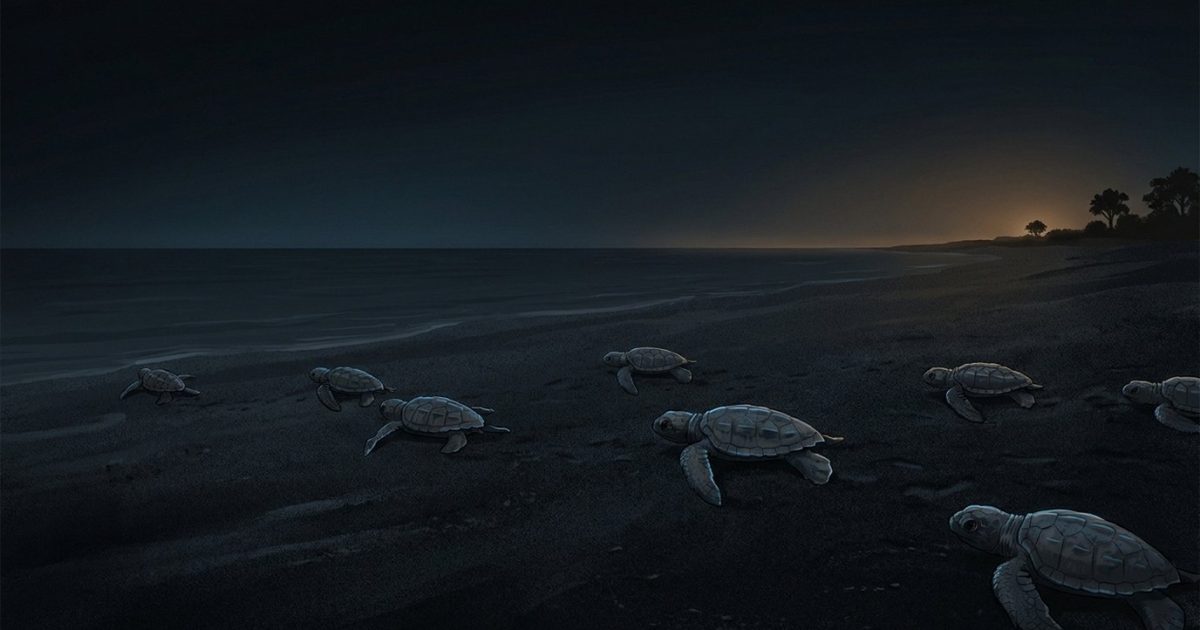
For roughly 150 million years, sea turtle hatchlings have found the ocean the same way: by moving toward the brightest, lowest point on the horizon — under natural conditions, the water surface reflecting open sky. A single illuminated beachfront promenade can invert this cue entirely. Florida Fish and Wildlife Conservation Commission guidelines note that any light visible from the beach is likely to cause disorientation, and field data from nesting beaches in Florida and the Mediterranean document near-total orientation failure under seafront lighting. The mechanism is well understood. The fix is also well understood. What lags is the regulatory will to require it. For the broader context of how ALAN reshapes marine and terrestrial ecosystems, the parent overview is light pollution and wildlife: how ALAN destroys ecosystems.
How Hatchlings Find the Sea
Sea-finding behavior in hatchling sea turtles is a visual orientation system calibrated to the brightness gradient between open sky over water and the darker landward horizon — and it is exquisitely sensitive to disruption.
When hatchlings emerge from their nest cavity, usually at night, they are not following scent, sound, or magnetic cues to the waterline. They are using a phototactic response — moving toward the brightest available horizon. On an undeveloped beach this works flawlessly: the seaward horizon, with open sky reflected across water, is reliably brighter than the dark landward direction blocked by dunes and vegetation. Witherington and Bjorndal (1991, Copeia) established that the sea-finding response is governed by visual brightness contrast rather than direction-specific cues; the turtle simply orients toward whatever is brightest in its visual field. Peak spectral sensitivity falls at 360 to 500 nm — ultraviolet through blue-green — where hatchling loggerheads show peak photopic sensitivity. Horch et al. (2008, Marine and Freshwater Behaviour and Physiology 41:2) confirmed this electroretinographically for Caretta caretta hatchlings. The same spectral range dominates cool-white LEDs.
The timing window is brutal. Hatchlings emerge as a clutch, make their run, and have a matter of hours before dehydration or terrestrial predation eliminates those that fail to reach the surf. Once a hatchling is disoriented on a lit beach — spinning in circles, heading inland, or moving parallel to the waterline — the physiological clock is already running. Exhausted hatchlings that do not reach the sea before dawn face road mortality, heat death, and predation by birds and mammals. The population-level arithmetic is unforgiving: Florida alone hosts tens of thousands of loggerhead nests per season; even a modest per-nest disorientation rate translates to hundreds of thousands of individual hatchlings lost annually to a single, technically preventable cause.
What Artificial Light Does
ALAN produces two distinct failure modes in hatchling orientation — disorientation and misorientation — and field data confirm that standard beachfront lighting is bright enough to trigger both.
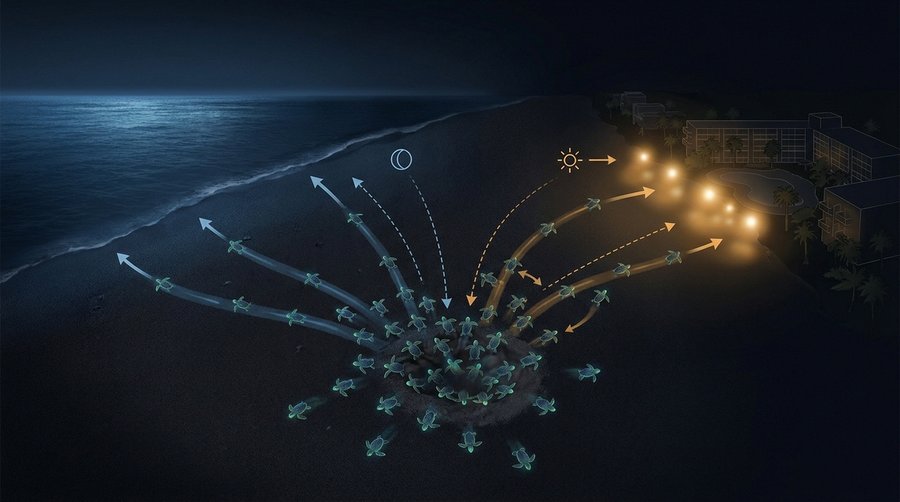
The terminology matters here. Disorientation occurs when artificial and natural light cues produce competing signals of roughly equal intensity, causing the hatchling to move in circles or erratic paths unable to resolve a direction. Misorientation occurs when an artificial light source clearly outcompetes the natural seaward horizon, producing straight-line movement directly toward the light — which means directly away from the ocean. Tuxbury and Salmon (2005, Biological Conservation 121:395-403) analyzed hatchling responses across a range of light intensities and source positions on Florida nesting beaches and documented both failure modes, with misorientation occurring preferentially when a single bright source dominated the visual field. This is exactly the geometry of a lit hotel or promenade above a beach access road.
The FWC guidelines frame the threshold conservatively: any light source visible from the beach surface is considered likely to cause problems. This is not regulatory overcaution — it reflects the spectral reality that even low-lumen sources emitting in the 360-500 nm range that hatchling retinas are most sensitive to can overwhelm the dim natural seaward brightness. The Witherington and Martin technical report (2000, FMRI Technical Report TR-2, second edition revised) documented that long-wavelength sources above 560 nm dramatically reduce both disorientation and misorientation rates compared to white or blue-rich sources at the same luminous intensity. This is the empirical foundation of the amber-lighting standard that Florida municipalities have been progressively adopting since the 1990s. For the mechanistic picture of how ALAN interacts with coastal marine ecosystems more broadly, see underwater light pollution: coral reefs, salmon, and algal blooms.
The population-level consequences accumulate quietly. A beach producing disoriented hatchlings for thirty seasons does not look ecologically destroyed — nest counts may even rise as adult female numbers hold stable. But a chronic mortality premium each season compounds over the 20-to-30-year lag before those hatchlings would have returned as breeding adults. Tuxbury and Salmon (2005) modeled that a sustained disorientation rate on a major nesting beach is sufficient to hold populations below replacement threshold without ever producing a single dramatic die-off event. Invisible attrition is the mechanism.
European Species at Risk
Three sea turtle species nest on EU-affiliated Mediterranean coastlines, all protected under the EU Habitats Directive — and every major nesting beach faces documented light pollution pressure from coastal resort development.
The loggerhead sea turtle (Caretta caretta) is the dominant nesting species in European waters. Zakynthos, in the Ionian Sea, hosts what MEDASSET identifies as the most important loggerhead nesting area in the entire Mediterranean — approximately 80% of all Mediterranean loggerhead nests concentrated along 5.5 kilometres of coastline in Laganas Bay. The National Marine Park of Zakynthos (NMPZ), established in 1999 as the first national park created specifically for sea turtle protection in the Mediterranean, operates lighting restrictions for beachfront establishments during the nesting season. These restrictions exist because the tourism infrastructure of Laganas Bay — hotels, waterfront bars, access roads — is directly adjacent to the nesting beaches. The conflict between resort lighting and hatchling orientation is not hypothetical at Zakynthos; it is actively managed, imperfectly, each season.
Additional EU nesting sites: Caretta caretta nests on Kefalonia, Crete, the Peloponnese coast, Linosa and Lampedusa in Italy, and in Cyprus — which hosts the second-largest loggerhead nesting concentration in the Mediterranean. Green sea turtles (Chelonia mydas) nest primarily in Cyprus and Turkey (within the EU coastal sphere of influence). Leatherbacks (Dermochelys coriacea) are rare nesters in the Mediterranean but regularly transit the Atlantic margins of EU waters. All three species are listed under Annex IV of the EU Habitats Directive 92/43/EEC, requiring strict protection for individual animals. Caretta caretta also carries Annex II listing, requiring EU member states to designate Special Areas of Conservation (SACs) for the species — a designation that in practice protects nesting beaches but has not, to date, produced binding lighting standards for those beaches or their adjacent infrastructure. The EU protects the turtle. It does not protect the darkness the turtle needs to navigate. That gap parallels the Natura 2000 ALAN legal gap documented for bats and offshore birds.
Amber Lighting as Solution
Long-wavelength sources above 560 nm — amber, orange, and red LEDs — reduce hatchling disorientation to near-zero at operational lumen levels that still meet human safety and visibility requirements.
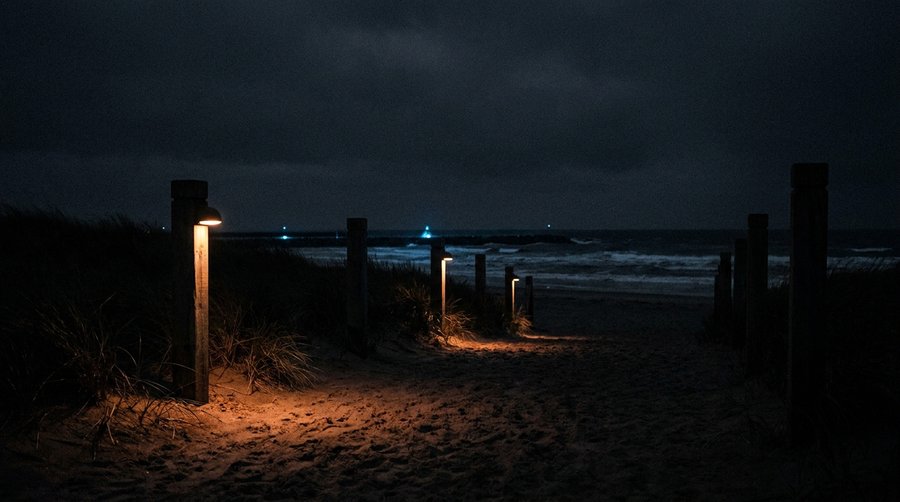
The spectral solution is the same principle that explains amber lighting’s advantages for insects and bats, but the mechanism here is different. For insects, amber reduces phototactic fatal attraction by falling outside peak UV-blue sensitivity. For sea turtle hatchlings, it works by falling outside the 360-500 nm spectral peak that governs sea-finding brightness assessment: a light source emitting only above 560 nm is largely invisible to the sea-finding system even when it is physically present on the beach. Witherington and Martin (2000) documented that amber sodium vapor sources — the wavelength-appropriate technology available in 2000 — produced dramatically lower disorientation rates than white incandescent or fluorescent sources on Florida test beaches. The shift to amber LEDs, which allow precise spectral control above 560 nm without filters, has since made the solution cheaper and more reliable.
Florida’s regulatory history is the best-documented implementation pathway. The state model lighting ordinance for sea turtle protection, issued by the Florida Department of Environmental Protection under Rule 62B-55, specifies that beachfront lighting must use long-wavelength sources emitting above 560 nm, with wavelengths below 560 nm absent from the output — not merely reduced but absent. FWC’s Three Golden Rules for beachfront fixtures: Low (mount as low as possible), Shielded (full cutoff, beam directed downward only, no horizontal or skyward component), Long wavelength (amber or red LED without filters or gels). By 2022, more than a hundred Florida local governments had adopted ordinances based on this model — the most concentrated geographic cluster of sea turtle lighting regulation in the world. The EU has no equivalent framework. Greece, Cyprus, and Italy manage nesting beach lighting through national park regulations and local agreements with tourism operators, without harmonised spectral standards or enforcement protocols. For the parallel regulatory story in outdoor lighting more broadly, see France’s 2018 lighting decree and what it demonstrates about the distance between scientific consensus and binding law. The S2.2 article on insects at streetlights covers the same amber-versus-blue spectral logic from the insect perspective.
The EU Regulatory Gap
The EU Habitats Directive protects Caretta caretta as an Annex II and IV priority species — but contains no lighting standards for nesting beaches, marina approaches, or coastal resort infrastructure.
The gap is structural, not accidental. Annex II of 92/43/EEC requires designation of SACs for Caretta caretta. Annex IV prohibits deliberate disturbance of individuals during breeding, rearing, and migration. ALAN on a nesting beach demonstrably disrupts hatchling sea-finding, reduces recruitment to the adult population, and discourages nesting females from returning to lit beaches. This is disturbance in any reasonable ecological reading of the directive. The legal interpretation that would make ALAN management on nesting beaches a Habitats Directive obligation has not been operationalised by the European Commission. No SAC management plan for a Mediterranean sea turtle nesting site, as of the time of writing, includes lighting standards with spectral requirements, lux ceilings, or curfew obligations tied to the nesting season window.
France’s Arrêté du 27 décembre 2018 provides the closest European analogue to turtle-protective lighting law — its CCT ceiling of 3000 K and curfews on façade and advertising lighting reduce the most harmful blue-rich sources at night. But the decree was not written for sea turtles, applies only in France, and does not reach the 560 nm threshold that FWC guidelines specify. The Mediterranean coastal states with the highest nesting density — Greece, Cyprus, Italy — have no equivalent national lighting legislation. What exists is a patchwork of national park regulations (NMPZ at Zakynthos, Bafa Lake and Dalyan in Turkey), voluntary agreements with tourism associations, and the work of conservation NGOs like ARCHELON in Greece and the Cyprus Wildlife Society. These are not substitutes for binding spectral standards tied to SAC designations. For the science and politics of dark sky protection as a framework that could fill this gap, see dark sky places in Europe: parks, reserves, and the science of protected night skies.
Frequently Asked Questions
Why do sea turtle hatchlings head toward streetlights?
Hatchlings use a phototactic sea-finding response — they move toward the brightest horizon in their visual field. On an undeveloped beach the seaward horizon is always brighter. When a streetlight, hotel facade, or access road lamp outcompetes the natural seaward brightness, hatchlings move toward the artificial source instead. Their vision peaks in sensitivity at 360-500 nm (UV to blue-green), which overlaps exactly with the spectral output of cool-white and standard LEDs. It is not confusion; it is the sea-finding system working correctly on a corrupted signal.
What lux level is safe for nesting beaches?
Florida FWC guidelines do not specify a single lux threshold as universally safe. They state that any light visible from the beach surface is likely to cause problems — because the relevant variable is not absolute intensity but spectral composition and brightness relative to the natural seaward horizon. Sources emitting predominantly above 560 nm (amber or red LEDs) are far less disruptive at equivalent lux levels than white or blue-rich sources, because hatchling spectral sensitivity is low above 560 nm. The practical standard is: low-mounted, fully shielded, long-wavelength source, with no horizontal or upward light component reaching the beach.
Does red or amber light help sea turtles?
Yes — substantially. Witherington and Martin (2000, FMRI Technical Report TR-2) documented that long-wavelength sources dramatically reduce both disorientation and misorientation on nesting beaches compared to white or blue-rich alternatives. FWC now specifies amber and red LEDs emitting above 560 nm as the required technology for beachfront lighting. The 560 nm threshold is the practical cut-off below which hatchling sea-finding sensitivity becomes significant; sources above it are largely outside the spectral range that drives the orientation response.
Are European sea turtle species protected from light pollution by EU law?
Caretta caretta, Chelonia mydas, and Dermochelys coriacea are all listed under Annex IV of the EU Habitats Directive 92/43/EEC, requiring strict protection. Caretta caretta also holds Annex II status, requiring Special Area of Conservation designations. These protections are real and meaningful for habitat designation and direct disturbance. They have not been extended to cover artificial lighting on or near nesting beaches. No binding EU lighting standard applies to beachfront infrastructure adjacent to SAC-designated sea turtle nesting sites. The protection is taxonomic, not photometric.