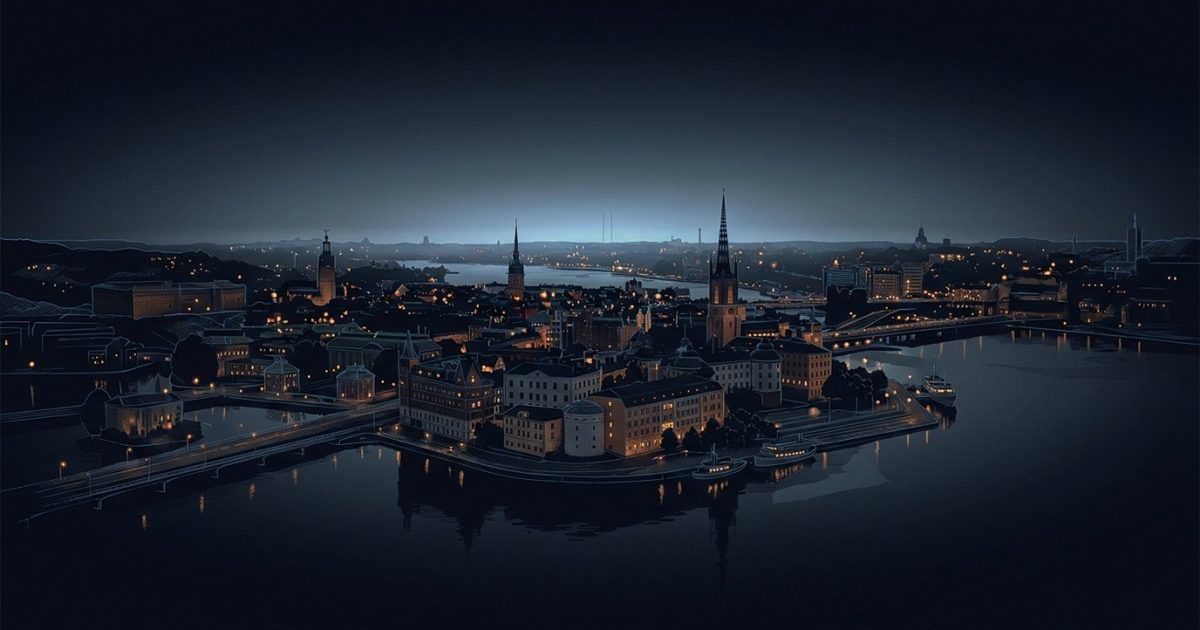
The human circadian system evolved under a reliable pattern: bright days, dark nights, seasonal variation in photoperiod. Scandinavia inverts that pattern every year — twice. Two months of Tromsø polar night, then two months of near-continuous Arctic daylight. Stockholm at 59°N gets 6 hours and 4 minutes of daylight on the winter solstice; in June, civil twilight never fully resolves to darkness. Against this already-stressed seasonal biology, artificial light at night (ALAN) delivers a third signal — a synthetic, year-round, broadband light source that the suprachiasmatic nucleus (SCN) cannot ignore and cannot categorise. The result is not simple insomnia. It is a layered disruption of a system already operating at the edge of its entrainment range. Most light-pollution health research is conducted at mid-latitudes. This is the context that literature almost entirely misses. For the core mechanistic framework — ipRGC pathways, melatonin signalling, and how the SCN responds to ALAN — see our parent article on light pollution and human health: the science of darkness, disrupted.
The Polar Night and the Midnight Sun
Two months without direct sunlight, then two months without full darkness — the Nordic photoperiod is the most extreme circadian stress test in the inhabited world.
Tromsø, at 69°N, enters its polar night on approximately November 27. The sun does not rise above the horizon again until January 15. That is 49 days — not of complete darkness, but of an extended blue-grey twilight in which even midday light levels rarely exceed a few hundred lux and the solar disk remains hidden behind the mountains of Børvasstindane. The midnight sun follows in summer: from May 20 to July 22, the sun remains continuously above the horizon, and nighttime at 69°N never gets darker than civil twilight.
Stockholm, at 59°N, is below the Arctic Circle — no true polar night, no true midnight sun. The photoperiod swing is still dramatic. The December solstice delivers 6 hours and 4 minutes of daylight. June midsummer delivers more than 18 hours, with civil twilight extending the light period further still; astronomical darkness is effectively absent for weeks. The Bergen and Helsinki profiles are similar.
What this means biologically is that the dominant zeitgeber — the light-dark cycle that calibrates the SCN — is not a stable input. It is a seasonally oscillating variable with an amplitude that far exceeds anything experienced at Mediterranean or tropical latitudes. The SCN in a Tromsø resident must function across a range from near-zero zeitgeber input in December to essentially continuous light input in June. Both extremes are physiological stressors. Neither is fully resolved by the human circadian architecture as we understand it.
How Nordic Bodies Adapt — and Where They Don’t
Scandinavian chronobiology research shows seasonal variation in cortisol and melatonin amplitude that mid-latitude populations never experience — and no complete adaptation mechanism has been identified.
Torbjörn Åkerstedt, Senior Professor of Psychology at the Karolinska Institute’s Department of Clinical Neuroscience in Stockholm, has spent more than four decades on shift work, sleep, and circadian biology in Scandinavian populations — his group provides the most detailed Nordic dataset on circadian functioning under extreme photoperiod conditions. Key findings: sleep duration and subjective sleep quality show pronounced seasonal variation in Swedish samples; the transition from summer to winter is associated with increased sleepiness, earlier onset of the cortisol awakening response, and a flattening of melatonin amplitude suggesting reduced circadian signal strength rather than clean adaptation.
The melatonin data are instructive. In high-latitude populations, winter melatonin duration is extended — DLMO (dim-light melatonin onset) shifts earlier, and the offset delays into the morning. This extended melatonin signal is one mechanism by which the circadian system registers shortened photoperiod. But “registers” is not the same as “adapts.” The downstream consequences are measurable: increased daytime sleepiness, reduced alertness, and — in a significant fraction of the population — seasonal mood deterioration that reaches clinical threshold. For the detailed mechanics of how the SCN interprets ipRGC input and drives melatonin secretion, see our companion sub-article on the melatonin and ipRGC-to-pineal signal pathway.
Seasonal affective disorder (SAD) is not a Nordic curiosity. Rastad et al. (2005, Psychiatry and Clinical Neurosciences) studied a Swedish county at 60.5°N (Dalarna) and found winter SAD prevalence of 8%, with a further 10.8% meeting criteria for subsyndromal SAD (S-SAD). Those are not outlier numbers: Danish data show 12.4% winter SAD, Finnish data 9.5%. Westrin and Lam (2007, Annals of Clinical Psychiatry) reviewed the full epidemiological picture and confirmed the latitude gradient — SAD prevalence consistently lower in Mediterranean populations (1–2%) than in northern European samples. The mechanism is well-characterised: reduced winter photoperiod compresses the daily window for serotonin synthesis, given that melatonin and serotonin share a tryptophan precursor. Flattened serotonergic tone in winter maps closely onto the mood deterioration data.
When ALAN Meets the Polar Night
Artificial light at night does not rescue the winter-stressed Nordic circadian system — it corrupts the only calibrating signal it still has.
This is the ALAN paradox. During polar night, the circadian system’s entrainment window compresses to a narrow band of twilight — an hour or two of dim light near the horizon at midday, the only genuine zeitgeber input available. For a person in Tromsø in December, this twilight signal is what their SCN uses to maintain circadian phase. It is weak, brief, and spectrally limited to the blue-grey of civil twilight. It is also partially masked by ALAN. The street lighting that makes December safe to walk in — the shop-window glow, the building facades, the car headlights — all emit at intensities sufficient to activate melanopsin in ipRGC cells and send a competing “daytime” signal to the SCN during that same twilight window.
Stockholm in December produces the same effect at lower intensity. Ambient ALAN in the city centre — reflected off snow cover, amplified by overcast skies — keeps the light environment from dropping to the near-zero lux needed for melatonin onset. From a circadian standpoint, a December night in central Stockholm resembles a permanent low-grade, spectrally ambiguous dusk — neither the darkness the pineal needs to secrete melatonin nor the genuine daylight that would set a clear zeitgeber signal. For the physics of how urban skyglow accumulates, see the overview of skyglow: causes, reach, and why it stretches 200 km.
The summer problem is the inverse. In Stockholm in June, civil twilight extends to approximately 23:30 and resumes before 01:00. The ambient light level around midnight — blue-shifted civil twilight — is sufficient to activate melanopsin and suppress melatonin onset in photosensitive individuals without any artificial source at all. Add ALAN, and the SCN receives no darkness signal between May and July. Melatonin is chronically suppressed. This is not a disorder in the clinical sense. It is simply the operating environment of anyone living in a northern European city in summer.
The Sami Perspective
The Sami developed an eight-season calendar over millennia as a cognitive tool for managing extreme photoperiodic variation — ALAN industrialisation is erasing the environmental signal that calendar was built to track.
The Sami people — the indigenous inhabitants of Sapmi, spanning northern Norway, Sweden, Finland, and the Kola Peninsula of Russia — do not recognise four seasons. Traditional Sami culture divides the year into eight: winter, springwinter, spring, springsummer, summer, autumnsummer, autumn, and autumnwinter. Each of the eight periods corresponds to specific environmental signals — snow consistency, reindeer behaviour, light quality, temperature gradient — used to coordinate the annual reindeer herding migration cycle. The division is not metaphorical or decorative. It is a functional response to extreme photoperiod variation: where four-season cultures see spring as a single phase, Sami herding practice distinguishes between early-spring conditions (when reindeer are calving and snow crusts are forming) and late-spring conditions (when migration to summer pastures begins). Ecologically distinct states. Different light signals. Different biology.
What this represents chronobiologically is a culturally encoded zeitgeber literacy — an accumulated knowledge system that treats light and dark transitions as actionable information across all eight phases of the year, not just the solstice extremes. Industrial ALAN in Lapland and northern Fennoscandia is degrading that environmental signal. The near-darkness of a Sami winter settlement is no longer near-darkness when it sits adjacent to a mining facility, a road-freight corridor, or a tourist resort. Reindeer — whose retinal and circadian physiology is adapted to Arctic photoperiods — show measurable disruption of seasonal movement patterns under ALAN exposure. The traditional Sami eight-season calendar was a human chronobiological adaptation. ALAN is making both the calendar and the biology it was built on increasingly difficult to operate. For the landscape of dark sky protection in northern Norway that bears directly on this issue, see our overview of Øvre Pasvik: Europe’s northernmost dark sky park and the broader context of dark sky places in Europe.
Practical Implications — Light Therapy and Offshore Shift Work
Nordic populations have the strongest evidence base for interventional chronobiology — and also the most extreme occupational ALAN exposure on the planet.
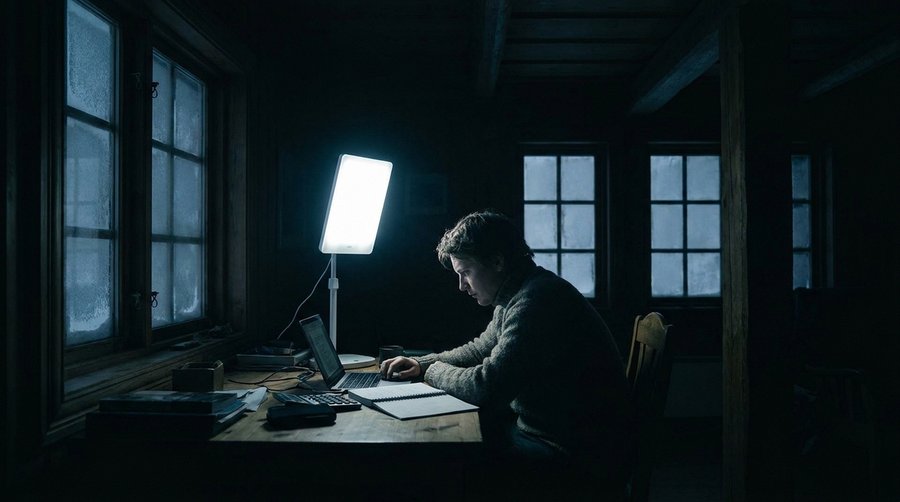
Bright light therapy at 10,000 lux for 30 minutes each morning is the most extensively validated non-pharmacological treatment for SAD available. Anna Wirz-Justice — Emeritus Professor of Psychiatric Neurobiology at the University of Basel, principal author of Chronotherapeutics for Affective Disorders (Karger, 2nd ed. 2013), and a central figure in establishing chronotherapy as clinical practice — documented the protocol across multiple controlled trials and reviews. The mechanism is straightforward: morning bright light drives DLMO earlier, extends the evening dark window, and allows melatonin secretion to occur at the appropriate biological time. At 10,000 lux, the 30-minute session delivers the photon flux that would require two to three hours of overcast Nordic winter daylight to accumulate. For a population whose winter ambient light levels routinely drop below the 200 lux of a typical indoor office, the light therapy box is compensating for a genuine zeitgeber deficit.
The most extreme Nordic ALAN scenario is offshore. Norwegian petroleum platform workers on the North Sea operate in continuous artificial illumination — no exterior darkness from November through January, and no natural circadian cues from October onward given polar night conditions. The Norwegian Offshore Petroleum Workers (NOPW) cohort study — tracking more than 25,000 workers over five decades of follow-up — found a hazard ratio of 1.86 (95% CI: 1.18–2.91) for aggressive prostate cancer in workers with 19.5 or more years of rollover shift work, compared to day-workers only. Rollover shift work on North Sea platforms is a double exposure: the shift rotation disrupts circadian phase, and the polar night removes the natural entraining signal that could partially compensate. ALAN reduction in Nordic cities is not merely desirable. It is a measurable public health lever for a population whose seasonal biology is already running near its limits.
Frequently Asked Questions
Why is SAD more common in Scandinavia?
The latitude gradient is well-established. A Swedish county study (Rastad et al. 2005, Psychiatry and Clinical Neurosciences) found winter SAD prevalence of 8%, with an additional 10.8% subsyndromal — compared to 1–2% in Mediterranean populations. The driving mechanism is photoperiod: compressed winter daylight reduces the daily window for zeitgeber entrainment and suppresses serotonergic tone through the melatonin-serotonin shared precursor pathway. Westrin and Lam (2007, Annals of Clinical Psychiatry) confirmed the latitude gradient across European and North American data.
Does ALAN make polar night insomnia worse?
The evidence strongly suggests yes, though controlled studies specifically isolating ALAN from other winter stressors in polar night settings are limited. During polar night, the circadian system’s only meaningful zeitgeber is the brief twilight window around midday. ALAN during or around that window sends a competing light signal to the SCN that partially masks the twilight cue — reducing zeitgeber signal strength at precisely the moment when it is most needed. Urban dwellers in northern Norway and Sweden show greater winter sleep disruption than rural populations at similar latitudes, a pattern consistent with differential ALAN exposure.
Should I use a light therapy box in winter?
If you live above 55°N and experience significant winter fatigue, mood decline, or sleep-phase delay, morning bright light therapy at 10,000 lux for 30 minutes is an evidence-based option with a well-characterised safety profile. Timing matters: the morning session, within an hour of waking, advances DLMO and is the most effective protocol for winter SAD. Wirz-Justice and colleagues established that the response rate for light therapy in SAD is comparable to antidepressant medication in multiple controlled trials. At northern latitudes, this replaces a genuine deficit in environmental photon flux — not a supplement to an otherwise adequate signal.
How do Sami people adapt to extreme seasonality?
Traditional Sami culture encoded the extreme photoperiod variation of northern Fennoscandia into an eight-season calendar — winter, springwinter, spring, springsummer, summer, autumnsummer, autumn, autumnwinter — each phase defined by specific environmental and biological cues tied to reindeer behaviour and snow conditions. It is a practically tested chronobiological system that aligns human activity with the environmental signals available at each phase of the Arctic year. Industrial ALAN is degrading the environmental signal that system was built to read — for human chronobiological function and for the reindeer herd behaviour traditional herding practice depends upon.