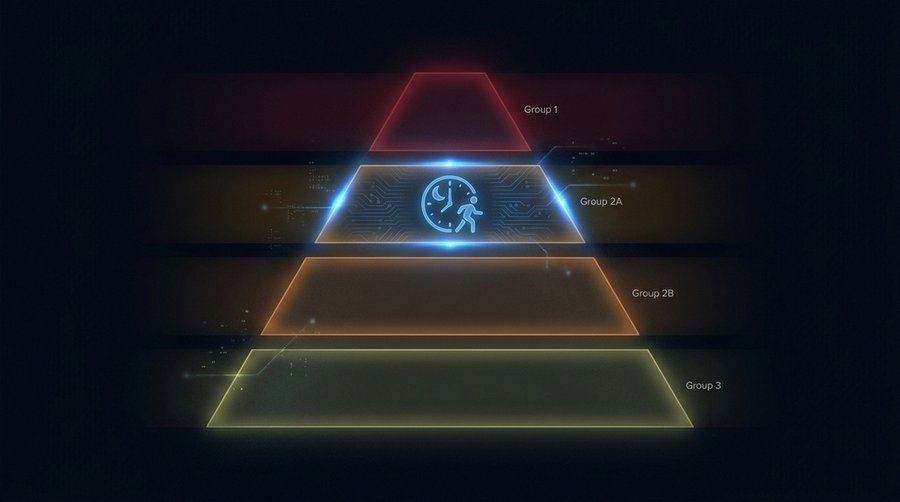
In 1987, Richard G. Stevens published a hypothesis in the American Journal of Epidemiology: electric light at night, by suppressing melatonin, might be driving the rise in breast cancer rates seen alongside industrialisation. It was speculative. The data came later — and kept accumulating for four decades. By 2007, the International Agency for Research on Cancer classified shift work with circadian disruption as a Group 2A probable carcinogen. In 2019, with twelve more years of research reviewed, IARC kept the classification. The mechanisms are documented. The dose-response curves remain contested. For the biological foundation, see our overview of light pollution and human health.
The Stevens Hypothesis (1987)
A 1987 paper proposed that electric light suppresses melatonin and promotes breast cancer — before a single cohort study existed to test it.
Richard G. Stevens published “Electric Power Use and Breast Cancer: A Hypothesis” in the American Journal of Epidemiology in 1987 (volume 125, issue 4, pages 556–561; PubMed 3548332). The logic was direct: breast cancer incidence had risen sharply in industrialised countries during the 20th century. Industrialisation introduced electric light at night as a standard feature of urban life. Experimental data showed light at night suppresses melatonin production in the pineal gland. Melatonin, in animal models, appeared to inhibit mammary tumour growth. Therefore: artificial light at night might be promoting breast cancer through melatonin suppression.
Stevens was also working with electromagnetic field (EMF) evidence in the same paper — a line of inquiry that later proved far weaker than the light-melatonin pathway. That conflation slowed initial uptake of the melatonin hypothesis. What the 1987 paper established, despite its limitations, was a testable framework: if the hypothesis held, women with the greatest lifetime exposure to light at night — night shift nurses, factory workers, flight attendants — should show elevated breast cancer rates relative to day workers.
The context mattered enormously. The 1980s expansion of 24-hour operations across OECD economies produced a large, identifiable exposed population. Healthcare, manufacturing, logistics — rotating and permanent night shifts became standard. Stevens provided the theoretical infrastructure. The epidemiologists provided the evidence. The gap between hypothesis and first large cohort result: fourteen years.
Nurses’ Health Study I: Schernhammer 2001
78,562 women, ten years of follow-up, a 36% excess breast cancer risk for the longest-exposed group. The first large prospective test of the Stevens hypothesis.
Eva Schernhammer and colleagues published in the Journal of the National Cancer Institute in 2001 (volume 93, issue 20, pages 1563–1568; PubMed 11604480). The Nurses’ Health Study I enrolled 78,562 female nurses across the United States, followed from 1988 to 1998, with rotating night-shift exposure documented prospectively across multiple questionnaire cycles. Women who had worked rotating nights for 30 or more years carried a relative risk of breast cancer of 1.36 — a 36% increase — versus women who had never worked nights. Women with 15 to 29 years of exposure showed RR 1.08, not statistically significant. The dose-response trend was significant at p=0.02.
Limitations matter. Exposure was self-reported. The healthy-worker effect could bias results toward the null — the true association may be stronger. No direct melatonin measurements were available; light-at-night exposure was inferred from shift-work status. Body mass index, alcohol consumption, and hormone use were adjusted for, but residual confounding cannot be excluded. These are the standard constraints of occupational cohort epidemiology. They do not invalidate the finding. They define what it can and cannot claim. A 36% elevated relative risk in a prospective cohort of 78,000 women, with a significant dose-response trend, is not a hint. It is a signal.
Nurses’ Health Study II: Schernhammer 2006
A younger cohort, shorter minimum exposure threshold, stronger signal — and a lesson in why meta-analytic heterogeneity does not refute the hypothesis.
Schernhammer et al. returned with NHS II in 2006 (Epidemiology, volume 17, issue 1, pages 108–111). The cohort: 115,022 women enrolled in 1989, generally younger than NHS I, followed through 1999. Women with more than 20 years of rotating night shifts showed a relative risk of breast cancer of 1.79 — a 79% increase over women who had never worked nights. Stronger signal than NHS I, over a shorter minimum exposure window.
Subsequent meta-analyses complicated the picture. Kamdar et al. in 2013 (Breast Cancer Research and Treatment; PubMed 23400581) concluded the evidence was insufficient to confirm the association. Travis et al. in JNCI in 2016 (volume 108, issue 12, doi 10.1093/jnci/djw169) combined three large UK prospective studies — over 750,000 women — with seven previously published cohorts. Pooled relative risk for any night shift work: 0.99. Effectively null. The heterogeneity between the Nurses’ cohorts and the UK studies is real and unresolved. The most plausible explanation is exposure heterogeneity, not noise: pooling a 30-year rotating shift nurse with a worker who covered occasional nights produces dilution. The Travis study defined “any night shift work” as the category. That is not the same exposure as the NHS I or II high-duration groups. The finding stands, properly contextualised.
IARC 2007 and the 2019 Reassessment
Twelve additional years of data did not weaken the carcinogenicity case. IARC kept Group 2A in 2019. That is a scientific result, not an institutional default.
In 2007, IARC Monograph 98 (“Painting, Firefighting, and Shiftwork”) classified “shiftwork that involves circadian disruption” as Group 2A — probably carcinogenic to humans. The basis: limited evidence in humans, sufficient evidence in experimental animals, strong mechanistic plausibility. Same category as red meat, wood dust, and moderate alcohol consumption — Group 2A is a well-populated category occupied by exposures where the probability of carcinogenicity is real without being proven.
In 2019, IARC Monograph 124 (“Night Shift Work”) reassessed the full evidence base. The terminology shifted from “shiftwork involving circadian disruption” to the more specific “night shift work.” The conclusion: Group 2A retained. Human evidence was characterised as limited for breast, prostate, colorectal, and rectal cancer. In IARC’s taxonomy, “limited evidence” means a positive association has been observed but chance, bias, and confounding cannot yet be ruled out with confidence. Not synonymous with weak. The animal evidence remained sufficient. Mechanistic evidence was upgraded, with melatonin suppression confirmed as a plausible oncostatic pathway across multiple independent experimental systems.
The Travis 2016 meta-analysis with its near-null RR was in front of the 2019 Working Group. They reviewed it, weighed the heterogeneity arguments, and kept the classification. IARC does not retain Group 2A out of inertia. The retained status reflects a judgment that mechanistic, animal, and exposure-specific human evidence — taken together — justifies a probable carcinogen classification even against a null meta-analytic pool.
Beyond Breast Cancer: Prostate, Colorectal, and Others
Breast cancer dominates the night-shift cancer literature. The mechanistic logic extends to prostate tissue equally — and the Garcia-Saenz 2018 data are underreported.
Prostate cells express melatonin receptors. Melatonin inhibits androgen-stimulated growth pathways via MT1 and MT2 receptor signalling. The oncostatic logic that applies to mammary tissue applies to prostate. Yet prostate is absent from most mainstream light-pollution health articles — not because the evidence is absent, but because epidemiological attention has been almost entirely concentrated on breast cancer since the Stevens hypothesis.
Ariadna Garcia-Saenz and colleagues examined both cancers in the MCC-Spain Study, published in Environmental Health Perspectives in 2018 (volume 126, issue 4, doi 10.1289/EHP1837; PubMed 29687979). The study enrolled 623 prostate cancer cases and 879 male controls from eleven Spanish regions, with outdoor ALAN assessed via International Space Station imagery of Barcelona and Madrid including spectral data on blue-light emission. Men in the highest outdoor blue-spectrum ALAN quintile showed more than a doubling of prostate cancer odds (OR = 2.05; 95% CI: 1.38–3.03). One observational study. Two cities. Effect size warrants appropriate caution. The mechanistic fit is real.
Colorectal cancer has its own data point. Schernhammer et al. 2003 in JNCI (volume 95, issue 11, pages 825–828; PubMed 12783938) used the NHS I cohort: women with 15 or more years of rotating night shifts showed RR 1.35 (95% CI: 1.03–1.77) for colorectal cancer. IARC’s 2019 listing of limited evidence across breast, prostate, colorectal, and rectal cancer reflects this distributed but consistently directional pattern. For age-specific circadian vulnerability in this mechanistic family, see our article on children, screens, and ALAN.
The Mechanism: Melatonin as Oncostatic Agent
The pathway from suppressed melatonin to accelerated tumour growth has been shown in human tissue — in a xenograft model where the only variable was the melatonin content of the blood.
David Blask and colleagues published the key experimental demonstration in Cancer Research in 2005 (volume 65, pages 11174–11184; PubMed 16322268). Breast cancer xenografts in nude rats were perfused with blood drawn from premenopausal women at night. Half the blood donors had melatonin suppressed by light exposure during the collection window; the other half had full nocturnal melatonin. Melatonin-rich blood suppressed tumour metabolism: linoleic acid uptake, cAMP signalling, and MAPK effector activity all fell. Blood from light-exposed women — melatonin-poor — accelerated tumour growth. Adding MT1/MT2 receptor antagonists blocked the effect entirely, confirming receptor-mediated pharmacology rather than non-specific blood chemistry.
The cascade connects directly to the ipRGC pathway described in the sibling article on the melatonin and ipRGC-to-pineal signal pathway: light at night fires ipRGCs → the SCN is held in day-phase signalling → the pineal is suppressed → AANAT collapses → no melatonin enters the bloodstream → oncostatic brake removed. Russel Reiter’s 2016 synthesis in the Journal of Pineal Research (volume 61, pages 253–278) covers the full receptor-mediated profile: melatonin suppresses tumour cell proliferation, inhibits angiogenesis, promotes apoptosis, and scavenges free radicals during the night-phase cellular maintenance window. Chronic ALAN removes all of it simultaneously. Not metaphorically — enzymatically.
The Evidence Transparency Problem
IARC 2A with a near-null meta-analysis and a mechanistically grounded xenograft result. How do you hold both without flinching from either?
The Nurses’ Health cohorts — most exposure-specific, longest follow-up — show +36% after 30 or more years, +79% after 20 or more years. Travis 2016 shows RR 0.99 for any night shift work. These are not contradictory. They are the expected outcome when a dose-dependent effect is studied with a heterogeneous, diluted exposure category. Pooling occasional night shifts with 30-year rotating careers in a single category guarantees null results by construction.
The confounders are real. Night shift workers carry higher average rates of obesity, smoking, and alcohol. Adjustment in cohort studies reduces but does not eliminate the signal. The healthy-worker reverse effect — the most health-compromised workers leaving shift work earliest — probably underestimates true long-duration risk.
My position: 2A is justified. The Blask xenograft result is not anecdote. The Reiter receptor biology is not speculation. The Nurses’ cohort data are not refuted by the Travis null — they are explained by the exposure heterogeneity Travis could not control for. “Probably carcinogenic” means the mechanism is established, the direction of evidence is consistent under high-exposure conditions, and the precautionary case for occupational action is real. Pretending the meta-analytic heterogeneity does not exist is advocacy. Dismissing the NHS cohorts because one mixed-exposure meta-analysis produced a null is also advocacy. For outdoor spectral policy implications see the France 2018 lighting decree, and for the Nordic circadian amplification context see Nordic chronobiology.
Frequently Asked Questions
Does night shift work really cause cancer?
IARC Group 2A — retained in 2019 — means “probably carcinogenic.” Long-term rotating shift work shows +36% to +79% breast cancer risk in the Nurses’ cohorts. Xenograft data show melatonin-depleted blood accelerates tumour metabolism via MT1/MT2 receptor signalling. What the evidence does not establish is the confirmed causal precision of cigarette smoking and lung cancer. Short or occasional night work shows no meaningful signal in pooled data. The risk is real and concentrated at the high end of cumulative lifetime exposure.
Why is IARC’s classification 2A and not 1?
Group 1 requires sufficient human evidence to rule out chance, bias, and confounding with confidence. Night shift work does not yet clear that bar — human evidence is “limited” in IARC’s taxonomy. Meta-analytic heterogeneity between the Nurses’ cohorts and UK prospective studies is part of why. The mechanism sustains 2A. Exposure-specific long-duration cohort data may eventually support an upgrade, but that case has not yet been made to IARC’s Group 1 standard.
What about outdoor streetlights — do they cause cancer?
The IARC classification applies to occupational night shift work, not ambient residential ALAN. Garcia-Saenz 2018 found doubled prostate cancer odds in the highest outdoor blue-ALAN quintile, but one observational study from two cities does not establish causation. The mechanistic pathway is coherent and supports precautionary lighting design choices. It does not support the claim that streetlights are a proven cancer cause. Occupational chronodisruption and ambient residential ALAN are mechanistically related but evidentially distinct.
Should shift workers take melatonin supplements?
No clinical trial evidence supports melatonin supplementation as cancer prevention for shift workers. Pharmacological doses of 1–10 mg produce supraphysiological concentrations that overwhelm receptor regulation and do not replicate the endogenous nocturnal profile. Chronobiologists use 0.1–0.5 mg for circadian phase-shifting — closer to physiological. Evidence-based interventions are occupational: minimise blue-enriched workplace lighting during night shifts, limit cumulative rotating-shift exposure duration where feasible, protect sleep timing on off-days.
Sources
- Stevens 1987 American Journal of Epidemiology 125(4):556-561
- Schernhammer et al. 2001 JNCI 93(20):1563-1568
- Schernhammer et al. 2006 Epidemiology 17(1):108-111
- Travis et al. 2016 JNCI 108(12):djw169
- Garcia-Saenz et al. 2018 Environmental Health Perspectives 126(4):047011
- IARC Monograph 124 Night Shift Work 2019
- Blask et al. 2005 Cancer Research 65:11174-11184