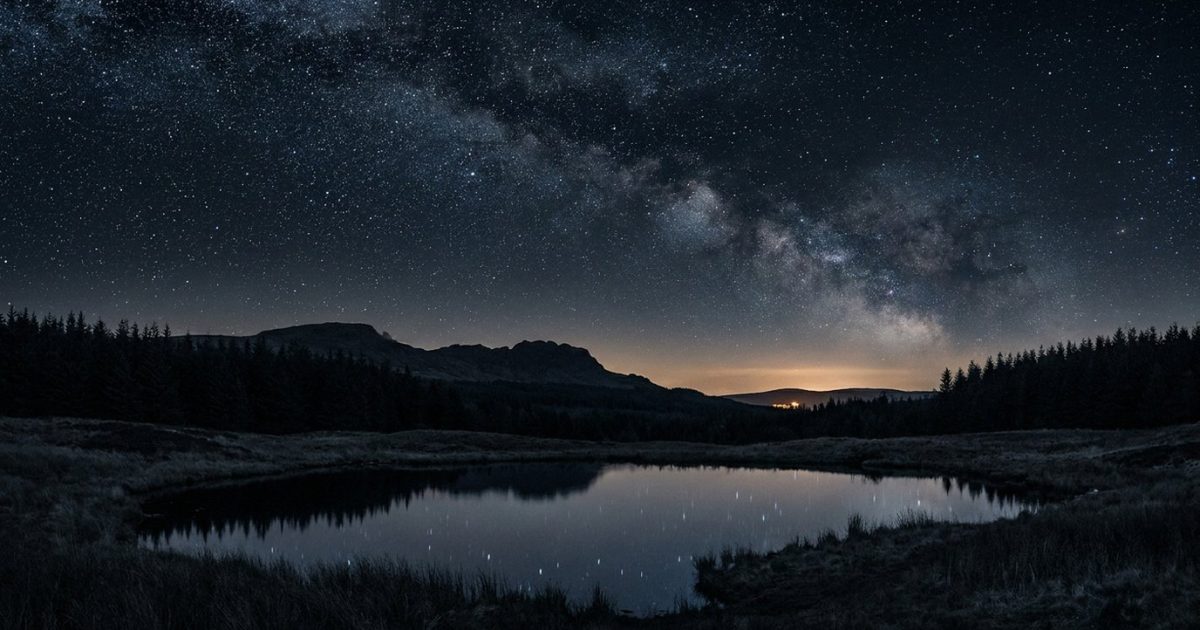
In November 2009, Galloway Forest Park — 78,000 ha of managed forest and moorland in Dumfries and Galloway, southwest Scotland — became the first IDA-certified Dark Sky Park in Europe and the fourth in the world. SQM readings at its core dark zones reach 23.6 mag/arcsec², consistent with Bortle Class 2 and, at the peak, approaching Class 1 conditions. This is managed Forestry and Land Scotland land, not a tourism construct: the park operates under an auditable lighting management plan, and approximately 20% of its area is designated as a no-permanent-illumination core zone. For the European network these designations belong to, see our guide to dark sky places in Europe.
Geography and the Park Itself
Galloway Forest Park covers 78,000 ha — roughly 780 km² — of the Southern Uplands in Dumfries and Galloway, Scotland’s most southwesterly council area.
The park was established in 1947 as the UK’s seventh National Forest Park. It sits roughly 120 km south of Glasgow and 140 km southwest of Edinburgh — close enough to both cities that darkness here is not the product of remoteness. It is the product of geography and deliberate management. The Galloway Hills form a natural barrier to the northeast, reducing the intrusion of the Glasgow light dome. To the west, the Irish Sea provides a dark horizon with no competing light sources. Dumfries, the nearest significant town, lies well to the east. The result is a three-sided shielding effect that few sites of comparable accessibility achieve.
The park is managed by Forestry and Land Scotland — the agency created in 2019 when the Forestry Commission Scotland was restructured into two separate bodies. Sixteen forests are contained within its boundaries. The terrain mixes dense conifer plantation, open moorland, and a network of lochs including Loch Trool, Loch Dee, and Clatteringshaws Reservoir. Visitor infrastructure exists at Kirroughtree and Glentrool visitor centres. There are no entry fees and no booking requirement for general access. Over 800,000 visitors arrive annually, though the majority are day walkers rather than dedicated stargazers.
How It Became the First Dark Sky Park in Europe
In November 2009, the International Dark-Sky Association designated Galloway Forest Park as a Gold Tier International Dark Sky Park — the first in Europe, and only the fourth anywhere in the world at the time.
The IDA designation process is not a formality. It requires an SQM measurement campaign across multiple reference points within the proposed boundary, a lighting management plan specifying how existing and future outdoor lighting will be controlled, evidence of community and authority commitment, and an IDA technical review typically lasting three to six months. The designation review concluded in 2009 with Galloway receiving Gold Tier status — the highest level within the Dark Sky Park category — reflecting the exceptional darkness of its core zones rather than merely acceptable conditions.
The timing matters. In 2009, only three other sites had received IDA Dark Sky Park designation: Natural Bridges National Monument in Utah (2007), Cherry Springs State Park in Pennsylvania (2008), and Horseshoe Canyon in Utah (2009). Galloway was the first outside North America. It demonstrated that the designation framework was portable across continents and administrative systems — a proof of concept that directly influenced subsequent European applications. Exmoor followed in 2011, Brecon Beacons in 2012, Northumberland in 2013, and the German, Irish, and Hungarian sites thereafter.
The Scottish Dark Sky initiative behind the application was driven by collaboration between Forestry Commission Scotland (now Forestry and Land Scotland) and local dark-sky advocates. The park’s low population density, its managed estate structure, and the pre-existing absence of large-scale permanent lighting within the forest boundaries meant that the lighting management plan was achievable rather than aspirational. Approximately 20% of the park’s area is now designated as a core dark zone with a policy of no permanent illumination.
SQM Values and Sky Quality
Galloway’s SQM range of 21.0 to 23.6 mag/arcsec² is the widest documented spread within any single European IDA Dark Sky Park — and the 23.6 peak is among the highest readings recorded at any permanently designated and monitored site in Europe.
The range reflects real geography. Readings of 21.0 mag/arcsec² occur near the park’s road margins and visitor centres, where some incidental lighting exists. The 23.6 reading has been documented at core dark-zone stations — approaching conditions found in professional observatory sites and consistent with what astronomers describe as photographic darkroom quality. A reading of 24 would be measured inside a sealed darkroom. Galloway’s peak gets close.
Bortle Class 2 is the rating for most of the park’s interior under optimal conditions. Bortle Class 1 — the scale’s theoretical maximum for natural sky darkness — begins at approximately 21.7 mag/arcsec² on the SQM; the park’s core stations exceed that threshold on clear, moonless nights. By comparison, Glasgow scores around 17–18 mag/arcsec² (Bortle Class 7–8). A European city average sits at roughly 18.0 mag/arcsec². Galloway’s core is five to six magnitudes darker — each magnitude representing a factor of 2.5 in brightness, meaning the core is roughly 150 times darker than a typical European city sky.
The light dome from Glasgow is visible on the northern horizon. It is not suppressed — but it is distant enough, and the Galloway Hills high enough, that it does not materially affect zenith readings at the park’s core stations. Seasonal variability is real: summer months bring astronomical twilight that never fully clears at Scottish latitudes, making autumn through early spring the optimal window. For SQM measurement methodology and instrument comparison, see our guide on measuring light pollution: methods, data, and research tools. For the Bortle scale and how its classifications map against sky phenomena, see skyglow: causes, reach, and why it stretches 200 km.
The Scottish Dark Sky Observatory
In 2012, the Scottish Dark Sky Observatory (SDSO) opened on a hilltop site near Dalmellington, East Ayrshire — on the northern edge of the Galloway Forest Park boundary — offering public stargazing access to a 20-inch telescope under managed dark skies.
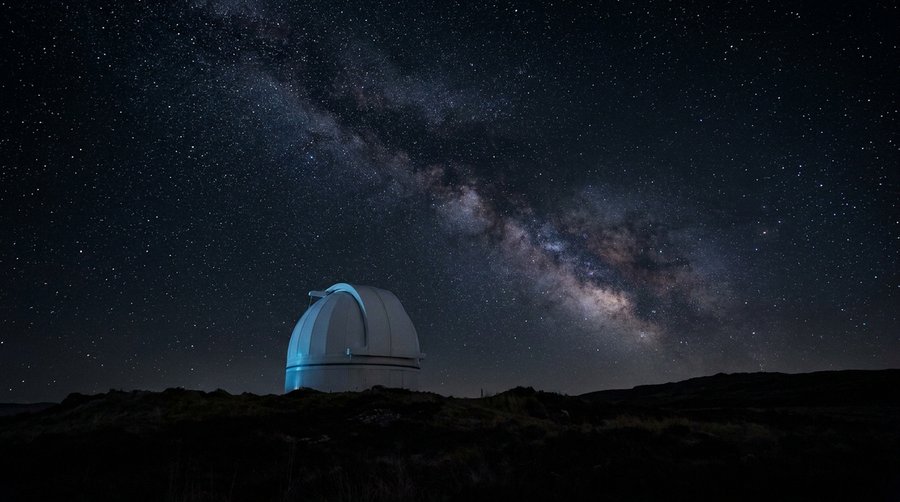
The observatory was inaugurated by First Minister Alex Salmond and operated for nearly a decade as the primary astronomy infrastructure serving the park’s visitors. It ran public stargazing evenings, school educational programmes across Scotland, and was a significant driver of the specialised dark-sky visitor segment that the 2009 designation had anticipated but not yet created.
On 23 June 2021, a fire destroyed the main observatory building at Dalmellington. The loss was substantial: the structure, telescope infrastructure, and associated facilities. Rather than rebuild on the original site, the SDSO’s board identified a new location with stronger institutional backing. In late 2024, the organisation purchased the former Clatteringshaws Visitor Centre site within the forest park itself — a location directly within the managed dark core rather than on the park’s edge. A £1.5 million redevelopment is planned, comprising two observing domes with large telescopes, a 360-degree planetarium, educational spaces, and a visitor centre. The project was expected to open in 2026–2027. This relocation positions the new facility at one of the park’s documented dark-core stations, rather than at its administrative perimeter. For the cultural loss dimension that complements the physical infrastructure story, see our article on noctalgia: the language of losing the night sky.
Economics and Astrotourism
A post-designation economic assessment found that for every £1 spent on installing dark-sky-compatible lighting in the park area, the return was £1.93 in increased tourism revenue — a documented positive ROI from a conservation-aligned infrastructure investment.
By the ten-year mark after designation, dark-sky and astronomy-related tourism was generating an estimated £500,000 per year for the local economy. The mechanism is straightforward: the 2009 Gold Tier status converted a large forest park — previously visited primarily by walkers and cyclists — into a named destination for stargazing, astrophotography, and guided astronomy events. Accommodation providers in the Newton Stewart and Gatehouse of Fleet areas reported increased bookings in the October-to-February window that previously represented a seasonal low. New visitor categories arrived: astronomy clubs, astrophotographers, families seeking a science-based outdoor experience.
The park receives over 800,000 visitors per year. Dark-sky visitors represent a minority of that figure but a disproportionate economic contribution per visit: they stay longer, book accommodation rather than day-tripping, and consume local hospitality in the evening hours when day visitors have left. The Dark Sky Rangers programme — trained guides who run public stargazing events at Clatteringshaws and Kirroughtree — directly monetises the sky quality as an interpretive resource, not merely a backdrop. The astrotourism model here is structurally the same as Northumberland’s, which generated £25 million per year by 2018 — Galloway operates at a smaller scale but demonstrates the same dynamic: designation converts darkness from a residual condition into an economic asset with documented returns.
How to Visit and Support
Galloway Forest Park is free to enter, accessible by road, and produces its best dark-sky conditions at new moon between October and March — a combination that requires planning but no permits.
The primary access routes are the A712 (Queen’s Way) through the park’s northern section, passing Clatteringshaws Reservoir, and the A714 south toward Glentrool Village, from which the Loch Trool trail and Bruce’s Stone viewpoint are reachable. Both are well-signed and accessible in standard vehicles. There are no entrance fees. The core dark zone requires no booking for independent use.
Timing is the main variable. New moon ±3 days is the optimal window — full moon raises effective sky brightness by three to five magnitudes, negating the park’s advantage. October through February provides the longest dark windows at this latitude; summer months are largely unusable for serious astronomy due to astronomical twilight. The Scottish weather introduces a practical constraint that no designation can resolve: clear nights are not guaranteed, and planning around a three-to-five night new-moon window maximises the probability of useful conditions.
Visitor etiquette matters at the scale of individual impact. Red-light torches are standard — the human rod system is least sensitive to wavelengths above 620 nm, allowing navigation without resetting dark adaptation, which takes 20 to 30 minutes under genuine darkness. White LED torches, phone screens at full brightness, and vehicle headlights pointed toward observation areas reset the process. The best viewpoints are Clatteringshaws Loch car park (accessible year-round, low horizon to the south and west), Kirroughtree Visitor Centre (events base for Dark Sky Rangers), and the Loch Trool area including Bruce’s Stone (elevated position, open southern sky). Leave No Trace principles apply throughout: the park is a managed ecological area, not a public gathering facility.
Frequently Asked Questions
How big is Galloway Forest Park and where is it?
Galloway Forest Park covers 78,000 ha (approximately 780 km²) in Dumfries and Galloway, southwest Scotland. It is the UK’s largest forest park, established in 1947 and managed by Forestry and Land Scotland. The park sits roughly 120 km south of Glasgow and 140 km southwest of Edinburgh. It is accessible via the A75 and A712 (Queen’s Way) from the north, or the A714 from the south. There are no entry fees and no booking requirement for general access.
How dark is Galloway Forest Park compared to other Dark Sky Parks?
Galloway’s SQM range of 21.0 to 23.6 mag/arcsec² gives it the widest documented spread within any European IDA Dark Sky Park, with a peak reading that approaches photographic darkroom conditions. The 23.6 figure is one of the highest recorded at any permanently designated and monitored European site. Its core zones are rated Bortle Class 2 under optimal conditions, with some stations exceeding the Bortle Class 1 threshold of approximately 21.7 mag/arcsec² on the SQM scale. For comparison, a typical European city scores 17–18 mag/arcsec² (Bortle Class 7–8). Northumberland National Park, the UK’s largest dark sky park at 405,000 ha, reaches approximately 21.8 mag/arcsec² — impressive, but without Galloway’s documented 23.6 peak.
Do I need to book to visit Galloway Forest Park for stargazing?
No booking is required for independent access to the park’s viewpoints and roads. The park is free to enter and open at all hours. Specific Dark Sky Ranger events at Clatteringshaws and Kirroughtree visitor centres may require advance booking and are typically offered on new-moon dates between October and March. The Scottish Dark Sky Observatory, destroyed by fire in June 2021, is being rebuilt at a new Clatteringshaws site with an expected opening in 2026–2027. Check Forestry and Land Scotland’s website for current event schedules and observatory opening dates.